
Master Aarav, an 8-year-old male child, 1st order child born of a non-consanguineous marriage from Chennai, Tamil Nadu, presented to the pediatric emergency on Day 5 of illness with cold clammy extremities, rapid feeble pulse, severe continuous periumbilical abdominal pain, persistent vomiting, and extreme restlessness, following 4 days of high continuous fever with severe retro-orbital headache and body aches.
- Rapid defervescence (temperature falling to normal or subnormal) followed immediately by cold clammy extremities and prostration
- Severe, unremitting abdominal pain and tenderness
- Persistent vomiting ($\ge 3$ episodes in 24 hours) and fluid refusal
- Mucosal bleeding (epistaxis, gum bleeding, black tarry melena)
- Respiratory distress with tachypnea (pleural effusion / ascites)
- Restlessness, extreme lethargy, or confusion
HOPI
The history is dated back to 5 days ago when the child acutely developed high continuous fever with chills, reaching $103-104^\circ\text{F}$, associated with severe retro-orbital headache, flushed face, and excruciating bone and joint aches ("breakbone fever").
Dengue has three distinct clinical phases: Febrile Phase (Days 1–3), Critical / Plasma Leakage Phase (Days 4–6), and Convalescent / Reabsorption Phase (Days 7–10). The most critical concept to demonstrate in the viva is that Dengue Shock develops at the time of DEFERVESCENCE (when the fever abruptly drops), NOT during the peak of fever! Inquire meticulously about the 7 WHO warning signs and distinguish between Compensated Shock (tachycardia, cold peripheries, narrow pulse pressure $\le 20\text{ mmHg}$, normal systolic BP) and Decompensated Shock (hypotension, unrecordable pulse).
- Febrile Phase (Days 1 to 4):
- Sudden onset high fever ($103.5^\circ\text{F}$), severe throbbing frontal and retro-orbital headache worsened by eye movements, generalized muscle pain, and transient flushing of the face and chest.
- Managed with oral paracetamol syrup; mother avoided ibuprofen or mefenamic acid.
- Onset of Critical Phase & Defervescence (Day 5 - Last 18 Hours):
- Today morning (Day 5), the fever abruptly subsided from $103^\circ\text{F}$ down to $97.8^\circ\text{F}$ ($36.5^\circ\text{C}$).
- However, instead of improving, the child became extremely restless, weak, irritable, and complained of feeling icy cold.
- Mother noted that both hands and feet became cold, clammy, and pale Points to acute systemic plasma leakage into serous cavities, triggering severe intravascular hypovolemia and compensated shock.
- Severe Abdominal Pain & Vomiting (Warning Signs):
- Developed continuous, severe, dull periumbilical and right hypochondriac abdominal pain 12 hours ago.
- Vomited 5 times over the past 8 hours, initially food contents, then clear mucus.
- Respiratory Symptoms & Abdominal Fullness:
- Developed fast breathing and abdominal distension over the past 6 hours Reflects right-sided pleural effusion and ascites from increased microvascular permeability.
- Bleeding Manifestations:
- Developed one episode of minor epistaxis (nosebleed) 4 hours ago, and mother noticed bleeding from gums while brushing teeth.
- Urinary Output:
- Urine output markedly reduced: passed urine only once in the last 12 hours ($<0.5\text{ mL/kg/hour}$ $\rightarrow$ oliguria).
- Negative History:
- No history of black tarry stools (melena) or vomiting frank altered blood (hematemesis) Rules out gross gastrointestinal hemorrhage at presentation.
- No history of seizures, altered consciousness, or jaundice Rules out dengue encephalopathy or severe acute fulminant hepatic failure.
- No history of chronic cough, tuberculosis contact, or native medicine ingestion.
Past History
- History of mild febrile viral illness diagnosed as primary dengue fever 2 years ago (confirmed by Dengue NS1 positivity).
- Significance: Secondary Dengue Infection with a different serotype triggers massive Antibody-Dependent Enhancement (ADE), wherein pre-existing non-neutralizing heterotypic antibodies facilitate viral entry into Fc-receptor-bearing monocytes, provoking an explosive cytokine cascade and severe plasma leakage.
Family history
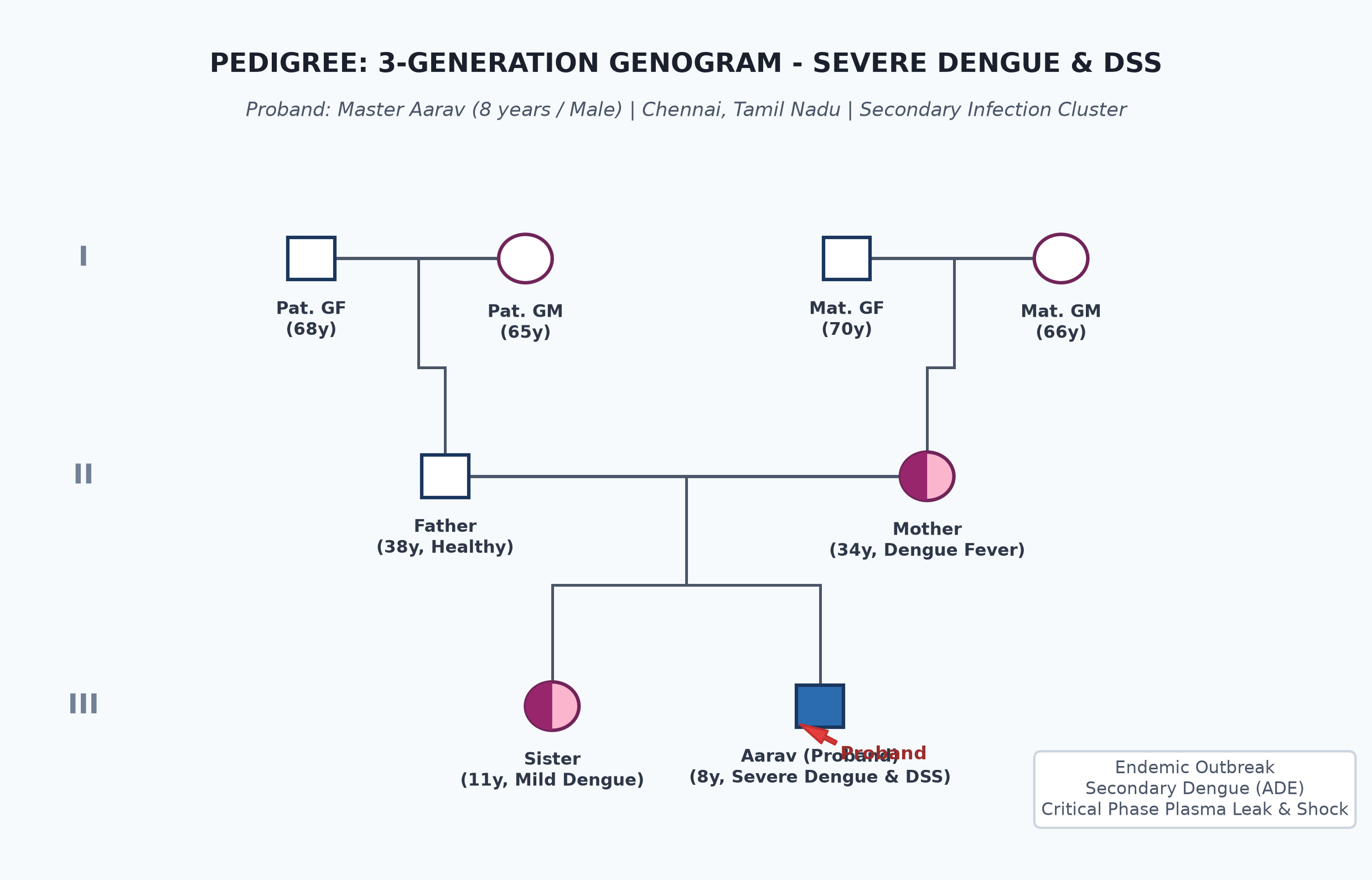
- Non-consanguineous marriage.
- Father 38 years, private employee; Mother 34 years, homemaker.
- Cluster Outbreak: Mother and elder sister (11 years old) were treated for mild Dengue fever 2 weeks ago; living in an urban residential area with water stagnation in air coolers and construction sites nearby.
Immunization history
- Fully immunized up to age according to the National Immunization Schedule.
Dietary history
- Adequate pre-morbid nutrition; currently refusing all oral feeds and liquids due to severe nausea and vomiting.
24-Hour Recall Deficit Analysis
$$ \text{Ideal Body Weight (IBW for 8 years, 50th centile WHO)} = 25.5\text{ kg} $$| Nutrient | Expected Intake (ICMR-NIN 2024 for IBW 25.5 kg) | Observed Intake | Deficit | Percentage Deficit |
|---|---|---|---|---|
| Energy (kcal) | $25.5\text{ kg} \times 60\text{ kcal/kg} = 1530\text{ kcal}$ | 210 kcal | 1320 kcal | 86.3% Deficit |
| Protein (g) | $25.5\text{ kg} \times 0.95\text{ g/kg} = 24.2\text{ g}$ | 3.5 g | 20.7 g | 85.5% Deficit |
Socioeconomic and KAP
- Modified BG Prasad Socioeconomic Class II (Upper Middle Class).
- Urban apartment with piped water; construction site within 50 meters with open stagnant water pools.
- Parents aware of the local dengue outbreak, brought child immediately upon observing cold extremities.
Summary of History
Master Aarav, an 8-year-old male child with past history of primary dengue infection, presents on Day 5 of illness with acute defervescence accompanied by warning signs (severe abdominal pain, persistent vomiting, mucosal bleeding, oliguria) and features of circulatory shock (cold clammy extremities, restlessness, tachypnea).
I would like to consider a diagnosis of Severe Dengue with Dengue Shock Syndrome (Compensated Shock) in the critical plasma leakage phase, secondary to secondary dengue infection, requiring emergent crystalloid fluid resuscitation and hematocrit monitoring.
General head to toe examination
- Behavioral State: Restless, anxious, irritable, answers questions with weak whispered voice.
- Comprehensive Hemodynamic & Shock Assessment:
- Heart Rate: 136 beats/minute, rapid, thready peripheral pulses (radial and dorsalis pedis barely palpable; femorals palpable).
- Respiratory Rate: 34 breaths/minute, rapid, regular, shallow (tachypnea).
- Blood Pressure (Right Arm Supine): $90/72\text{ mmHg}$
- Pulse Pressure: $90 - 72 = \mathbf{18\text{ mmHg}}$ (Narrowed Pulse Pressure $\le 20\text{ mmHg}$ $\rightarrow$ Hallmark of Compensated Shock!).
- Temperature: $36.4^\circ\text{C}$ (Subnormal / Afebrile during critical phase).
- Capillary Refill Time (CRT): 3.5 seconds (Prolonged; normal $<2\text{ sec}$).
- Extremities: Hands and feet are cold, clammy, mottled, with pale nail beds.
- Anthropometry:
| Parameter | Observed | Expected (50th WHO) | Centile | Inference |
|---|---|---|---|---|
| Weight | 25.0 kg | 25.5 kg | $50^{\text{th}}\text{ centile}$ | Normal baseline weight |
| Height | 127.0 cm | 127.0 cm | $50^{\text{th}}\text{ centile}$ | Normal Stature |
| BMI | $15.5\text{ kg/m}^2$ | $15.8\text{ kg/m}^2$ | $50^{\text{th}}\text{ centile}$ | Normal |
- General Physical Findings:
- Cutaneous: Generalized cutaneous pallor; scattered pinpoint petechiae over both forearms and anterior shins; Tourniquet Test positive ($>20$ petechiae per square inch).
- Mucosa: Mild bleeding from gingival margins on probing; dried blood crusts in right nostril; tongue dry and furred.
- Edema: Mild puffiness of eyelids and dorsum of feet.
Systemic Examination
Respiratory System
- Tachypneic (34/min); mild subcostal retractions.
- Percussion: Dull note on percussion over the right infrascapular and axillary areas (dullness shifting with posture $\rightarrow$ Right Pleural Effusion); left lung field resonant.
- Auscultation: Decreased breath sounds at right lung base; normal vesicular breath sounds on left.
Abdomen
- Distended, full flanks; moves with respiration.
- Palpation: Diffusely tender, maximal tenderness in epigastrium and right upper quadrant; no guarding or rigidity.
- Hepatomegaly: Liver palpable 3.0 cm below right costal margin, soft, smooth, exquisitely tender, span 10.0 cm (tender hepatomegaly of dengue).
- Percussion: Shifting dullness positive (moderate ascites).
- Auscultation: Sluggish bowel sounds (2-3/minute).
Cardiovascular & Central Nervous System
- Tachycardia (136 bpm); heart sounds rapid, distant; no murmurs.
- Neurological: Restless, no focal deficits, no neck stiffness, Glasgow Coma Scale 14/15 ($E_4 V_4 M_6$).
Summary
Master Aarav, an 8-year-old boy presenting on Day 5 of illness with acute defervescence, cold clammy extremities, prolonged CRT ($3.5\text{ sec}$), tachycardia (136 bpm), narrowed pulse pressure ($90/72\text{ mmHg}$, $\Delta = 18\text{ mmHg}$), tender hepatomegaly (3 cm), right pleural effusion, ascites, oliguria, and mucosal bleeding.
Final Clinical Diagnosis: Severe Dengue: Dengue Shock Syndrome (Compensated Shock) in the critical plasma leakage phase, with significant plasma leakage (right pleural effusion and ascites), mucosal bleeding, and severe thrombocytopenia, without decompensated hypotension or massive gastrointestinal hemorrhage.
Differential Diagnosis
| Condition | Points IN FAVOR | Points AGAINST |
|---|---|---|
| Severe Dengue with DSS (Compensated Shock) | Day 5 defervescence shock, narrow pulse pressure $\le 20$, severe abdominal pain, right pleural effusion, ascites, petechiae | Primary Diagnosis |
| Septic Shock (Bacterial Sepsis) | Tachycardia, prolonged CRT, oliguria, hypotension | Sepsis typically presents with high fever and "warm shock" early; dengue shock characteristically develops at defervescence with narrow pulse pressure and intense hemoconcentration |
| Severe Malaria (Algid Malaria) | Fever, thrombocytopenia, hepatomegaly, shock | Malaria features chills/rigors and high parasitemia; peripheral smear and rapid antigen test will be negative for Plasmodium; lacks selective right pleural effusion |
| Scrub Typhus with Capillary Leak | Acute febrile illness, thrombocytopenia, serositis | Absence of pathognomonic eschar; scrub typhus fevers persist without abrupt defervescence shock; leukocytosis with high CRP in scrub (leukopenia in dengue) |
| Acute Meningococcemia | Petechial purpuric rash, shock, prostration | Meningococcemia purpura is rapidly progressive and necrotic (purpura fulminans); high fever persists during shock; lacks the selective defervescence plasma leak pattern |
Investigation Protocol & Diagnostic Workup
flowchart TD
    A["Child with Defervescence, Narrow Pulse Pressure ≤ 20 mmHg & Abdominal Pain"] --> B["Stat Micro-Hematocrit (Hct), Platelet Count & Blood Gas"]
    B --> C{"Hematocrit Elevated > 45% (Hemoconcentration) & Platelets < 50,000?"}
    C -->|Yes: Dengue Shock Syndrome| D["Immediate IV Fluid Resuscitation: Isotonic Normal Saline 10 mL/kg over 1 hr"]
    D --> E["Reassess Vitals & Micro-Hct Hourly"]
    E --> F{"Vitals Improved & Hct Falling?"}
    F -->|Yes| G["Gradually Step Down Fluids: 7 mL/kg/hr -> 5 mL/kg/hr -> 3 mL/kg/hr"]
    F -->|No: Shock Persists & Hct Remains High| H["Switch to Colloid (Dextran 40 / 5% Albumin) 10-20 mL/kg over 1 hr"]
    F -->|No: Shock Persists & Hct Drops Sharply| I["Occult Internal Hemorrhage: Emergency Blood Transfusion 10-20 mL/kg"]
1. Hematological Profile (The Critical Hematocrit Clue)
- Hematocrit (Hct): $48.5\%$ (Baseline normal for 8y is $36\%$; rise of $>34\%$ confirms severe hemoconcentration and plasma leakage).
- Platelet Count: $24,000/\mu\text{L}$ (Severe thrombocytopenia; normal $150,000-450,000/\mu\text{L}$).
- Total Leukocyte Count: $3100/\mu\text{L}$ (Leukopenia with relative lymphocytosis; characteristic of acute dengue).
2. Confirmatory Serology & Biomarkers
- Dengue NS1 Antigen: Positive.
- Dengue Serology (IgM & IgG ELISA):
- Dengue IgM: Moderately positive (ratio $1.8$).
- Dengue IgG: Extremely high positive ($>1:2560$) $\rightarrow$ Definitively confirms Secondary Dengue Infection.
3. Serum Biochemistry & Blood Gas
- Venous Blood Gas: pH $7.31$, $HCO_3^-$ $16.2\text{ mEq/L}$, Base Excess $-7.2\text{ mEq/L}$, Lactate $3.8\text{ mmol/L}$ (Compensated metabolic lactic acidosis from tissue hypoperfusion).
- Liver Function Tests: AST $280\text{ U/L}$, ALT $165\text{ U/L}$ (AST significantly higher than ALT, typical for dengue); Total Bilirubin $0.8\text{ mg/dL}$; Serum Albumin $2.6\text{ g/dL}$ (Hypoalbuminemia reflecting severe plasma leak).
- Renal Function Tests: Serum Creatinine $0.6\text{ mg/dL}$, BUN $22\text{ mg/dL}$ (mild pre-renal azotemia).
4. Bedside Ultrasound (POCUS) & Chest Radiography
- Point-of-Care Ultrasound (POCUS):
- Gallbladder wall thickening ($5.5\text{ mm}$ with double-rim sign / subserosal fluid).
- Moderate free fluid in pelvis and Morrison's pouch (ascites).
- Bilateral pleural effusions (Right effusion $2.5\text{ cm}$ fluid depth; Left effusion $1.0\text{ cm}$).
- Chest X-Ray (Right Lateral Decubitus): Confirms significant right-sided subpulmonic pleural effusion.
Therapeutic Management Protocol (NVBDCP / WHO 2009 Guidelines)
1. Emergency Fluid Resuscitation for Compensated Shock
- Hour 0 to 1:
- Infuse Isotonic Crystalloid (0.9% Normal Saline or Ringer's Lactate) at $10\text{ mL/kg}$ over 1 hour ($250\text{ mL}$ over 60 minutes).
- Reassess at 1 hour: Pulse volume, CRT, heart rate, blood pressure, urine output, and repeat micro-hematocrit.
- Hours 1 to 4 (Step-Down Phase):
- If vital signs improve (pulse pressure widens $>25\text{ mmHg}$, CRT $<2\text{ sec}$, urine output $>1\text{ mL/kg/hr}$) and Hct drops to $42\%$:
- Reduce fluid rate to $7\text{ mL/kg/hour}$ for 2 hours, then $5\text{ mL/kg/hour}$ for 2 hours, and $3\text{ mL/kg/hour}$ for 4 hours.
- Total Fluid Duration: Fluid resuscitation must strictly be limited to the 24 to 48-hour plasma leakage window. Once the child is stable and hematocrit normalizes, fluids MUST be stopped to prevent hypervolemic pulmonary edema!
2. Blood Products & Transfusion Policy
- Prophylactic Platelet Transfusion: STRICTLY NOT RECOMMENDED despite platelet count of $24,000/\mu\text{L}$.
- In the absence of massive mucosal or internal hemorrhage, platelet transfusions carry high risk of volume overload and TRALI without improving outcomes.
- If hematocrit suddenly plummets with persistent shock: Transfuse Fresh Whole Blood ($20\text{ mL/kg}$) or Packed Red Cells ($10\text{ mL/kg}$) for occult internal bleeding.
3. Monitoring Protocol in PICU
- Hourly vitals (HR, BP, pulse pressure, CRT) and hourly urine output.
- Micro-hematocrit checked every 4 to 6 hours to guide fluid titration.
- Strict fluid balance chart (input vs output).