
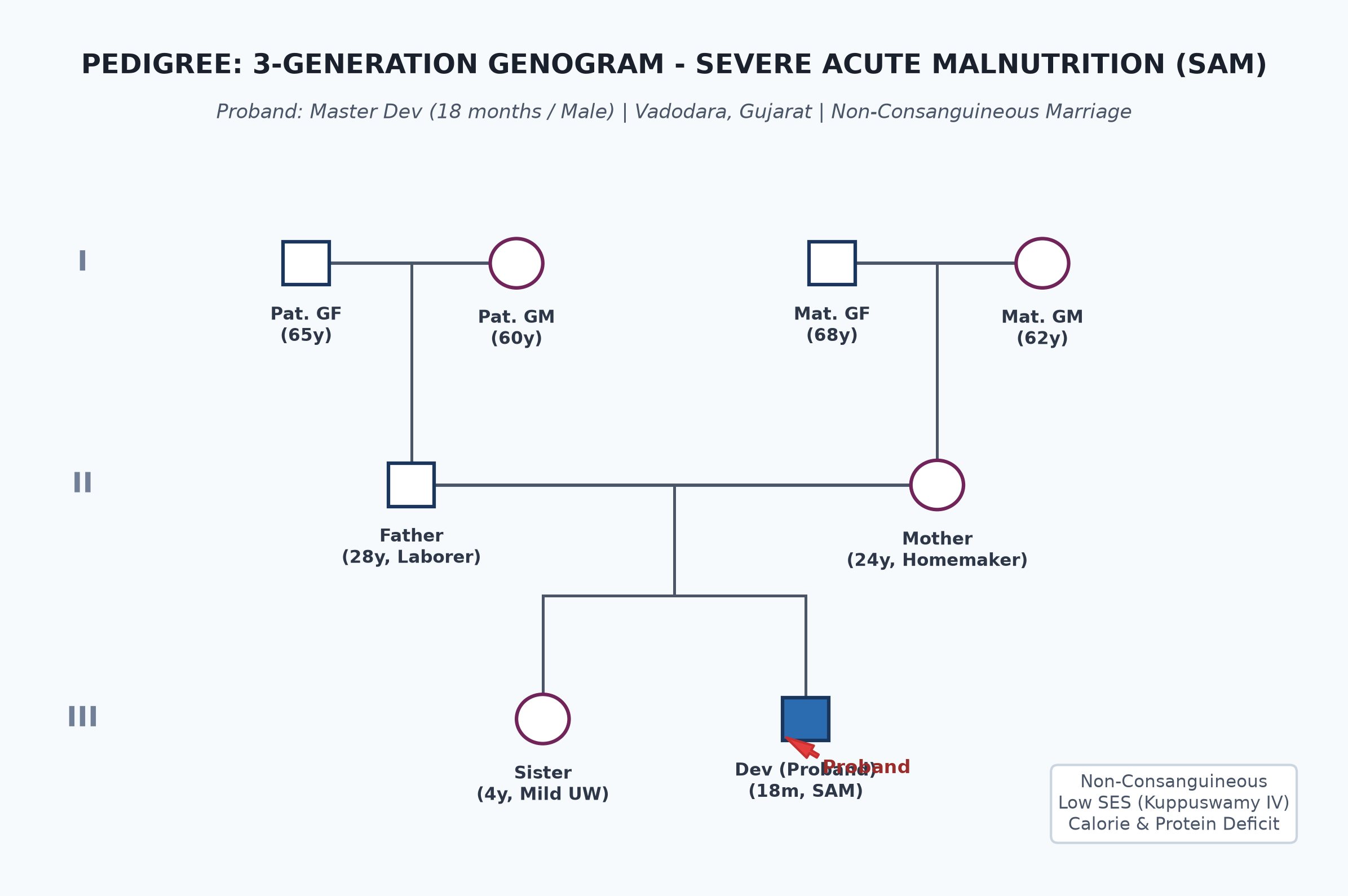
Master Dev, an 18-month-old male child, 2nd order child born of a non-consanguineous marriage from Vadodara, Gujarat, presented with complaints of progressive weight loss, severe thinning of limbs, and failure to thrive for the past 6 months, listlessness, lethargy, and hair color changes for 2 months, swelling over both feet for 10 days, and watery loose stools for 3 days.
- Severe visible muscle wasting ("skin and bone" appearance or baggy pants appearance)
- Bilateral pitting pedal edema (hallmark of kwashiorkor or marasmic-kwashiorkor)
- Anorexia, severe apathy, listlessness, or extreme irritability
- Recurrent diarrhea, vomiting, or acute systemic infections (pneumonia, sepsis)
- Dermatological changes (flaky paint dermatosis, pellagroid rash) and hair changes (flag sign, thinning)
HOPI
The history is dated back to 6 months ago when the mother first noticed that the child had ceased gaining weight and was progressively becoming thinner and weaker following an episode of acute measles-like viral exanthem with pneumonia.
Always probe the critical triad of SAM: precipitating infection (measles, persistent diarrhea, pertussis, tuberculosis), faulty infant and young child feeding (IYCF) practices (delayed or diluted complementary feeding, early cessation of breastfeeding), and underlying socioeconomic vulnerability. Specifically inquire about "danger signs": inability to drink/breastfeed, repeated vomiting, hypothermia, lethargy, convulsions, and hypoglycemia symptoms. In the dietary history, strictly quantify caloric and protein intake against the child's Ideal Body Weight (IBW) for chronological age or 50th centile weight-for-height, not actual weight.
- Progressive Wasting & Failure to Thrive:
- Noticed 6 months ago; the child began losing fat over the buttocks, thighs, and arms.
- The skin over the gluteal region became loose, wrinkled, and folded, hanging like "baggy pants" Points to total loss of subcutaneous fat stores and severe skeletal muscle catabolism.
- Ribs and shoulder girdles became visibly prominent; face appeared hollow and wizened like an elderly person ("old man facies").
- Behavioral Changes & Lethargy:
- Over the last 2 months, the child became intensely miserable, irritable on handling, yet generally apathetic, quiet, and listless when left alone.
- Stopped playing with his elder sister, ceased walking independently, and preferred to lie motionless in the mother's lap Reflects reductive adaptation where basal metabolic rate, cardiac output, and neuromuscular activity are suppressed to conserve energy.
- Bilateral Pedal Edema:
- Appeared 10 days ago, initially over the dorsum of both feet and extending up to lower shins.
- Pitting on pressure, symmetrical, painless, not associated with puffiness of the face in the morning Hallmark of Kwashiorkor-Marasmus crossover, reflecting severe oxidative stress, endothelial dysfunction, and hypoalbuminemia.
- Hair & Skin Changes:
- Hair became light brown/reddish, sparse, dry, brittle, and easily pluckable without pain. Mother noticed alternate bands of light and dark pigmentation (Flag sign).
- Skin over the thighs and perineum developed dark hyperpigmented plaques that peeled off leaving raw, hypopigmented weeping areas (Flaky paint / Crazy pavement dermatosis) Indicates profound micronutrient deficiency, particularly zinc, essential fatty acids, and niacin.
- Acute Watery Diarrhea:
- For the past 3 days, passing 5 to 6 episodes per day of watery, non-foul smelling, yellow stools without blood or visible mucus.
- Decreased oral intake and refusing home-cooked meals Precipitating medical complication requiring inpatient Nutritional Rehabilitation Center (NRC) admission.
- Negative History:
- No history of chronic cough, prolonged fever, or contact with an adult pulmonary tuberculosis patient Rules out underlying pediatric tuberculosis as primary driver.
- No history of gross blood in stools or recurrent greasy, bulky, foul-smelling, difficult-to-flush stools Rules out celiac disease, cystic fibrosis, and exocrine pancreatic insufficiency.
- No history of persistent vomiting, jaundice, clay-colored stools, or abdominal distension prior to acute illness Rules out chronic liver disease or gastrointestinal obstruction.
- No history of fast breathing, chest indrawing, stridor, or cyanosis Rules out severe acute lower respiratory tract infection / empyema.
- No history of convulsions, altered sensorium, or coma Rules out severe neuro-hypoglycemia or intracranial infection.
Past History
- Had an attack of measles at 11 months of age associated with severe bronchopneumonia requiring 7 days of private clinic hospitalization; never regained original weight trajectory after this illness.
- Recurrent episodes of acute watery diarrhea (3 episodes in past 4 months), treated with unmeasured packets of ORS and over-the-counter antimicrobial syrups.
- No history of surgical interventions or known chronic illnesses.
Family history
- Born of a non-consanguineous Hindu marriage.
- Father 28 years, daily-wage construction laborer; Mother 24 years, homemaker.
- Elder female sibling (4 years old) has mild underweight (Weight-for-Age -1.5 SD) but attends Anganwadi regularly and is clinically active.
- No family history of tuberculosis, diabetes, asthma, childhood deaths, or chronic gastrointestinal diseases.
Immunization history
- Received birth doses (BCG, OPV-0, Hepatitis B) and primary UIP vaccines up to 14 weeks (Pentavalent 1-3, OPV 1-3, fIPV 1-2, Rotavirus 1-3).
- Received MR-1 and Vitamin A (1 lakh IU) at 9 months.
- Missed MR-2, DPT booster-1, OPV booster, and Vitamin A second dose (due at 16-18 months) due to frequent family relocation between construction work sites.
Dietary history
- Breastfeeding: Breastfed within 2 hours of birth; exclusively breastfed until 8 months of age (delayed complementary feeding).
- Complementary Feeding: Initiated at 8 months with diluted buffalo milk (diluted 1:1 with tap water) and watery rice water / thin dal water. Semi-solid purees, khichdi, mashed fruits, and eggs were never introduced.
- Current Diet: Consumes small sips of diluted cow's milk (approx. 200 mL/day) and 1 small bowl of diluted rice kanji twice daily. Completely stopped taking family meals since onset of loose stools.
| Food Item | Quantity | Calories (kcal) | Protein (g) |
|---|---|---|---|
| Diluted Cow's Milk (1:1 water) | 200 mL | 67 | 3.2 |
| Watery Rice Kanji | 2 small katoris (~150 mL) | 90 | 1.8 |
| Total Observed Daily Intake | — | 157 kcal | 5.0 g |
24-Hour Recall Deficit Analysis
$$ \text{Ideal Body Weight (IBW for 18 months, 50th centile WHO)} = 11.5\text{ kg} $$| Nutrient | Expected Intake (ICMR-NIN 2024 for IBW 11.5 kg) | Observed Intake | Deficit | Percentage Deficit |
|---|---|---|---|---|
| Energy (kcal) | $11.5\text{ kg} \times 82\text{ kcal/kg} = 943\text{ kcal}$ | 157 kcal | 786 kcal | 83.4% Deficit |
| Protein (g) | $11.5\text{ kg} \times 1.11\text{ g/kg} = 12.8\text{ g}$ | 5.0 g | 7.8 g | 60.9% Deficit |
The expected calories and proteins must strictly be calculated from the Ideal Body Weight (IBW) for age, not from the child's severely depleted actual weight.
Socioeconomic and KAP
- Modified BG Prasad Socioeconomic Class IV (Lower Class / Poor).
- Lives in a temporary single-room asbestos-roof tenement at a construction site; uses shared community borewell water without boiling; open defecation practiced.
- Mother believes that giving solid grains or lentils during diarrhea worsens loose motions and "causes indigestion" (faulty restrictive feeding taboo).
Summary of History
Master Dev, an 18-month-old male child born of non-consanguineous parentage from Vadodara, Gujarat, belonging to low socioeconomic class, presented with post-measles failure to thrive, progressive severe muscle and fat wasting over 6 months, accompanied by listlessness, flag sign in hair, crazy-pavement dermatosis, bilateral pedal edema of 10 days duration, and 3 days of acute watery diarrhea with poor oral intake.
I would like to think of Severe Acute Malnutrition (SAM with Marasmic-Kwashiorkor presentation) precipitated by delayed and severely deficient complementary feeding and post-measles nutritional decline, currently complicated by acute dehydrating diarrhea, anorexia, and high risk of hypoglycemia and hypothermia, requiring immediate inpatient NRC stabilization.
General head to toe examination
- Child Behavioral State: Prechtl State 2 (drowsy, lethargic, weak whimpering cry on disturbance, poor eye contact, severely miserable).
- Vitals:
- Pulse Rate: 124 beats/minute, low volume, regular, peripheral pulses palpable but faint.
- Respiratory Rate: 28 breaths/minute, regular, shallow abdominothoracic, no grunting, no subcostal retractions.
- Blood Pressure: Right arm supine: $78/48\text{ mmHg}$ ($5^{\text{th}}\text{ to } 10^{\text{th}}$ centile, low normal).
- Temperature: $35.6^\circ\text{C}$ (Axillary) -> Hypothermia present ($<36.0^\circ\text{C}$ / $<36.5^\circ\text{C}$ rectal).
- Capillary Refill Time (CRT): 2.5 seconds; peripheral extremities are cold and clammy.
- Anthropometry:
| Parameter | Observed | Expected (50th WHO) | Z-score / Centile | Inference |
|---|---|---|---|---|
| Weight | 6.2 kg | 11.5 kg | $< -3\text{ SD}$ | Severe Wasting & Underweight |
| Length (Infantometer) | 74.0 cm | 82.3 cm | $< -3\text{ SD}$ | Stunting (Chronic Malnutrition) |
| Weight-for-Length | 6.2 kg for 74 cm | 9.2 kg | $< -3\text{ SD}$ | Severe Wasting (SAM Diagnostic) |
| Mid-Upper Arm Circumference (MUAC) | 10.8 cm | $\ge 12.5\text{ cm}$ | Red Zone | SAM Diagnostic ($<11.5\text{ cm}$) |
| Head Circumference | 44.5 cm | 47.0 cm | $-2\text{ SD}$ | Head sparing relative to length/weight |
| Bilateral Pitting Edema | Present (Grade +) | Absent | Diagnostic | Bilateral Pedal Edema (Kwashiorkor) |
- General Physical Findings:
- Pallor: Severe pallor present in conjunctiva, tongue, palmar creases, and nail beds.
- Bilateral Pedal Edema: Grade + (mild pitting edema over dorsum of both feet).
- Old Man / Wizened Facies: Temporal fat pad depletion, sunken cheeks, prominent zygomatic arches.
- Loss of Subcutaneous Fat: Severe loss over axillae, groin, thighs, and gluteal folds ("baggy pants").
- Skin Changes: Flaky paint dermatosis over medial thighs and buttocks with hyperpigmented peeling desquamation.
- Hair Changes: Sparse, hypopigmented light brownish hair with alternating bands (Flag sign), dry and easily pluckable.
- Eyes: Clear cornea, no Bitot spots, no conjunctival xerosis, no corneal clouding or keratomalacia.
- Oral Cavity: Angular cheilitis and atrophic glossitis (riboflavin and iron deficiency); no thrush or aphthae.
- Lymphadenopathy / Clubbing / Cyanosis: Absent.
Systemic Examination
Abdomen
- Inspection: Scaphoid in supine position, thin abdominal wall with visible superficial veins (no caput medusae); lax musculature; umbilicus flat; no divarication of recti.
- Palpation: Soft, generalized mild distension on palpation, non-tender; no guarding or rigidity.
- Liver: Palpable 2.5 cm below right costal margin in midclavicular line; soft, smooth, non-tender, rounded edge; span 7.5 cm (suggests hepatic steatosis / fatty liver of kwashiorkor).
- Spleen: Not palpable.
- Kidneys: Not ballotable.
- Percussion: Tympanitic note centrally, no shifting dullness.
- Auscultation: Hyperactive bowel sounds (7-8/minute).
Cardiovascular System (CVS)
- Precordium quiet, apex beat palpable in 4th left intercostal space inside midclavicular line, low amplitude.
- $S_1$ and $S_2$ soft; no gallop, no murmurs.
- Clinical Caution: Severe myocardial atrophy and reduced cardiac output; highly vulnerable to volume overload and acute congestive heart failure during fluid administration.
Respiratory System (RS)
- Bilateral symmetrical chest expansion; clear breath sounds bilaterally; no crackles, no wheezing, no bronchial breathing.
Central Nervous System (CNS)
- Conscious, severely lethargic, hypotonic muscle tone in all four limbs, power 4/5, deep tendon reflexes sluggish ($1+$ bilaterally), plantars flexor. Cranial nerves intact.
Summary
Master Dev, an 18-month-old male child born of non-consanguineous marriage from Vadodara, Gujarat, belonging to low socioeconomic class, presents with post-measles failure to thrive, severe wasting, bilateral pedal edema, flaky paint dermatosis, flag sign in hair, hepatomegaly (fatty liver), and acute watery diarrhea with hypothermia ($35.6^\circ\text{C}$). Anthropometry confirms Severe Acute Malnutrition with Weight-for-Length $< -3\text{ SD}$, MUAC 10.8 cm (Red Zone), and bilateral pitting pedal edema (Grade +).
Final Clinical Diagnosis: Severe Acute Malnutrition (SAM with Marasmic-Kwashiorkor presentation) with medical complications (Hypothermia, Dehydrating Diarrhea, Grade + Edema, and Anorexia / Failed Appetite Test), requiring immediate admission to the Nutritional Rehabilitation Center (NRC) for WHO 10-step inpatient stabilization.
Differential Diagnosis
| Condition | Points IN FAVOR | Points AGAINST |
|---|---|---|
| Severe Acute Malnutrition (Marasmic-Kwashiorkor) | MUAC 10.8 cm, WFH $<-3$ SD, bilateral pedal edema, baggy pants sign, flaky paint dermatosis, apathy | Primary Clinical Diagnosis |
| Pediatric Tuberculosis with Severe Wasting | Severe wasting, failure to gain weight, chronic illness | No chronic fever or cough, no known contact with adult TB index case, no lymphadenopathy, chest clear |
| Celiac Disease (Gluten Enteropathy) | Wasting, loose stools, muscle loss, abdominal distension | Onset usually with wheat weaning; patient consumed primarily diluted buffalo milk and rice gruel (rice is gluten-free); dermatosis and hair changes favor primary dietary SAM |
| Congenital Hepatic Fibrosis / Cirrhosis | Edema, hepatomegaly, poor growth | Edema is acute and pedal rather than tense ascites; no jaundice, spider nevi, or portal hypertension |
| Nephrotic Syndrome | Bilateral pedal edema, low albumin | Edema is dependent, no periorbital morning swelling; urine dipstick will confirm absence of $4+$ proteinuria |
Investigation Protocol & Diagnostic Workup
flowchart TD
    A["Child with Weight-for-Length < -3 SD, MUAC < 11.5 cm, or Bilateral Edema"] --> B{"Appetite Test & Medical Complications?"}
    B -->|Passed & No Complications| C["Community-Based Management (CMAM) with RUTF"]
    B -->|Failed Appetite OR Complicated: Edema, Hypothermia, Shock, Hypoglycemia| D["Inpatient NRC Admission (WHO 10-Step Protocol)"]
    D --> E["Immediate Blood Sugar & Thermal Control (10% Dextrose + Kangaroo Care)"]
    D --> F["Rehydration with ReSoMal (NO standard IV fluids unless in shock)"]
    D --> G["Start Starter Diet: F-75 Formula (100 kcal/kg/day, 0.9 g protein/kg/day)"]
    G --> H{"Appetite Returned & Edema Subsiding?"}
    H -->|Yes: Day 3 to 7| I["Transition to F-100 / RUTF (Catch-up Growth: 150-220 kcal/kg/day)"]
    H -->|No / Deteriorating| J["Re-evaluate for Sepsis, Malaria, TB, UTI, Refeeding Syndrome"]
1. Immediate Bedside Tests
- Bedside Blood Glucose (Glucometer): Crucial immediately on arrival. Hypoglycemia defined as blood glucose $< 54\text{ mg/dL}$ ($< 3.0\text{ mmol/L}$) in SAM.
- Appetite Test: Conducted using ready-to-use therapeutic food (RUTF) in a calm environment. Failure to consume minimum required quantity mandates inpatient NRC admission.
- Urine Routine & Microscopy: Exclude urinary tract infection and proteinuria.
2. Laboratory Investigations
- Complete Blood Count (CBC) with Peripheral Smear: Hemoglobin, MCV, MCH, reticulocyte count, microcytic hypochromic anemia vs dimorphic anemia; total leukocyte count and differential to evaluate occult sepsis (hypothermia and leukopenia often herald gram-negative septicemia).
- Serum Electrolytes: Sodium, Potassium, Magnesium, and Inorganic Phosphorus.
- Key Alert: Total body potassium and magnesium are severely depleted in SAM, even if serum sodium is normal or low. Potassium supplementation is mandatory.
- Refeeding Watch: Monitor serum phosphorus closely when initiating refeeding to detect refeeding hypophosphatemia.
- Serum Albumin & Total Protein: Typically $< 2.0\text{ g/dL}$ in kwashiorkor.
- Blood Culture, Urine Culture, and Stool Routine/Hanging Drop: Rule out bacteremia, Shigella, Giardia, or rotavirus.
- Chest Radiograph (CXR AP view) & Mantoux / TST / CBNAAT (Gastric Aspirate): Screen for occult pulmonary tuberculosis.
Therapeutic Management Protocol (WHO 10 Steps at NRC)
Phase 1: Stabilization (Days 1 to 7)
========================================================================================
THE 10 ESSENTIAL STEPS OF INPATIENT SAM MANAGEMENT (WHO / IAP NRC PROTOCOL)
========================================================================================
1. Treat / Prevent Hypoglycemia: 10% Dextrose 5 mL/kg IV or 50 mL 10% dextrose oral/NG.
2. Treat / Prevent Hypothermia: Room temperature 25-28°C, Kangaroo Mother Care, warm blankets.
3. Treat / Prevent Dehydration: ReSoMal (5 mL/kg q30min x 2h, then 5-10 mL/kg/h alternate hours).
4. Correct Electrolyte Imbalance: Potassium 3-4 mEq/kg/day & Magnesium 0.4-0.6 mEq/kg/day.
5. Treat / Prevent Infections: Broad-spectrum antibiotics (Amoxicillin or Ampicillin + Gentamicin).
6. Correct Micronutrient Deficiencies: Vitamin A, Zinc (2 mg/kg/d), Folic Acid (5 mg day 1, 1 mg/d).
   *** NEVER GIVE IRON IN STABILIZATION PHASE! *** (Iron promotes bacterial proliferation & free radicals).
7. Start Cautious Feeding: F-75 diet (130 mL/kg/day = 100 kcal/kg/day and 0.9 g protein/kg/day).
8. Achieve Catch-Up Growth: Transition to F-100 (150-220 kcal/kg/day and 4-6 g protein/kg/day).
9. Provide Sensory Stimulation & Emotional Support: Play therapy, structured interaction.
10. Prepare for Discharge & Follow-up: Immunization completion, maternal counseling, home diet.
========================================================================================
- Hypothermia & Hypoglycemia Management:
- Active rewarming using skin-to-skin contact (KMC) and warm clothing; keep room warm ($25-28^\circ\text{C}$).
- Immediately feed $50\text{ mL}$ of $10\%$ glucose or sugar water orally, followed by first feed of F-75 within 30 minutes.
- Rehydration:
- Do NOT use standard IV fluids unless child is in frank circulatory shock (weak fast pulse, cold extremities, CRT $>3$ sec). If in shock: $10\% \text{ Dextrose in } 0.45\% \text{ Saline}$ or Ringer's Lactate with $5\%$ Dextrose at $15\text{ mL/kg}$ over 1 hour.
- For dehydration without shock: Use ReSoMal (Rehydration Solution for Malnutrition) orally or by nasogastric tube at $5\text{ mL/kg}$ every 30 minutes for the first 2 hours, then $5\text{--}10\text{ mL/kg/hour}$ alternating with F-75.
- Feeding with F-75 (Starter Formula):
- Composition: $75\text{ kcal}$ and $0.9\text{ g protein}$ per $100\text{ mL}$.
- Volume: $130\text{ mL/kg/day}$ divided into 2-hourly feeds (12 feeds/day) or 3-hourly feeds (8 feeds/day).
- Antibiotics:
- Even in the absence of fever, all SAM children have occult bacteremia.
- Oral Amoxicillin ($50\text{ mg/kg/day}$ divided TID) for 7 days if uncomplicated, OR IV Ampicillin ($50\text{ mg/kg}$ Q6H) plus IV Gentamicin ($7.5\text{ mg/kg}$ OD) for 7 days if complicated.
- Micronutrient Therapy:
- Zinc: $2\text{ mg/kg/day}$ for 14 days.
- Folic Acid: $5\text{ mg}$ on Day 1, then $1\text{ mg/day}$.
- Vitamin A: Single oral dose of 200,000 IU ($>12$ months) on Day 1, Day 2, and Day 14 if ocular signs or measles; single dose on Day 1 if no eye signs.
Phase 2: Transition & Rehabilitation (Days 8 to 21)
- Transition to F-100 / RUTF:
- Begun once appetite returns and pedal edema has subsided.
- Gradually increase F-100 ($100\text{ kcal}$ and $2.9\text{ g protein}$ per $100\text{ mL}$) to achieve catch-up growth target of $>10\text{ g/kg/day}$.
- Iron Supplementation:
- Initiated ONLY in the rehabilitation phase once appetite is vigorous and child is gaining weight: Elemental iron $3\text{ mg/kg/day}$ divided BID.