
Miss Sneha, a 9-year-old female child, 1st order child born of a non-consanguineous marriage from a rural apple-farming village near Shimla, Himachal Pradesh, presented with high continuous fever with chills for 9 days, severe frontal headache, dry irritating cough, facial puffiness and pedal edema for 4 days, progressive breathlessness for 2 days, and a painless dark crusted sore discovered in the left axilla.
- High continuous or remittent fever with chills and headache lasting $>7$ days
- Pathognomonic painless, non-pruritic "cigarette-burn" eschar with regional lymphadenopathy
- Generalized lymphadenopathy and hepatosplenomegaly
- Bilateral conjunctival suffusion, periorbital edema, and capillary leak
- Tachypnea and breathlessness (ARDS / scrub interstitial pneumonitis)
- Vomiting, abdominal pain, and altered sensorium (meningoencephalitis)
HOPI
The history is dated back to 9 days ago when the child developed high continuous fever reaching $103-104^\circ\text{F}$, associated with severe frontal headache, retro-orbital ache, and generalized body pain.
Scrub typhus (Orientia tsutsugamushi) is an acute rickettsial zoonosis transmitted by the bite of larval trombiculid mites (chiggers). In children, it frequently presents as Acute Febrile Illness (AFI) progressing to Tropical Multi-Organ Dysfunction Syndrome (MODS): capillary leak syndrome, pneumonitis/ARDS, acute kidney injury, myocarditis, and aseptic meningoencephalitis. The single most crucial bedside clinical maneuver is the Eschar Hunt in hidden cutaneous folds. Inquire about outdoor play in overgrown grass, farm visits, and prompt response to oral Doxycycline.
- High Continuous Fever (9 Days Duration):
- Fever was relentless, spiking to $104^\circ\text{F}$, partially responsive to paracetamol, accompanied by shivering chills, prostration, and dry cough.
- The Pathognomonic Axillary Eschar:
- While bathing the child 3 days ago, the mother noticed a small, painless, black crusted sore in the left axillary vault.
- The lesion caused zero pain, itching, or oozing, and the child had never complained of it Classic pathognomonic eschar of scrub typhus: necrotic dermal ulcer covered by a black crust surrounded by an erythematous halo at the site of trombiculid mite bite.
- Mother noted tender swelling in the left armpit draining the sore.
- Capillary Leak & Facial Puffiness:
- Over the past 4 days, the child developed bilateral eye redness without discharge, swelling of both eyelids, and puffy feet.
- Progressive Breathlessness (Scrub Pneumonitis / ARDS):
- For the past 48 hours, the child became noticeably tachypneic, complaining of chest tightness and difficulty breathing when lying flat Points to acute endothelial damage, increased pulmonary capillary permeability, and interstitial scrub pneumonia.
- Abdominal Symptoms:
- Developed dull aching diffuse abdominal pain, nausea, and 3 episodes of non-bilious vomiting over the last 2 days.
- Negative History:
- No history of seizures, delirium, coma, or neck stiffness Rules out acute rickettsial meningoencephalitis.
- No history of spontaneous bleeding, epistaxis, or black tarry stools.
- No history of dark cola-colored urine (rules out malaria hemoglobinuria).
- No history of jaundice or clay-colored stools.
Past History
- Full-term normal delivery, birth weight 2.9 kg; no history of serious past illnesses or hospitalizations.
- No history of drug allergies.
Family history
- Born of a non-consanguineous marriage.
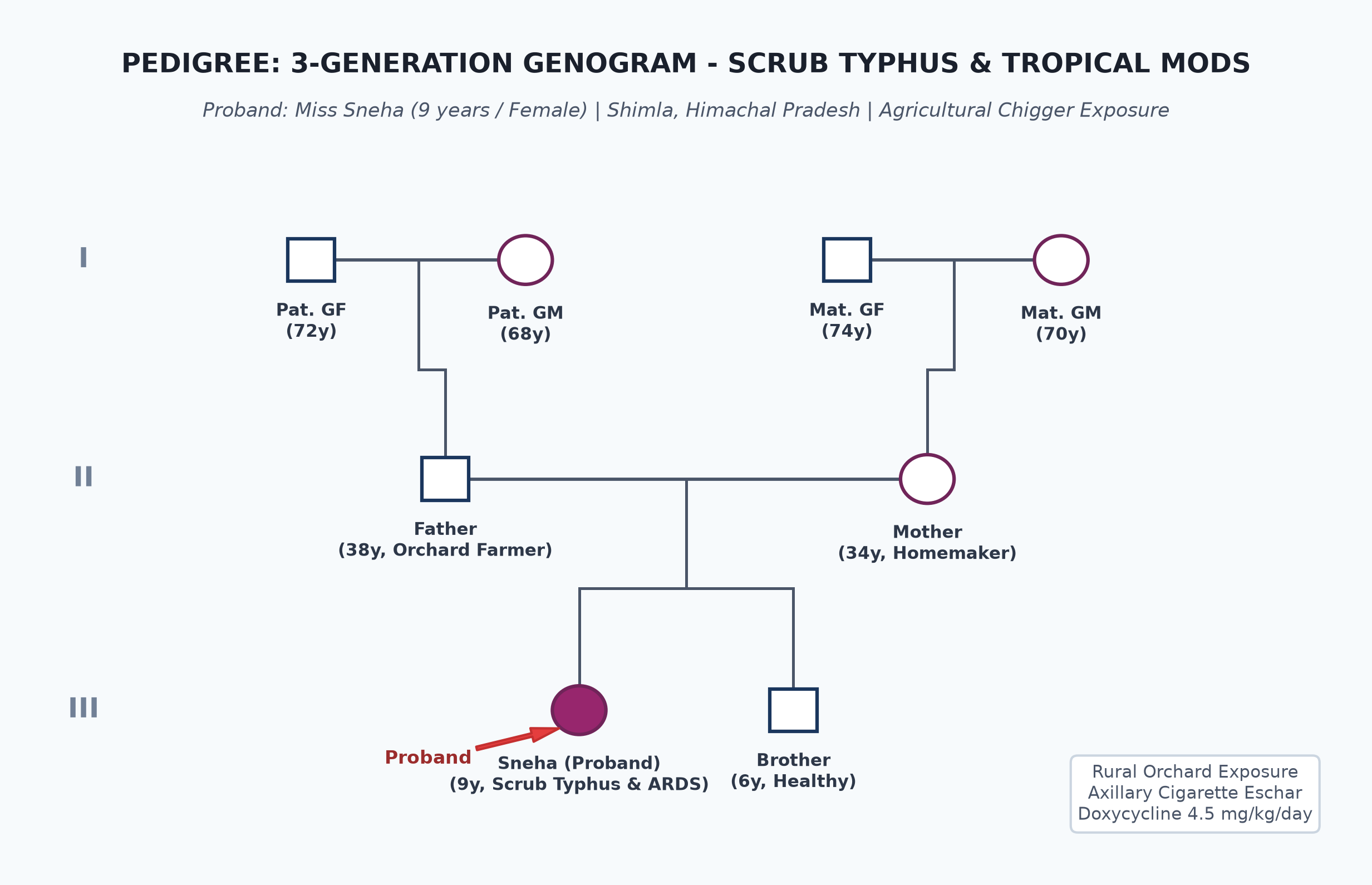
- Father 38 years, orchard farmer; Mother 34 years, homemaker.
- Younger brother (6 years old) is healthy.
- Residence: Lives on an apple orchard farm with overgrown secondary scrub vegetation and rodent burrows; frequently plays in outdoor grassy fields barefoot.
Immunization history
- Fully immunized up to age as per the National Immunization Schedule.
Dietary history
- Consumes a mixed family diet; intake reduced by 50% over the past week.
24-Hour Recall Deficit Analysis
$$ \text{Ideal Body Weight (IBW for 9 years, 50th centile WHO)} = 28.0\text{ kg} $$| Nutrient | Expected Intake (ICMR-NIN 2024 for IBW 28 kg) | Observed Intake | Deficit | Percentage Deficit |
|---|---|---|---|---|
| Energy (kcal) | $28.0\text{ kg} \times 58\text{ kcal/kg} = 1624\text{ kcal}$ | 780 kcal | 844 kcal | 52.0% Deficit |
| Protein (g) | $28.0\text{ kg} \times 0.95\text{ g/kg} = 26.6\text{ g}$ | 11.2 g | 15.4 g | 57.9% Deficit |
Socioeconomic and KAP
- Modified BG Prasad Socioeconomic Class III (Middle Class).
- Rural agricultural community; seasonal post-monsoon surge of scrub typhus recognized in the region.
Summary of History
Miss Sneha, a 9-year-old female child residing in a rural Himalayan farming area, presents with 9 days of high continuous fever, headache, dry cough, conjunctival suffusion, facial puffiness, progressive breathlessness, and a painless black crusted eschar in the left axilla with regional lymphadenitis.
I would like to consider a diagnosis of Scrub Typhus (Orientia tsutsugamushi infection) complicated by Capillary Leak Syndrome and Scrub Pneumonitis / Mild ARDS, requiring immediate oral/IV Doxycycline therapy.
General head to toe examination
- Behavioral State: Conscious, oriented, anxious, sitting propped up in bed due to breathlessness.
- Vitals:
- Heart Rate: 126 beats/minute, regular, normal volume.
- Respiratory Rate: 38 breaths/minute, rapid, with intercostal retractions (Tachypnea).
- Blood Pressure: $94/62\text{ mmHg}$ ($50^{\text{th}}$ centile, normotensive).
- Temperature: $39.4^\circ\text{C}$ ($103.0^\circ\text{F}$).
- Oxygen Saturation ($SpO_2$): $91\%$ on room air (improves to $97\%$ on 2 L/min nasal prongs oxygen).
- Capillary Refill Time: $<2$ seconds.
- Anthropometry:
| Parameter | Observed | Expected (50th WHO) | Centile | Inference |
|---|---|---|---|---|
| Weight | 27.5 kg | 28.0 kg | $50^{\text{th}}\text{ centile}$ | Normal baseline weight |
| Height | 133.0 cm | 133.5 cm | $50^{\text{th}}\text{ centile}$ | Normal Stature |
- Dermatological Examination (The Eschar Hunt):
- Left Axillary Vault: A solitary, pathognomonic $8 \times 6\text{ mm}$ oval, painless ulcer covered by a thick black necrotic crust (eschar), surrounded by an elevated, erythematous indurated rim ("cigarette-burn" appearance). Completely non-tender.
- Other Cutaneous Signs: Faint, non-pruritic maculopapular rash over the trunk; bilateral conjunctival suffusion without purulent discharge.
- Lymphatic System:
- Left Axillary Lymph Nodes: Two enlarged lymph nodes, largest measuring $2.0 \times 1.5\text{ cm}$, firm, moderately tender (regional lymphadenitis).
- Generalized Lymphadenopathy: Multiple shotty, non-tender lymph nodes palpable in bilateral cervical ($1\text{ cm}$) and inguinal ($1\text{ cm}$) chains.
Systemic Examination
Respiratory System (Scrub Pneumonitis)
- Tachypneic (38/min) with mild intercostal and subcostal indrawing.
- Percussion: Resonant bilaterally; no stony dullness.
- Auscultation: Bilateral fine, end-inspiratory crepitations (crackles) audible over the bilateral mid and lower lung zones; no wheezing.
Abdomen
- Symmetrically full, soft, mild generalized tenderness.
- Hepatomegaly: Liver palpable 3.0 cm below right costal margin, soft, smooth, non-tender, span 9.5 cm.
- Splenomegaly: Spleen tip palpable 2.0 cm below left costal margin, soft-to-firm, non-tender.
- Free fluid: Mild shifting dullness present (ascites from capillary leak).
Cardiovascular & Central Nervous System
- Tachycardia (126 bpm), normal heart sounds ($S_1, S_2$ normal), no murmurs.
- Neurological: Fully conscious, oriented, no neck stiffness, Kernig sign negative, cranial nerves intact.
Summary
Miss Sneha, a 9-year-old girl from an endemic Himalayan region, presents with 9 days of high continuous fever, headache, bilateral conjunctival suffusion, generalized lymphadenopathy, hepatosplenomegaly, and tachypnea with hypoxemia ($SpO_2\text{ }91\%$), with discovery of a pathognomonic black cigarette-burn eschar in the left axilla.
Final Clinical Diagnosis: Scrub Typhus (Orientia tsutsugamushi) presenting with Capillary Leak Syndrome and Scrub Pneumonitis / Acute Lung Injury, without septic shock or meningoencephalitis, requiring immediate Doxycycline therapy.
Differential Diagnosis
| Disorder | Points IN FAVOR | Points AGAINST |
|---|---|---|
| Scrub Typhus | Pathognomonic axillary eschar, regional adenitis, fever $>7$ days, conjunctival suffusion, pneumonitis, rural endemic area | Primary Clinical Diagnosis |
| Severe Dengue (Critical Phase) | Fever, headache, conjunctival suffusion, capillary leak, thrombocytopenia | Dengue lacks an eschar; shock develops characteristically at defervescence; leukopenia in dengue, whereas scrub has leukocytosis |
| Enteric Fever (Typhoid) | High continuous fever $>7$ days, headache, hepatosplenomegaly, cough | Enteric fever lacks an eschar, conjunctival suffusion, or acute pneumonitis; blood culture will confirm or refute Salmonella |
| Leptospirosis | Fever, headache, conjunctival suffusion, hepatosplenomegaly, pneumonitis | Leptospirosis features exquisite calf muscle tenderness, conjunctival suffusion without eschar, and severe direct hyperbilirubinemia with renal failure |
| Infectious Mononucleosis (EBV) | Fever, generalized lymphadenopathy, hepatosplenomegaly, rash | EBV features exudative pharyngitis with membrane, palatal petechiae, and atypical lymphocytes; lacks eschar or acute capillary leak |
Investigation Protocol & Diagnostic Workup
flowchart TD
    A["Child with Prolonged Fever, Conjunctival Suffusion & Axillary Eschar"] --> B["Stat Scrub Typhus IgM ELISA & Weil-Felix Test"]
    B --> C{"Scrub Typhus IgM Positive (Optical Density > 0.5)?"}
    C -->|Yes| D["Confirm Orientia tsutsugamushi Infection"]
    D --> E["Workup for Tropical MODS: Chest X-Ray, LFT, RFT, CBC, ABG/VBG"]
    E --> F["IMMEDIATELY Start Oral/IV Doxycycline (4.5 mg/kg/day divided BID)"]
    F --> G["Supportive Care: Oxygen via Prongs, Restrictive Fluid Balance"]
    G --> H{"Defervescence Achieved within 24-48 Hours?"}
    H -->|Yes| I["Complete 7 to 10 Days of Doxycycline Therapy"]
    H -->|No| J["Re-evaluate: Drug Resistance, Co-Infection (Malaria/Dengue), or Non-Rickettsial FUO"]
1. Confirmatory Serology
- Scrub Typhus IgM ELISA: Strongly positive (Optical Density $1.64$; cutoff $>0.5$ in endemic areas) $\rightarrow$ Confirms active Orientia tsutsugamushi infection.
- Weil-Felix Agglutination Test: OX-K titer $1:320$ (Diagnostic $\ge 1:160$; OX-2 and OX-19 negative).
2. Hematological & Inflammatory Biomarkers
- Complete Blood Count:
- Total Leukocyte Count: $15,800/\mu\text{L}$ ($76\%$ neutrophils with toxic granulation).
- Platelet Count: $78,000/\mu\text{L}$ (Moderate thrombocytopenia).
- Hemoglobin: $10.8\text{ g/dL}$.
- Inflammatory Markers:
- CRP: $86\text{ mg/L}$ (Markedly elevated; normal $<6\text{ mg/L}$).
- ESR: $62\text{ mm/hr}$.
3. Organ Function & Blood Gas
- Liver Function Tests: AST $142\text{ U/L}$, ALT $118\text{ U/L}$ ($2-3\times$ transaminitis); Total Bilirubin $1.1\text{ mg/dL}$; Serum Albumin $2.9\text{ g/dL}$ (Hypoalbuminemia).
- Renal Function: Serum Creatinine $0.5\text{ mg/dL}$ (normal).
- Venous Blood Gas: pH $7.36$, $p\text{O}_2$ $62\text{ mmHg}$ on room air ($SpO_2\text{ }91\%$).
4. Chest Radiography
- Chest X-Ray (AP view): Bilateral diffuse reticulonodular interstitial infiltrates with prominent peribronchial cuffing and mild blunting of bilateral costophrenic angles (Scrub interstitial pneumonitis / mild ARDS).
Therapeutic Management Protocol
1. Specific Antimicrobial Therapy: Doxycycline Protocol
- Drug of Choice: Doxycycline orally (or IV).
- Dosage: $4.5\text{ mg/kg/day}$ divided into two equal doses every 12 hours (BID) orally.
- For this child ($27.5\text{ kg}$): $60\text{ mg}$ BID (or $100\text{ mg}$ morning, $50\text{ mg}$ evening).
- Duration: 7 to 10 days.
- Viva Trap Point: Short-course Doxycycline ($\le 14$ days) is completely safe in children $<8$ years of age and does NOT cause dental discoloration.
- Diagnostic Therapeutic Trial: Defervescence is expected dramatically within 24 to 48 hours.
2. Respiratory & Supportive Management
- Oxygen Therapy: Humidified oxygen via nasal prongs at $2\text{ L/min}$ to maintain $SpO_2 \ge 94\%$.
- Restrictive Fluid Balance: Avoid overhydration; maintenance fluids at standard Holliday-Segar rate to prevent worsening interstitial pulmonary edema.
- Monitoring: Serial respiratory rate, oxygen saturation, and platelet counts.