
Miss Meera, a 4-year-old female child, 2nd order offspring born of a 2nd-degree consanguineous marriage from Madurai, Tamil Nadu, presented with complaints of profound failure to thrive and severe short stature noticed since infancy, excessive thirst (polydipsia) and passing large volumes of pale urine (polyuria) with recurrent dehydration episodes without diarrhea for 2 years, episodic severe generalized muscle weakness and inability to stand from the floor (hypokalemic paralysis) for 6 months, and bilateral genu valgum deformities with difficulty in walking for 4 months, with an ultrasound showing bilateral medullary nephrocalcinosis.
- Severe growth failure, failure to thrive, and profound stunting (Height Z-score <-3 SD)
- Polyuria, polydipsia, and recurrent unprovoked dehydration without diarrhea (Impaired medullary concentrating gradient)
- Episodic profound muscle weakness, hypotonia, or periodic paralysis (Hypokalemia)
- Skeletal deformities: Genu Valgum ('knock-knees'), widened wrists, and rachitic rosary (Metabolic bone buffering)
- Vomiting, anorexia, constipation, and obstinate failure to gain weight (Chronic systemic metabolic acidosis)
- Bilateral Medullary Nephrocalcinosis and recurrent nephrolithiasis (Hypercalciuria + hypocitraturia + alkaline urine)
HOPI
The child was noticed to have poor weight gain from 6 months of age. Despite adequate breastfeeding and complementary feeding, she remained frail, thin, and small compared to her peers.
RTA is a clinical syndrome characterized by Normal Anion Gap (Hyperchloremic) Metabolic Acidosis with a relatively preserved GFR. The cardinal diagnostic crossroads in a viva is differentiating Distal (Type 1) RTA from Proximal (Type 2) RTA:
- Distal RTA (Type 1): Defective hydrogen ion ($H^+$) secretion in alpha-intercalated cells. Hallmark: Urine pH is paradoxically alkaline ($>5.5$) despite severe systemic acidosis; Medullary Nephrocalcinosis is present in $>80\%$; low alkali requirement ($2-3\text{ mEq/kg/day}$).
- Proximal RTA (Type 2): Defective bicarbonate ($HCO_3^-$) reabsorption. Urine pH can be acidified ($<5.5$); Nephrocalcinosis is absent; high alkali requirement ($10-20\text{ mEq/kg/day}$); often part of Fanconi syndrome. Inquire meticulously about polyuria, episodic paralytic weakness (hypokalemia), and previous unexplained sibling deaths.
- Profound Growth Failure (Failure to Thrive):
- Weight and height have persistently tracked far below the 3rd percentile.
- Mother reports the child has gained less than 1.5 kg over the past 2 years.
- Polyuria, Polydipsia & Unprovoked Dehydration:
- Drinks 2.5 to 3 liters of water daily, demanding water repeatedly through the night.
- Passes large amounts of dilute urine frequently; required 3 emergency hospital admissions for severe dehydration without any preceding loose stools or vomiting.
- Episodic Generalized Muscle Weakness (Hypokalemic Episodes):
- Over the past 6 months, child experienced 3 distinct episodes where she woke up in the morning unable to stand or walk, complaining of severe weakness in both thighs and arms.
- Episodes lasted 24 to 48 hours and resolved completely after receiving intravenous fluid drips at the local hospital Points to acute hypokalemic periodic paralysis precipitated by renal potassium wasting.
- Skeletal Deformities & Bone Pain:
- Developed progressive inward deviation of both knees (knock-knees) over the past 4 months.
- Reluctant to run; complains of leg pain after walking 50 meters.
- Negative Inquiries:
- No history of hearing impairment or delayed speech (excludes sensorineural deafness seen in ATP6V1B1 mutations).
- No history of gross hematuria, dark urine, or eye puffiness.
- No history of seizures, tetany, or carpopedal spasms.
Past history
- Three emergency admissions for acute dehydration and hypokalemic weakness treated with IV fluids; no definitive diagnosis was established.
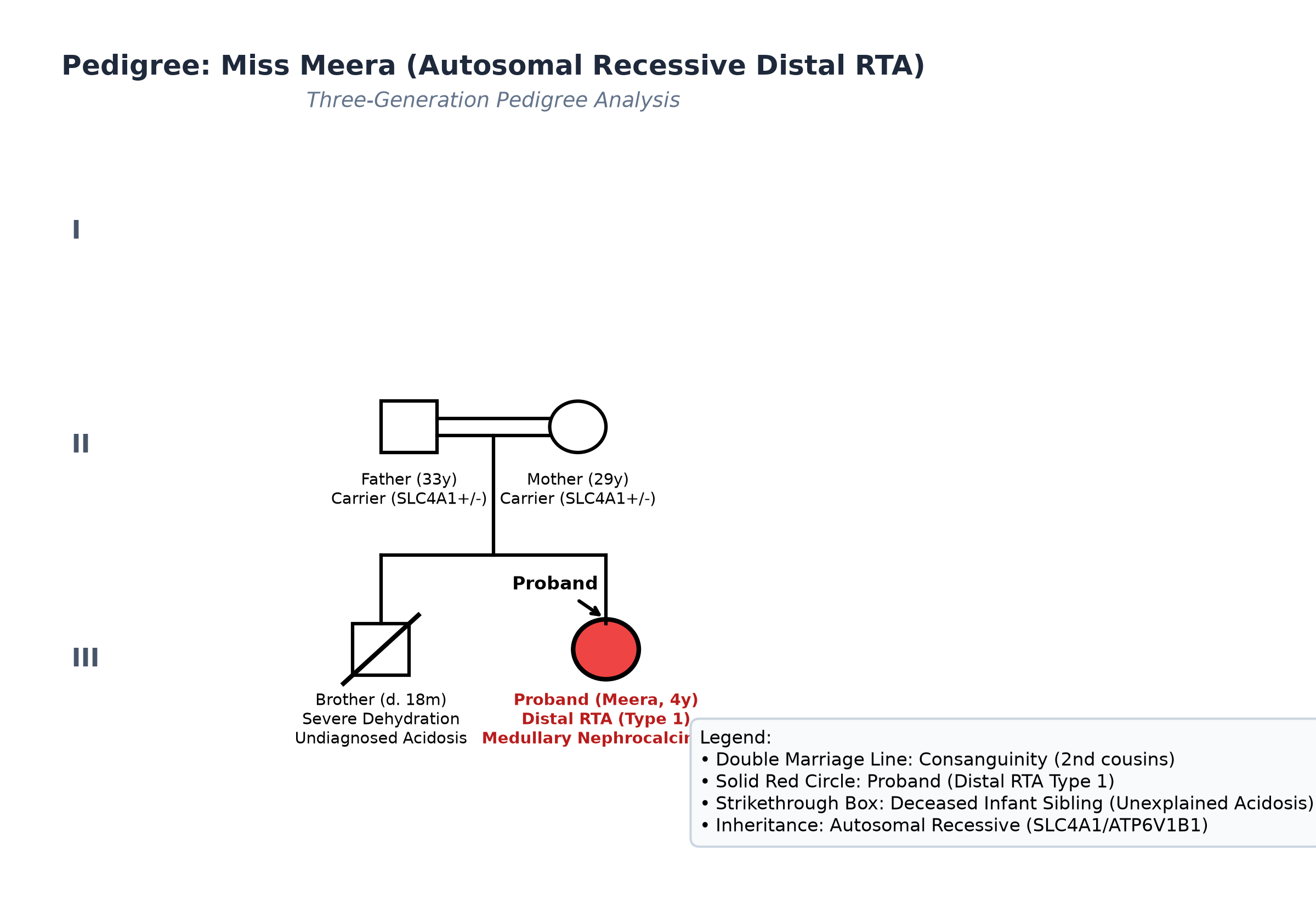
- History of an elder brother who presented with similar growth failure and polyuria and died at 18 months of age of severe unexplained metabolic acidosis.
Antenatal, natal and postnatal history
- Born to a 25-year-old multigravida; uneventful pregnancy; term vaginal delivery; birth weight 2.7 kg.
- Neonatal period uneventful.
Development history
- Motor milestones mildly delayed: walked at 18 months. Language and social milestones are completely normal; fluent Tamil.
Family history
- Parents are first cousins (second-degree consanguineous marriage).
- Father 33 years, shopkeeper; Mother 29 years, homemaker; both healthy.
- Family Pedigree: Elder brother died at 18 months of age during an acute diarrheal dehydration episode with profound uncorrectable metabolic acidosis.
- No other relatives with kidney stones or deafness.
Immunization history
- Fully immunized per the National Immunization Schedule.
Dietary history
- Vegetarian diet; poor appetite, refuses solids, prefers drinking water.
| Food Item | Quantity | Calories (kcal) | Protein (g) |
|---|---|---|---|
| Cow's Milk (toned) | 300 mL | 180 | 9.6 |
| Idli (rice + urad dal, 2) | 60 g | 100 | 3.2 |
| Cooked Rice with Ghee | 80 g cooked | 120 | 1.8 |
| Sambar (dal + vegetables) | 1 small katori | 70 | 2.5 |
| Curd / Yogurt | 50 g | 30 | 1.6 |
| Mashed Banana | 1 small (50 g) | 45 | 0.6 |
| Puffed Rice / Biscuit | 20 g | 75 | 1.1 |
| Total Observed Daily Intake | — | 620 kcal | 20.4 g |
24-Hour Recall Deficit Analysis
$$ \text{Ideal Body Weight (IBW for 4 years, 50th centile WHO)} = 16.3\text{ kg} $$| Nutrient | Expected Intake (ICMR-NIN 2024 for IBW 16.3 kg) | Observed Intake | Deficit | Percentage Deficit |
|---|---|---|---|---|
| Energy (kcal) | $16.3\text{ kg} \times 74\text{ kcal/kg} = 1206\text{ kcal}$ | 620 kcal | 586 kcal | 48.6% Deficit |
| Protein (g) | $16.3\text{ kg} \times 1.0\text{ g/kg} = 16.3\text{ g}$ | 20.4 g | Nil (Adequate) | 0% Deficit |
The expected calories and proteins should be calculated from the ideal body weight, not from current weight.
Socioeconomic and KAP
- Modified BG Prasad Socioeconomic Class III (Middle Class).
Summary of History
Miss Meera, a 4-year-old female child born of consanguineous parents with an elder sibling infant death, presents with chronic failure to thrive, severe linear stunting, polyuria, polydipsia, recurrent unprovoked dehydration, episodic hypokalemic muscle weakness, and progressive genu valgum deformities, with preserved cognition and no hematuria.
I would like to consider a provisional diagnosis of Inherited Renal Tubular Acidosis (most consistent with Primary Distal RTA / Type 1 dRTA), complicated by Renal Hypokalemia, Medullary Nephrocalcinosis, and Metabolic Rickets.
General head to toe examination
- General Appearance: Alert, cheerful, noticeably short and thin child, sitting comfortably, severe stunting.
- Vitals:
- Heart Rate: 98 beats/minute, regular.
- Respiratory Rate: 24 breaths/minute, regular, no deep Kussmaul respiration currently.
- Blood Pressure: $88/54\text{ mmHg}$ ($50^{\text{th}}$ centile, completely normotensive).
- Temperature: $36.9^\circ\text{C}$ ($98.4^\circ\text{F}$) axillary.
- Capillary Refill Time: $<2$ seconds.
- Anthropometry:
| Parameter | Observed | Expected (50th WHO) | Z-score / Centile | Inference |
|---|---|---|---|---|
| Weight | 10.8 kg | 16.3 kg | $<-3.0\text{ SD}$ | Severe Underweight |
| Pre-morbid Weight | 11.0 kg | 16.3 kg | $<-3.0\text{ SD}$ | Chronic growth arrest |
| Height | 88.0 cm | 103.0 cm | $<-3.0\text{ SD}$ | Severe Stunting (Linear Growth Failure) |
| Height Age | ~2.3 years | 4.0 years | — | Stunting lag of nearly 2 years |
| Weight-for-Height | 10.8 kg for 88 cm | 12.2 kg | $-1.5\text{ SD}$ | Moderate wasting |
| Head Circumference | 48.5 cm | 49.5 cm | Normal | Age-appropriate |
| BMI | $13.9\text{ kg/m}^2$ | $15.3\text{ kg/m}^2$ | $-1.5\text{ SD}$ | Moderate thinness |
- Rachitic & Skeletal Examination:
- Bilateral Genu Valgum: Marked inward deviation of knees; Intermalleolar Distance (IMD) is $7.0\text{ cm}$.
- Wrists: Symmetrical widening and thickening of distal radius and ulna.
- Chest: Palpable rachitic rosary beads along costochondral junctions.
- Audiometry / Ear Exam:
- Normal otoacoustic emissions (OAE) and brainstem evoked response audiometry (Normal Hearing; rules out sensorineural deafness associated with ATP6V1B1 / dRTA with deafness).
- Systemic Signs:
- Mild pallor; no jaundice, cyanosis, clubbing, or lymphadenopathy.
- Completely normal abdominal, cardiovascular, and respiratory examinations.
- Neurological: Power 4+/5 in proximal muscles, tone normal, reflexes $2+$ symmetrical, plantars flexor.
Systemic Examination
Abdomen
- Flat, soft, non-tender; kidneys not ballotable; bladder not distended; no organomegaly.
Cardiovascular & Respiratory Systems
- Normal heart sounds; no murmurs; lungs clear bilaterally.
Summary
Miss Meera, a 4-year-old female child born of consanguineous parents, presents with severe linear growth failure ($<-3\text{ SD}$), polyuria, polydipsia, recurrent hypokalemic weakness, bilateral genu valgum (IMD 7.0 cm), and rachitic changes, with normal hearing, normal blood pressure, and absence of glomerular signs.
Final Clinical Diagnosis: Primary Distal Renal Tubular Acidosis (Type 1 dRTA, Autosomal Recessive), presenting with Normal Anion Gap Metabolic Acidosis, Hypokalemia, Bilateral Medullary Nephrocalcinosis, and Metabolic Rickets.
Differential Diagnosis: Distal vs Proximal RTA vs Bartter Syndrome
| Parameter | Distal RTA (Type 1) | Proximal RTA (Type 2) | Bartter Syndrome |
|---|---|---|---|
| Primary Defect | Impaired distal $H^+$ secretion | Impaired proximal $HCO_3^-$ reabsorption | NKCC2 defect in thick ascending limb |
| Acid-Base Status | Metabolic Acidosis (Normal AG) | Metabolic Acidosis (Normal AG) | Hypokalemic Metabolic Alkalosis |
| Urine pH in Acidosis | Invariable $>5.5$ ($6.5-7.5$) | Can acidify to $<5.5$ | Variable ($>6.0$) |
| Urinary Anion Gap | POSITIVE ($+15\text{ to }+30$) | Negative | Negative / Variable |
| Nephrocalcinosis | PRESENT ($>80\%$) | ABSENT | PRESENT |
| Serum Potassium | Low (Hypokalemia) | Low to Normal | Very Low (Severe Hypokalemia) |
| Fanconi Syndrome | Absent | Present (Glucosuria, Aminoaciduria) | Absent |
| Alkali Requirement | Low ($2-3\text{ mEq/kg/day}$) | Massive ($10-20\text{ mEq/kg/day}$) | None (Requires Indomethacin + KCl) |
Investigation Protocol & Acid-Base Mathematics
flowchart TD
    A["Child with Stunting, Polyuria, Hypokalemia & Genu Valgum"] --> B["Serum Electrolytes, Arterial Blood Gas & Simultaneous Urine pH"]
    B --> C["Calculate Serum Anion Gap: Na - (Cl + HCO3)"]
    C --> D{"Serum AG Normal (8-12 mEq/L) & Hyperchloremia?"}
    D -->|Yes| E["Calculate Urinary Anion Gap (UAG): Na + K - Cl (Urine)"]
    E --> F{"UAG is POSITIVE & Urine pH > 5.5 in Acidosis?"}
    F -->|Yes| G["Confirm Distal RTA (Type 1 dRTA)"]
    G --> H["Renal USG: Medullary Nephrocalcinosis"]
    H --> I["Urine Calcium-to-Creatinine Ratio & Citrate: Hypercalciuria + Hypocitraturia"]
    I --> J["Initiate Oral Alkali: Shohl's Solution (Potassium/Sodium Citrate 2-3 mEq/kg/day)"]
1. Arterial Blood Gas & Serum Electrolyte Profile
- Venous Blood Gas:
- pH: $7.21$ (Severe uncompensated systemic metabolic acidosis).
- Serum Bicarbonate ($HCO_3^-$): $11.4\text{ mEq/L}$ (Markedly depressed).
- $pCO_2$: $28\text{ mmHg}$ (Compensatory respiratory hyperventilation).
- Serum Electrolytes:
- Serum Sodium: $136\text{ mEq/L}$.
- Serum Potassium: $2.7\text{ mEq/L}$ (Severe hypokalemia; normal $3.5-5.0\text{ mEq/L}$).
- Serum Chloride: $114\text{ mEq/L}$ (Marked Hyperchloremia; normal $98-106\text{ mEq/L}$).
- Serum Anion Gap Calculation (Display Math Block): $$ \text{Serum AG} = \text{Na}^+ - [\text{Cl}^- + \text{HCO}_3^-] = 136 - [114 + 11.4] = 136 - 125.4 = \mathbf{10.6\text{ mEq/L}} $$ (Normal Anion Gap: $8\text{ to } 12\text{ mEq/L} \to$ Confirms Hyperchloremic Normal Anion Gap Metabolic Acidosis!)
2. Simultaneous Urine Chemistry & Urinary Anion Gap (UAG)
- Simultaneous Urine pH: $6.8$ (Paradoxically ALKALINE ($>5.5$) despite severe systemic blood acidosis pH 7.21 $\to$ Pathognomonic for Distal RTA Type 1!).
- Spot Urine Electrolytes:
- $\text{Na}^+_{\text{urine}} = 42\text{ mEq/L}$.
- $\text{K}^+_{\text{urine}} = 36\text{ mEq/L}$.
- $\text{Cl}^-_{\text{urine}} = 48\text{ mEq/L}$.
- Urinary Anion Gap (UAG) Calculation (Display Math Block): $$ \text{UAG} = \text{Na}^+_{\text{urine}} + \text{K}^+_{\text{urine}} - \text{Cl}^-_{\text{urine}} = 42 + 36 - 48 = \mathbf{+30\text{ mEq/L}} $$ (A POSITIVE UAG demonstrates severely impaired renal excretion of ammonium [$NH_4^+$], definitively confirming Distal RTA!)
3. Renal Ultrasound & Mineral Metabolism
- Renal Ultrasound: Bilateral kidneys show striking diffuse Medullary Nephrocalcinosis (hyperechoic acoustic shadowing rimming all renal medullary pyramids); normal renal size and parenchyma.
- Spot Urine Calcium-to-Creatinine Ratio: $0.42\text{ mg/mg}$ (Marked hypercalciuria; normal $<0.20\text{ mg/mg}$).
- 24-Hour Urine Citrate: $42\text{ mg/day}$ (Severe hypocitraturia; normal $>180\text{ mg/day}$). (Combination of Alkaline Urine + Hypercalciuria + Hypocitraturia explains rapid calcium phosphate precipitation and nephrocalcinosis!)
- Serum Creatinine: $0.4\text{ mg/dL}$ (Normal GFR).
Comprehensive Long-Term Management Plan
1. Acute Hypokalemia & Acidosis Correction
- Never administer sodium bicarbonate rapidly without correcting potassium first, as bicarbonate drives transcellular potassium shift and triggers fatal cardiac arrhythmias!
- Potassium Replacement: Administer oral or slow IV Potassium Chloride to elevate serum potassium $>3.5\text{ mEq/L}$.
2. Definitive Alkali Therapy (Shohl's Solution)
- Alkali Requirement in Distal RTA: Low-dose therapy: $2.0\text{ to } 3.0\text{ mEq/kg/day}$ of base is sufficient to neutralize daily endogenous acid production ($1-2\text{ mEq/kg/day}$ in children).
- Drug of Choice: Shohl's Solution / Potassium-Sodium Citrate Solution:
- Each mL of modified Shohl's contains $1\text{ mEq of base}$ ($1\text{ mEq } Na^+ + 1\text{ mEq } K^+ + 2\text{ mEq Citrate}$).
- Dose for Meera (Weight 10.8 kg): $$ \text{Daily Base Requirement} = 10.8\text{ kg} \times 2.5\text{ mEq/kg} = \mathbf{27\text{ mEq/day}} $$
- Administer $9\text{ mL}$ of Shohl's solution orally three times daily (total $27\text{ mL/day}$).
- Why Citrate is Superior to Bicarbonate:
- Citrate is metabolized in the liver to bicarbonate, providing steady systemic alkalinization.
- Unmetabolized citrate is excreted in urine, curing hypocitraturia and chelating free calcium to halt the progression of medullary nephrocalcinosis!
3. Monitoring & Catch-up Growth
- Monitoring Parameters: Monthly venous bicarbonate (target $\ge 22\text{ mEq/L}$) and serum potassium ($4.0-5.0\text{ mEq/L}$).
- Growth Catch-up: Correction of chronic systemic metabolic acidosis restores growth hormone sensitivity, leading to dramatic linear catch-up growth within 6 to 12 months!
- Nephrocalcinosis Surveillance: Annual renal ultrasound; preexisting nephrocalcinosis rarely regresses completely, but further stone formation is prevented.