
Miss Ananya, a 6-year-and-6-month-old female child, 1st order child born of a non-consanguineous marriage to healthy parents from Bengaluru, Karnataka, presented to the Pediatric Endocrinology & Growth Clinic with chief complaints of rapid linear growth acceleration noticed over the past 10 months (growing $9.5\text{ cm}$ over the preceding year, far exceeding normal childhood growth velocity), progressive bilateral breast enlargement noticed since 5.8 years of age (currently at Tanner Stage B3 with palpable firm glandular breast tissue extending beyond the areolar border), emergence of fine, pigmented pubic hair along the labia majora (Tanner Stage P2), and development of adult-type apocrine body odor, without history of headaches, visual disturbances, unprovoked laughter seizures (gelastic seizures), or exogenous estrogen exposure, whose radiological bone age demonstrated profound skeletal advancement (Bone Age: 9.5 years, advanced by 3.0 years ahead of chronological age), with pelvic ultrasonography revealing a pubertal pear-shaped uterus measuring $4.8\text{ cm}$ with an echogenic endometrial stripe and bilateral enlarged ovaries ($>3.0\text{ mL}$) with multiple mature follicles, and a formal GnRH Stimulation Test demonstrating a true pubertal LH response with a Peak Stimulated LH of $14.8\text{ IU/L}$ and an LH to FSH ratio of $1.4$, with contrast-enhanced brain and pituitary MRI ruling out hypothalamic hamartomas and intracranial masses, confirming Idiopathic Central Precocious Puberty (GnRH-Dependent True Isosexual Precocious Puberty), successfully initiated on Depot Leuprolide Acetate ($3.75\text{ mg IM}$ every 28 days) to preserve adult target height and prevent premature epiphyseal fusion.
When examining a child with early secondary sexual development, examiners test candidates on three fundamental pillars:
- Classification (The Core Branch Point):
- Central Precocious Puberty (CPP / GnRH-Dependent / True): Premature activation of the hypothalamic GnRH pulse generator. The sequence of puberty is NORMAL and ISOSEXUAL (thelarche $\to$ pubarche $\to$ menarche), but occurs abnormally early ($<8$ years in girls, $<9$ years in boys).
- Peripheral Precocious Puberty (PPP / GnRH-Independent / Pseudoprecocity): Autonomous peripheral secretion of sex steroids (ovarian cyst, CAH, Leydig/Granulosa cell tumor, McCune-Albright). Gonadotropins are SUPPRESSED (flat LH response on GnRH test).
- Gender Etiology Disparity (Classic Viva Pearl):
- In girls: $>85-90\%$ of Central Precocious Puberty is Idiopathic (Benign).
- In boys: $>50-75\%$ of Central Precocious Puberty is secondary to an identifiable organic CNS tumor or lesion (Hypothalamic Hamartoma, Optic Glioma, Germinoma)! Brain MRI is mandatory in all boys and in young girls ($<6$ years).
- The Dual Goals of GnRHa Therapy:
- Biochemical / Skeletal: Suppress sex steroid secretion, decelerate rapid bone age advancement, and prevent premature epiphyseal fusion to maximize final adult height.
- Psychosocial: Prevent early menarche in an emotionally immature young child and reduce psychosocial distress.
Chief Complaints
- Rapid acceleration of height noticed by parents and schoolteachers for 10 months.
- Progressive enlargement of both breasts noticed since 5 years 9 months of age.
- Appearance of dark hair over the private parts for 4 months.
- Development of strong adult-like body odor from the armpits for 6 months.
HOPI
Miss Ananya was born at term following an uncomplicated pregnancy, with normal birth weight ($3200\text{ g}$) and normal early developmental and linear growth tracking along the 50th percentile until 5.5 years of age:
- Evolution of Pubertal Stigmata:
- Around 5 years and 9 months of age, mother noticed a tender, firm lump beneath both nipples (thelarche).
- Over the subsequent 9 months, the breast enlargement progressed steadily: the glandular breast tissue expanded beyond the borders of the areola, with enlargement of the areolae and prominent Montgomery tubercles (Tanner Stage B3).
- Four months ago, sparse, lightly pigmented, straight hair appeared along the inner borders of the labia majora (Tanner Stage P2).
- Mother noted the appearance of prominent adult-like apocrine axillary odor, requiring regular washing.
- No history of vaginal discharge, spotting, or breakthrough vaginal bleeding (menarche has not yet occurred).
- Rapid Linear Growth Acceleration (Pubertal Growth Spurt):
- Parents noted the child outgrew clothes and footwear every 2-3 months.
- Her height jumped from $114\text{ cm}$ at 5.5 years to $123.5\text{ cm}$ currently at 6.5 years, demonstrating a markedly accelerated annualized growth velocity of $9.5\text{ cm/year}$ (normal prepubertal velocity at this age is $5.0-6.0\text{ cm/year}$).
- Height has crossed upward from the 50th percentile to $>97\text{th}$ percentile on the WHO growth chart.
- Systemic & Neurological Review:
- No history of persistent headaches, morning vomiting, or visual disturbances (diplopia or visual field loss).
- No history of seizures, sudden episodes of unprovoked, mirthless laughter (Gelastic Seizures suggestive of Hypothalamic Hamartoma).
- No history of prior head trauma, cranial irradiation, or central nervous system infections (meningitis/encephalitis).
- No history of exposure to external hormone sources: no maternal oral contraceptive ingestion, estrogenic creams, lavender or tea tree oil applications.
- No history of bone fractures, bone pains, or large irregular café-au-lait skin patches with jagged 'Coast of Maine' borders (excludes McCune-Albright syndrome).
Past History
- No prior hospitalizations or chronic illnesses.
- No history of long-term medication use.
Antenatal, Natal, and Developmental History
- Antenatal: Uneventful; full-term normal vaginal delivery; cried immediately; birth weight $3200\text{ grams}$.
- Developmental: Normal early milestones (walked at 12 months, fluent speech at 2 years). Excellent academic and cognitive performance; enrolled in 1st grade.
Family History
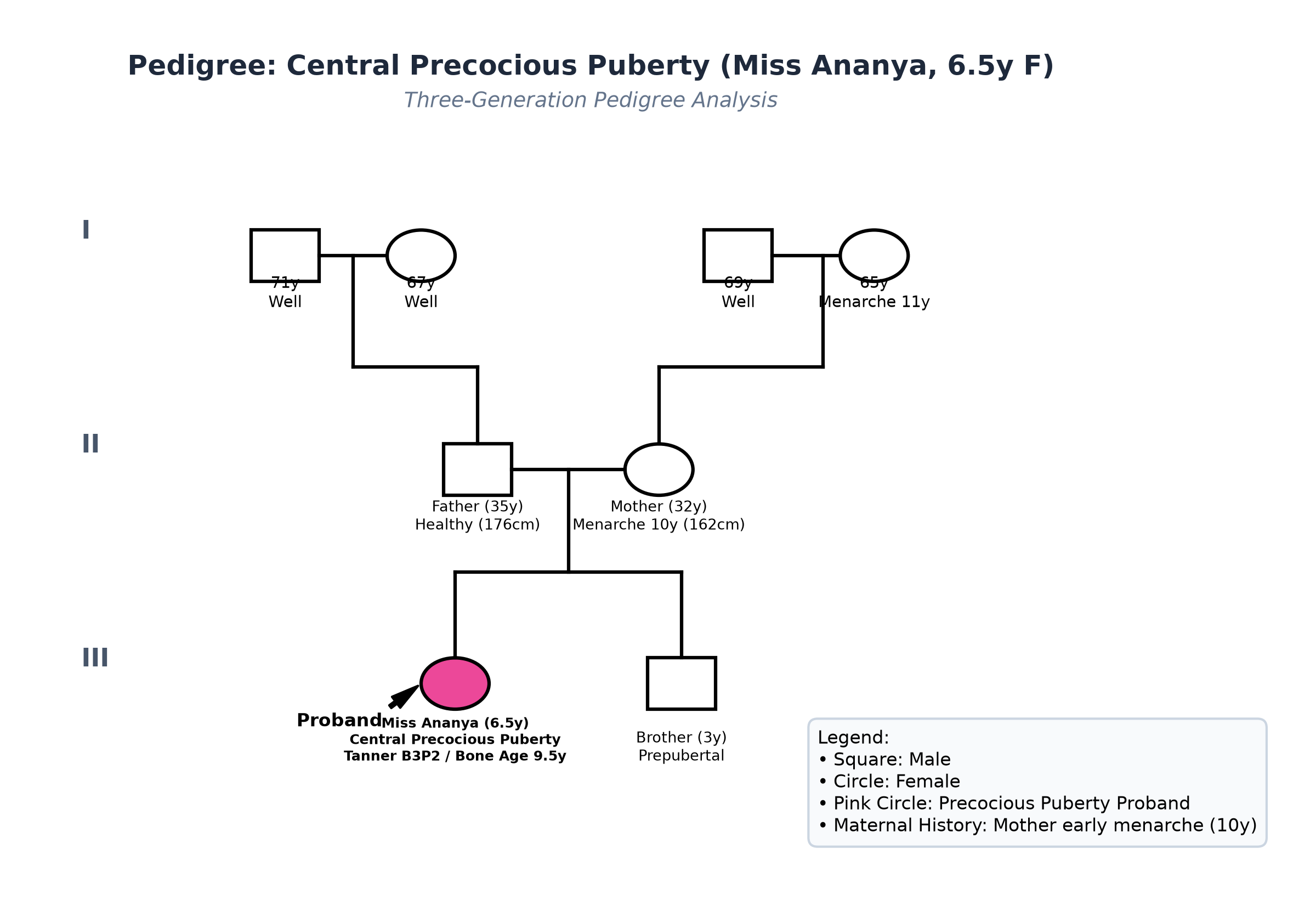
- Non-consanguineous marriage. Father's height: $176\text{ cm}$; Mother's height: $162\text{ cm}$.
- Mid-Parental Target Height (MPTH) Calculation: $$\text{Target Height} = \frac{\text{Father's Ht} + \text{Mother's Ht} - 13\text{ cm}}{2} = \frac{176 + 162 - 13}{2} = 162.5\text{ cm} \quad (\text{Target Range: } 157.5 - 167.5\text{ cm})$$
- Maternal Pubertal History: Mother attained menarche at 10.0 years of age (relatively early maternal menarche, indicating a family predisposition to earlier pubertal timing).
- Younger brother (3 years old) is prepubertal and healthy.
Immunization History
- Fully immunized up to age according to the National Immunization Schedule, including MMR and DTP boosters.
Detailed Dietary History & 24-Hour Recall
The child consumes a nutritious home-cooked South Indian vegetarian diet:
| Food Item | Quantity | Calories (kcal) | Protein (g) |
|---|---|---|---|
| Cow's Milk | 400 mL | 260 | 13.0 |
| Idli / Dosa (rice + urad dal) | 3 pieces | 240 | 6.0 |
| Boiled Rice | 1.5 cups | 240 | 4.8 |
| Sambar (dal + vegetables) | 1.5 katoris | 150 | 6.5 |
| Curd / Yogurt | 1 cup | 80 | 4.0 |
| Seasonal Fruit (Apple / Banana) | 1 medium | 70 | 0.8 |
| Snacks / Nuts | Small handful | 120 | 3.5 |
| Total Observed Daily Intake | — | 1160 kcal | 38.6 g |
24-Hour Recall Deficit Analysis (ICMR-NIN 2024 Standards)
$$ \text{Ideal Body Weight (IBW for Chronological Age 6.5y, 50th centile WHO)} = 21.5\text{ kg} $$| Nutrient | Expected Intake (ICMR-NIN 2024 for IBW 21.5 kg) | Observed Intake | Deficit | Percentage Deficit |
|---|---|---|---|---|
| Energy (kcal) | $21.5\text{ kg} \times 60\text{ kcal/kg} = 1290\text{ kcal}$ | 1160 kcal | 130 kcal | 10.0% Deficit (Mild) |
| Protein (g) | $21.5\text{ kg} \times 1.0\text{ g/kg} = 21.5\text{ g}$ | 38.6 g | Nil (Adequate) | 0% Deficit |
The expected calories and proteins should be calculated from the ideal body weight, not from current weight.
Socioeconomic & KAP
- Modified BG Prasad Socioeconomic Class I (Upper Class). Parents are software professionals who noticed the rapid growth spurt early and promptly sought specialist pediatric endocrine consultation.
Summary of History
Miss Ananya, a 6.5-year-old female child, presents with progressive isosexual pubertal development (thelarche Stage B3 since 5.8y, pubarche Stage P2, adult apocrine odor) accompanied by marked linear growth acceleration ($9.5\text{ cm/year}$), with a maternal history of early menarche, without neurological symptoms, gelastic seizures, or exogenous hormone exposure.
I would like to formulate a provisional clinical diagnosis of: Isosexual Precocious Puberty, clinically most consistent with Central Precocious Puberty (GnRH-Dependent), with Advanced Linear Growth Acceleration.
General Physical & Anthropometric Examination
- General Appearance: Tall, robust, mature-looking young girl; conscious, alert, cooperative; no pallor, icterus, cyanosis, or peripheral edema; no café-au-lait macules, neurofibromas, or thyroid swelling.
- Vitals:
- Heart Rate: 82 beats/minute, regular.
- Respiratory Rate: 18 breaths/minute.
- Blood Pressure: $96/62\text{ mmHg}$ (Normal for age and height).
- Temperature: $36.8^\circ\text{C}$.
- Comprehensive Anthropometry (Plotted on WHO 2006 / IAP 2015 Growth Standards):
| Parameter | Observed | Expected (50th WHO for 6.5y) | Z-score / Centile | Clinical Inference |
|---|---|---|---|---|
| Height | 123.5 cm | 118.0 cm | $+1.9\text{ SD}$ ($97^{\text{th}}$ centile) | Tall Stature for Age (Growth Spurt) |
| Weight | 24.2 kg | 21.5 kg | $+1.2\text{ SD}$ ($85^{\text{th}}$ centile) | Weight accelerated proportional to height |
| Height Age | 7.5 years | 6.5 years | $+1.0\text{ year}$ | Advanced height age |
| Growth Velocity | $9.5\text{ cm/year}$ | $5.5\text{ cm/year}$ | $>97^{\text{th}}$ centile | Active Pubertal Growth Spurt |
| BMI | $15.9\text{ kg/m}^2$ | $15.3\text{ kg/m}^2$ | Normal (50th-75th centile) | Healthy body habitus |
| Upper Segment (US) | 65.5 cm | — | — | Crown to pubic symphysis |
| Lower Segment (LS) | 58.0 cm | — | — | Pubic symphysis to floor |
| US : LS Ratio | $1.13 : 1$ | $1.15 : 1$ for 6.5 years | Normal for age | Proportionate stature |
Detailed Sexual Maturity Rating (Tanner Staging)
- Breast Development (Thelarche):
- Stage B3: Further enlargement of breast and areola with no separation of their contours; palpable, firm, non-tender glandular breast bud measuring $4.0 \times 4.0\text{ cm}$ bilaterally, extending significantly beyond the areolar margin.
- Areolae are pigmented ($2.5\text{ cm}$ diameter); nipples are prominent.
- Pubic Hair (Pubarche):
- Stage P2: Sparse growth of long, slightly pigmented, downy hair, straight or only slightly curled, primarily along the medial borders of the labia majora.
- Axillary Hair: Absent.
- External Genitalia Examination:
- Normal female external genitalia; clitoris is normal ($<6\text{ mm}$, no virilization).
- Labia majora and minora are fuller and estrogenized with moist, dull-pink vaginal mucosa.
- No hymenal opening discharge, blood, or foreign body.
Detailed Systemic Examination
Central Nervous System & Visual Fields
- Mental Status: Bright, age-appropriate cognitive and emotional responses.
- Cranial Nerves: Visual acuity $6/6$ bilaterally; visual fields by confrontation are completely normal (no bitemporal hemianopsia to suggest optic chiasm compression).
- Fundoscopy: Bilateral optic disc margins are crisp and sharp; no papilledema or optic atrophy.
- Motor System: Normal bulk, tone, and power (5/5) in all extremities; deep tendon reflexes $2+$ symmetrical; plantars flexor. Normal gait and cerebellar tests.
Other Systems
- Neck / Thyroid: Thyroid gland is not enlarged (Grade 0); no bruits.
- Cardiovascular: S1, S2 heard normally; no murmurs; peripheral pulses equal.
- Respiratory: Clear vesicular breath sounds bilaterally.
- Abdomen: Soft, non-tender; liver and spleen not palpable; no pelvic or abdominal masses palpable.
- Skin: Completely devoid of café-au-lait macules, neurofibromas, or axillary freckling; no acne or hirsutism.
Summary
Miss Ananya, a 6.5-year-old female child, presents with rapid linear growth spurt ($9.5\text{ cm/year}$), Tanner Stage B3 breast development, Stage P2 pubic hair, and estrogenized vaginal mucosa, with advanced height ($+1.9\text{ SD}$) and an early maternal menarche history, with normal visual fields and no neurological signs.
Final Clinical Diagnosis: Central Precocious Puberty (GnRH-Dependent True Isosexual Precocious Puberty), clinically presenting with Tanner Stage B3P2 Development and Active Pubertal Growth Spurt.
Differential Diagnosis of Early Sexual Development in Girls
| Disorder | Points IN FAVOR | Points AGAINST |
|---|---|---|
| Idiopathic Central Precocious Puberty (CPP) | Age 6.5y, normal sequence (thelarche $\to$ pubarche), growth spurt, advanced bone age, pubertal LH response to GnRH | Primary Diagnosis |
| Hypothalamic Hamartoma / CNS Tumor | True central precocious puberty, pubertal LH peak | Normal Brain/Pituitary MRI; absence of gelastic seizures, headaches, or visual field deficits |
| Premature Thelarche (Benign Variant) | Breast enlargement in young girl | Bone age is NOT advanced; growth velocity is normal ($5\text{ cm/yr}$); uterus remains prepubertal tubular; LH response is flat/prepubertal |
| McCune-Albright Syndrome | Early pubertal signs, breast enlargement | No 'Coast of Maine' café-au-lait macules, no fibrous dysplasia of bones, gonadotropins are suppressed (peripheral precocity), ovarian cysts absent |
| Granulosa Cell Ovarian Tumor | Rapid breast development, estrogenization | Autonomous estrogen secretion with suppressed LH/FSH; ovarian mass visible on USG; often presents with early vaginal bleeding without pubarche |
Investigation Protocol & Laboratory Workup
flowchart TD
    A["Girl <8 Years with Progressive Breast Development & Growth Spurt"] --> B["First Step: Left Hand & Wrist Radiograph (Greulich & Pyle Bone Age)"]
    B --> C["Pelvic Ultrasound: Measure Uterine Length, Endometrial Stripe & Ovarian Volumes"]
    C --> D["Gold Standard: GnRH Stimulation Test (Measure Basal & Stimulated LH / FSH)"]
    D --> E{"Peak Stimulated LH >5.0 IU/L & LH:FSH Ratio >0.66?"}
    E -->|Yes| F["Confirm Central Precocious Puberty (GnRH-Dependent)"]
    E -->|No| G["Evaluate for Peripheral Precocious Puberty (Ovarian/Adrenal USG, GNAS mutation)"]
    F --> H["Mandatory Neuroimaging: Contrast-Enhanced Brain & Pituitary/Hypothalamic MRI"]
    H -->|Normal MRI| I["Diagnosis: Idiopathic Central Precocious Puberty"]
    I --> J["Therapy: Long-Acting GnRH Agonist (Depot Leuprolide 3.75 mg IM q28d)"]
1. Hormonal Profile & GnRH Stimulation Test
| Parameter | Baseline (0 min) | Peak Stimulated (30-60 min) | Diagnostic Cutoff (Pubertal Response) | Inference |
|---|---|---|---|---|
| Serum LH | $1.8\text{ IU/L}$ | $14.8\text{ IU/L}$ | Peak LH $>5.0\text{ IU/L}$ (Ultrasensitive assay) | True Pubertal Central Response |
| Serum FSH | $3.2\text{ IU/L}$ | $10.5\text{ IU/L}$ | Variable rise | Pubertal gonadotropin activation |
| LH : FSH Ratio | — | $1.41$ | Ratio $>0.66\text{ to }1.0$ | Pubertal LH predominance |
| Serum Estradiol ($17\beta$-E2) | $38.5\text{ pg/mL}$ | — | $>20.0\text{ pg/mL}$ (Prepubertal $<10$) | Ovarian estrogenic activity |
| Serum TSH / Free T4 | $2.4\text{ mIU/L} / 1.2\text{ ng/dL}$ | — | Normal reference | Excludes severe hypothyroidism |
| Serum DHEA-S / 17-OHP | $45\text{ mcg/dL} / 0.8\text{ ng/mL}$ | — | Normal for age | Excludes adrenal tumors / CAH |
2. Skeletal Maturation & Pelvic Imaging
- Left Wrist & Hand Radiograph (Bone Age):
- Evaluated using Greulich and Pyle radiographic atlas.
- Bone age is 9.5 years at chronological age 6.5 years (Advanced by 3.0 years).
- Epiphyses of proximal and middle phalanges show marked enlargement and contouring matching a 9-10 year old girl.
- Predicted Adult Height Calculation (Bayley-Pinneau method): Untreated, the projected adult height is $148.0\text{ cm}$ (a severe loss of $14.5\text{ cm}$ below her mid-parental target height of $162.5\text{ cm}$ due to impending premature epiphyseal fusion!).
- Pelvic Ultrasonography:
- Uterus: Longitudinal length is $4.8\text{ cm}$ (Prepubertal $<3.5\text{ cm}$); pear-shaped configuration with uterine body-to-cervix ratio of $2:1$; distinct echogenic endometrial stripe ($2.4\text{ mm}$).
- Right Ovary: Volume $3.4\text{ mL}$ (Prepubertal $<1.5\text{ mL}$) containing 6 follicles measuring $4-7\text{ mm}$.
- Left Ovary: Volume $3.1\text{ mL}$ containing 5 follicles measuring $4-6\text{ mm}$.
- No solitary follicular cysts, ovarian teratomas, or granulosa cell tumors.
- Contrast-Enhanced Brain & Pituitary MRI:
- Thin-slice ($1.5\text{ mm}$) sagittal and coronal T1/T2 images through the sella and hypothalamic region:
- Pituitary gland shows physiological pubertal enlargement with convex superior margin.
- Normal infundibular stalk; normal optic chiasm.
- No Hypothalamic Hamartoma, optic pathway glioma, germinoma, or space-occupying lesion identified.
Comprehensive Multidisciplinary Management Plan
1. Long-Acting GnRH Agonist (GnRHa) Therapy
- Depot Leuprolide Acetate:
- Dose: $3.75\text{ mg}$ administered as an intramuscular (or deep subcutaneous) injection every 28 days.
- Mechanism of Action: Continuous, non-pulsatile stimulation of pituitary GnRH receptors induces receptor down-regulation and uncoupling, halting gonadotropin (LH/FSH) pulsatility within 2-4 weeks and returning estradiol to prepubertal levels ($<10\text{ pg/mL}$).
- Counseling Regarding Initial Flare: Inform parents that a transient, mild vaginal spotting or breast tenderness may occur 1-2 weeks after the first injection due to initial gonadotropin release before receptor desensitization occurs.
- Monitoring & Treatment Targets:
- Growth velocity should decelerate from $9.5\text{ cm/yr}$ down to a normal prepubertal rate of $4.5-5.5\text{ cm/year}$.
- Progression of breast development should arrest or regress (Tanner B3 $\to$ B2).
- Annual left wrist radiograph: bone age advancement should decelerate, allowing chronological age to catch up, restoring predicted adult height back toward target height ($>160\text{ cm}$).
- Check random stimulated LH 30-60 minutes post-depot injection at 3-6 months (target $\text{LH} <2.0\text{ IU/L}$).
2. Discontinuation Criteria & Pubertal Resumption
- Timing of Cessation: Treatment is typically discontinued around 10.5 to 11.0 years of chronological age (or when bone age reaches 12.0-12.5 years and optimal adult height potential is secured).
- Post-Treatment Fertility: Normal physiological puberty promptly resumes within 6 to 12 months after stopping GnRHa, with menarche typically occurring 12 to 18 months post-cessation, with preserved normal adult fertility.
3. Psychosocial Support & Parental Guidance
- Reassure parents that early breast development does not reflect advanced sexual maturity or emotional adulthood.
- Provide guidance on age-appropriate sex education, addressing curiosity, and protecting the child from premature adult expectations or inappropriate social interactions.