
Miss Tanvi, a 7-year-old female child, 1st order child born of a non-consanguineous marriage to healthy parents from Mumbai, Maharashtra, presented to the Pediatric Emergency & Neurology Intensive Care Unit with chief complaints of rapidly progressive, symmetrical, ascending motor weakness starting in both lower limbs for 4 days, resulting in acute inability to walk, stand, or climb stairs, followed by progressive bilateral upper limb weakness for 2 days, accompanied by severe dull, aching lower back and calf muscle pain, whose symptoms were preceded 14 days earlier by an acute, self-limiting diarrheal illness characterized by watery stools, fever, and abdominal cramps (consistent with Campylobacter jejuni enteritis), whose physical examination demonstrated classic Symmetrical Ascending Flaccid Quadriparesis with Generalized Areflexia (Absent Deep Tendon Reflexes 0/4), preserved touch and pinprick sensation without a sensory level, and intact bowel and bladder sphincter control, but showing signs of Autonomic Instability (labile blood pressure with sinus tachycardia) and early Diaphragmatic Muscle Fatigue (Single Breath Count decreased to 14), whose cerebrospinal fluid analysis at Day 7 revealed pathognomonic Cytoalbuminologic Dissociation (CSF Protein: $148\text{ mg/dL}$ with WBC: $2\text{ cells}/\mu\text{L}$), with Nerve Conduction Studies confirming Acute Inflammatory Demyelinating Polyradiculoneuropathy (AIDP), fulfilling Brighton Diagnostic Criteria Level 1, successfully stabilized and treated with a full course of Intravenous Immunoglobulin (IVIG: $2\text{ g/kg}$ over 2 days), intensive autonomic monitoring, and protocolized respiratory failure surveillance.
When examining a child with acute flaccid paralysis, examiners evaluate candidates on four fundamental pillars:
- Temporal Profile & Antecedent Clues:
- Monophasic illness reaching nadir between 12 hours and 28 days (average 1-2 weeks).
- Antecedent trigger 1 to 4 weeks prior: Gastrointestinal (Campylobacter jejuni) or Upper Respiratory (Mycoplasma, CMV, EBV). C. jejuni triggers molecular mimicry against gangliosides (GM1, GD1a).
- Physical Findings (Bedside Localization):
- Symmetrical ascending flaccid motor weakness (lower limbs > upper limbs).
- Generalized Areflexia / Hyporeflexia: Biceps, triceps, knee, and ankle jerks are 0/4.
- Absence of Sensory Level: Pain and paresthesias are frequent, but the ABSENCE of a discrete sensory level or sphincter disturbance is the hallmark distinguishing GBS from Transverse Myelitis or spinal cord compression!
- The 20/30/40 Rule for Respiratory Muscle Paralysis:
- Vital Capacity $<20\text{ mL/kg}$
- Maximum Inspiratory Pressure (MIP) $>-30\text{ cm }\text{H}_2\text{O}$
- Maximum Expiratory Pressure (MEP) $<40\text{ cm }\text{H}_2\text{O}$
- Bedside Single Breath Count $<15-20$ indicates impending diaphragmatic failure!
- Therapeutic Rules (Classic Viva Trap):
- IVIG ($2\text{ g/kg}$) or Therapeutic Plasma Exchange (TPE) are equally effective.
- Systemic Corticosteroids are CONTRAINDICATED in GBS (large clinical trials proved they do NOT hasten recovery and may delay nerve repair!).
Chief Complaints
- Rapidly progressive weakness of both legs, resulting in inability to walk or stand for 4 days.
- Weakness of both hands and arms, inability to hold objects or lift arms for 2 days.
- Severe dull, aching pain in the lower back, buttocks, and calf muscles for 4 days.
- High blood pressure and fast heart rate noticed upon emergency admission.
HOPI
Miss Tanvi was completely healthy until 2 weeks prior to admission, when she experienced an acute diarrheal illness:
- Antecedent Gastrointestinal Trigger:
- Two weeks ago, she developed acute-onset high-grade fever, abdominal cramping, and 6-8 watery, foul-smelling stools daily without macroscopic blood.
- The illness lasted 3 days and resolved completely with oral rehydration solution and zinc; she returned to school for 7 days without complaints.
- Onset & Symmetrical Ascending Progression of Weakness:
- Four days ago, the child complained of heaviness and tingling sensations ('pins and needles') in both feet and toes (Paresthesias).
- Later that evening, she struggled to climb the stairs to her 2nd-floor apartment, complaining that her legs were 'giving way'.
- Over the next 24 hours (Day 2 of weakness), leg weakness worsened rapidly: she was unable to walk independently, developed a waddling uncoordinated gait, and collapsed when attempting to stand.
- Accompanied by intense, dull, aching pain in the lower back, gluteal regions, and calves, which was aggravated by passive straight leg raising.
- Two days ago (Day 3 of weakness), the weakness ascended symmetrically to involve the upper extremities: she became unable to hold a spoon, write, button her shirt, or lift her arms above her shoulders.
- On the day of admission (Day 4), she became completely bedridden, unable to sit up without support or turn in bed.
- Respiratory & Bulbar Review:
- Mother noticed that her voice became softer and weak over the past 24 hours.
- She experienced mild difficulty coughing effectively; when asked to take a deep breath and count aloud, she could only count up to 14 on a single breath (normal $>30$), indicating early diaphragmatic muscle weakness.
- No nasal regurgitation of fluids, choking on swallowing, or facial droop (cranial nerves currently spared).
- No shortness of breath or cyanosis at rest currently.
- Bladder, Bowel & Autonomic Review:
- Passed urine normally twice today; no urinary retention, incontinence, or catheter requirement (sphincter function preserved).
- Parents noticed episodic profuse facial sweating (diaphoresis) and flushing, accompanied by a resting heart rate $>120\text{ bpm}$ and elevated blood pressure readings in the emergency triage area (Autonomic Dysautonomia).
- Negative Inquiries:
- No fever at the onset of neurological weakness (excludes acute transverse myelitis, poliomyelitis, or viral encephalitis).
- No loss of consciousness, confusion, or seizures.
- No discrete sensory band or numbness across the chest or abdomen.
Past History
- No previous episodes of muscle weakness or paralysis.
- No history of recent vaccinations in the preceding 6 weeks.
- No history of heavy metal exposure or tick bites.
Antenatal, Natal, and Developmental History
- Antenatal: Uneventful; full-term normal vaginal delivery; cried immediately; birth weight $3000\text{ grams}$.
- Developmental: Normal developmental milestones; running, jumping, and riding a bicycle age-appropriately until 4 days ago. Currently enrolled in 2nd grade.
Family History
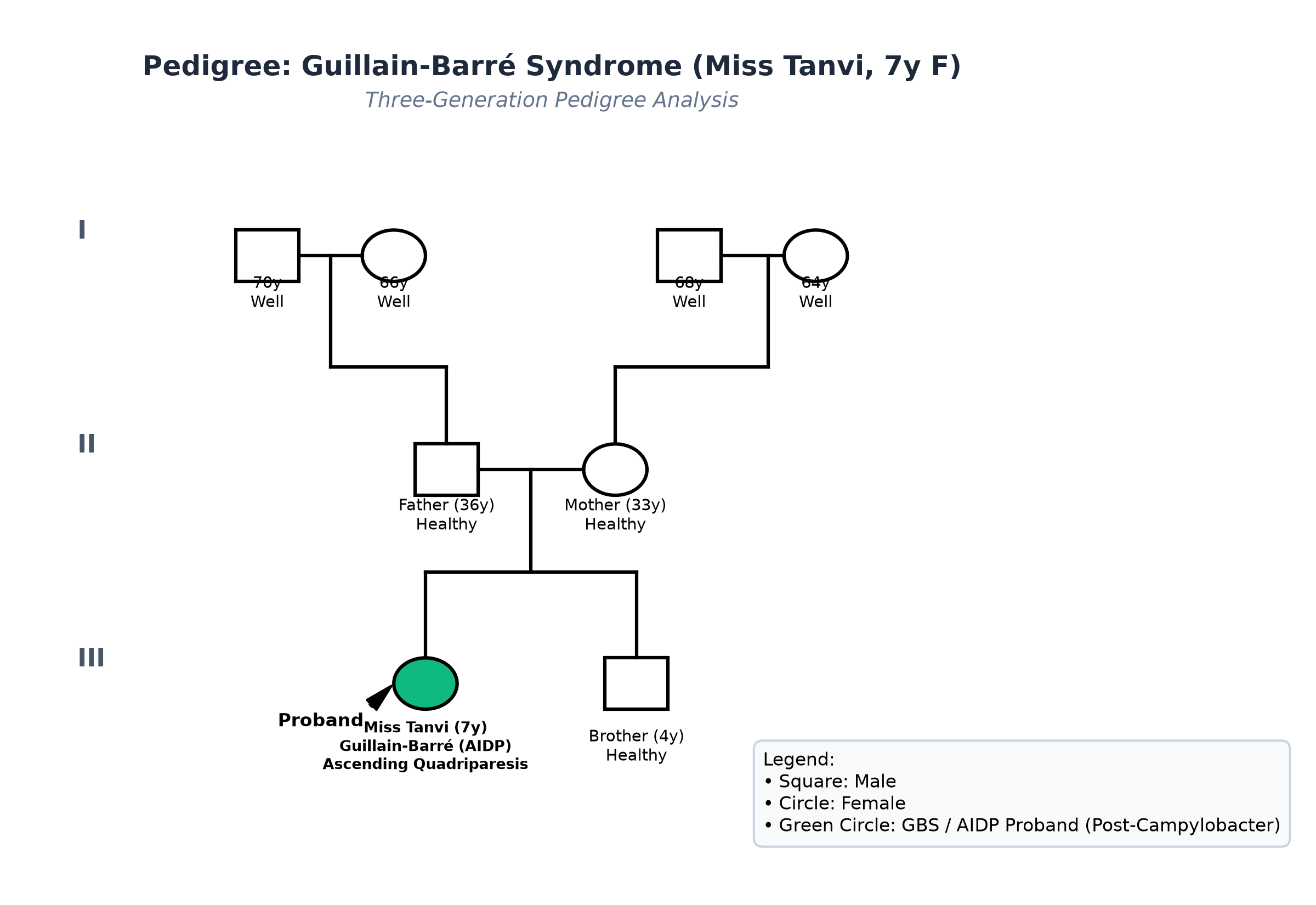
- Non-consanguineous marriage. Parents and younger brother (4 years old) are completely healthy. No family history of neuropathy, neuromuscular disorders, or autoimmune diseases.
Immunization History
- Fully immunized up to age according to the National Immunization Schedule, including MMR and DTP boosters.
Detailed Dietary History & 24-Hour Recall
Due to acute illness and back pain, oral intake has been somewhat reduced over the past 2 days:
| Food Item | Quantity | Calories (kcal) | Protein (g) |
|---|---|---|---|
| Cow's Milk (boiled) | 400 mL | 260 | 13.0 |
| Soft Khichdi (rice + moong dal) | 1.5 bowls | 240 | 7.5 |
| Idli with Sambar | 2 pieces | 160 | 4.5 |
| Apple Puree / Fruit Juice | 1 cup | 80 | 0.5 |
| Curd / Yogurt | 1 small cup | 70 | 3.5 |
| Total Observed Daily Intake | — | 810 kcal | 29.0 g |
24-Hour Recall Deficit Analysis (ICMR-NIN 2024 Standards)
$$ \text{Ideal Body Weight (IBW for 7 years, 50th centile WHO)} = 23.0\text{ kg} $$| Nutrient | Expected Intake (ICMR-NIN 2024 for IBW 23 kg) | Observed Intake | Deficit | Percentage Deficit |
|---|---|---|---|---|
| Energy (kcal) | $23.0\text{ kg} \times 60\text{ kcal/kg} = 1380\text{ kcal}$ | 810 kcal | 570 kcal | 41.3% Deficit |
| Protein (g) | $23.0\text{ kg} \times 1.0\text{ g/kg} = 23.0\text{ g}$ | 29.0 g | Nil (Adequate) | 0% Deficit |
The expected calories and proteins should be calculated from the ideal body weight, not from current weight.
Socioeconomic & KAP
- Modified BG Prasad Socioeconomic Class II. Parents are extremely frightened by the sudden paralysis and are fully cooperative with PICU admission and IVIG administration.
Summary of History
Miss Tanvi, a 7-year-old female child, presents with acute symmetrical, ascending flaccid quadriparesis developing over 4 days following an antecedent diarrheal illness 2 weeks prior, with severe neuropathic radicular back pain, generalized areflexia, early diaphragmatic fatigue, and autonomic instability, with intact sphincters and absence of a sensory level.
I would like to formulate a provisional clinical diagnosis of: Acute Flaccid Paralysis (Lower Motor Neuron Quadriparesis), clinically most consistent with Guillain-Barré Syndrome (Acute Inflammatory Demyelinating Polyradiculoneuropathy - AIDP), complicated by Autonomic Instability and Impending Respiratory Muscle Compromise.
General Physical & Vital Signs (PICU Triage)
- General Appearance: Lying supine in bed, conscious, alert, anxious; voice is weak and soft; breathes quietly at rest but exhibits mild abdominal paradox upon deep inspiration; no pallor, icterus, cyanosis, or peripheral edema.
- Vitals & Autonomic Monitoring:
- Heart Rate: 128 beats/minute (Sinus Tachycardia; fluctuates between 110 and 140/min).
- Respiratory Rate: 24 breaths/minute, regular.
- Blood Pressure: $124/82\text{ mmHg}$ ($>95^{\text{th}}\text{ percentile} + 8\text{ mmHg}$ $\to$ Stage 1 Hypertension secondary to sympathetic overactivity; fluctuates down to $90/60\text{ mmHg}$ on sitting).
- Temperature: $36.9^\circ\text{C}$ (Afebrile).
- $\text{SpO}_2$: 98% in room air.
- Anthropometry:
- Weight: 22.5 kg (50th centile WHO).
- Height: 122.0 cm (50th centile WHO).
- BMI: $15.1\text{ kg/m}^2$ (Normal).
Detailed Neurological Examination (The Focal System)
Higher Mental Functions & Speech
- Conscious, oriented to time, place, and person; speech is hypophonic (soft volume due to decreased subglottic expulsive force), but articulation and language comprehension are completely normal.
Cranial Nerves
- Cranial Nerves I to XII examined systematically:
- Pupils $3\text{ mm}$, briskly reactive to light; extraocular movements full; no ptosis.
- Facial symmetry preserved; bilateral eye closure and smile are strong (CN VII spared).
- Gag reflex is brisk and symmetrical; soft palate elevates normally; uvula is central; no tongue deviation or fasciculations (CN IX, X, XII intact).
Motor System Examination
- Inspection & Bulk: Normal muscle bulk bilaterally; no wasting (weakness is too acute for atrophy); no fasciculations.
- Muscle Tone: Marked generalized flaccidity (hypotonia) in all four extremities; flaccid wrist drop and foot drop upon lifting limbs.
- Muscle Power (Medical Research Council - MRC Scale 0 to 5):
| Muscle Group / Joint | Right Side | Left Side | Symmetry |
|---|---|---|---|
| Shoulder Abduction (Deltoid) | $3 / 5$ | $3 / 5$ | Symmetrical |
| Elbow Flexion (Biceps) | $3 / 5$ | $3 / 5$ | Symmetrical |
| Elbow Extension (Triceps) | $3 / 5$ | $3 / 5$ | Symmetrical |
| Wrist Extension / Grip | $3 / 5$ | $3 / 5$ | Symmetrical |
| Hip Flexion (Iliopsoas) | $2 / 5$ | $2 / 5$ | Symmetrical |
| Knee Extension (Quadriceps) | $2 / 5$ | $2 / 5$ | Symmetrical |
| Ankle Dorsiflexion (Tibialis Ant) | $1 / 5$ | $1 / 5$ | Symmetrical |
| Neck Flexors | $3 / 5$ (Significant head lag) | — | Weakness correlates with diaphragmatic risk |
- Motor Pattern: Bilateral, symmetrical, ascending quadriparesis with distal lower limbs ($1/5$) and proximal lower limbs ($2/5$) significantly more paretic than upper limbs ($3/5$).
Deep Tendon Reflexes (DTRs) & Plantar Responses
- Biceps Reflex (C5-C6): 0 / 4 (Absent) bilaterally.
- Triceps Reflex (C7-C8): 0 / 4 (Absent) bilaterally.
- Supinator / Brachioradialis (C5-C6): 0 / 4 (Absent) bilaterally.
- Knee Jerk (L2-L4): 0 / 4 (Absent) bilaterally.
- Ankle Jerk (S1-S2): 0 / 4 (Absent) bilaterally.
- Plantar Response: Bilateral Equivocal / Mute (Absence of extensor Babinski sign confirms lower motor neuron pathology).
- Abdominal Reflexes: Present, symmetrical (superficial reflexes preserved).
Sensory System Examination
- Subjective complaint of tingling and numbness in both toes and feet.
- Light touch, pinprick, and temperature sensations are preserved over all dermatomes; NO discrete sensory level identified on trunk or abdomen.
- Joint position and vibration sense are mildly impaired at the great toes bilaterally.
- Nerve Root Irritation Signs:
- Straight Leg Raising Test (SLRT): Positive bilaterally at $45^\circ$, eliciting severe radicular lower back and sciatic pain (Radiculopathy).
- Kernig's sign: Mild resistance and back pain on knee extension.
Bedside Respiratory Muscle Function Assessment
- Single Breath Count: 14 (Patient can only count from 1 to 14 on a single maximal inspiration; normal is $>30$; count $<15$ indicates critical diaphragmatic weakness!).
- Neck Flexor Strength: Weak ($3/5$, marked head lag; neck flexor weakness is the single best clinical surrogate for phrenic nerve / diaphragmatic weakness).
- Cough Test: Weak, clearing cough with absent expulsive blast.
- Paradoxical Breathing: Mild paradoxical inward movement of the epigastrium during deep inspiration.
Summary
Miss Tanvi, a 7-year-old female child, presents with acute symmetrical ascending flaccid quadriparesis developing over 4 days following an antecedent diarrheal illness, with generalized areflexia (DTRs 0/4), neuropathic radicular pain, early diaphragmatic muscle weakness (Single Breath Count 14), and autonomic dysregulation, without a sensory level or sphincter involvement.
Final Clinical Diagnosis: Guillain-Barré Syndrome (Acute Inflammatory Demyelinating Polyradiculoneuropathy - AIDP), presenting with Ascending Flaccid Quadriparesis, Generalized Areflexia, Impending Respiratory Muscle Paralysis, and Autonomic Dysautonomia, fulfilling Brighton Diagnostic Criteria Level 1.
Differential Diagnosis of Acute Flaccid Paralysis in Children
| Disorder | Points IN FAVOR | Points AGAINST |
|---|---|---|
| Guillain-Barré Syndrome (AIDP) | Symmetrical ascending weakness, generalized areflexia, post-diarrheal, radicular pain, preserved sphincters, cytoalbuminologic dissociation | Primary Diagnosis |
| Acute Transverse Myelitis (ATM) | Acute flaccid weakness, lower limb involvement | ATM has a DISTINCT SENSORY LEVEL on the trunk, early and prominent urinary retention / bladder paralysis, and extensor plantars / hyperreflexia once spinal shock passes |
| Acute Flaccid Myelitis (Enterovirus D68) | Acute lower motor neuron paralysis | Weakness is ASYMMETRICAL, patchy, preceded by acute febrile illness, with CSF pleocytosis (elevated WBCs) and anterior horn cell lesions on spinal MRI |
| Myasthenia Gravis (Juvenile) | Muscle weakness, respiratory compromise | Weakness exhibits marked diurnal fatigability, prominent ptosis, diplopia, and ophthalmoplegia; DTRs are PRESERVED; sensation is completely normal |
| Hypokalemic Periodic Paralysis | Acute flaccid quadriparesis, hyporeflexia | Serum potassium is profoundly low ($<2.5\text{ mEq/L}$); weakness develops over hours, resolves rapidly with potassium; no preceding illness or dysautonomia |
Investigation Protocol & Electrodiagnostic Staging
flowchart TD
    A["Child with Acute Ascending Flaccid Paralysis & Generalized Areflexia"] --> B["IMMEDIATE PICU MONITORING: Single Breath Count, Vital Capacity, Continuous ECG/BP"]
    B --> C["Cerebrospinal Fluid (CSF) Analysis at Day 7: Cytoalbuminologic Dissociation"]
    C --> D["Nerve Conduction Study (NCS): Demyelinating vs Axonal (AIDP vs AMAN)"]
    D --> E{"Single Breath Count <15 OR VC <20 mL/kg OR Autonomic Collapse?"}
    E -->|Yes| F["Elective Endotracheal Intubation & Mechanical Ventilation (PICU)"]
    E -->|No| G["Intensive Monitoring & Spontaneous Breathing Trial"]
    F & G --> H["First-Line Immunotherapy: Intravenous Immunoglobulin (IVIG 2 g/kg over 2 days)"]
    H --> I["Multidisciplinary Rehabilitation: Physical Therapy & Autonomic Support"]
1. Cerebrospinal Fluid (CSF) Analysis (Day 7 of Illness)
| Parameter | Observed Value | Biological Reference Range | Clinical Significance |
|---|---|---|---|
| Opening Pressure | $120\text{ mm }\text{H}_2\text{O}$ | $70-180\text{ mm }\text{H}_2\text{O}$ | Normal intracranial pressure |
| CSF Appearance | Clear, Colorless | Clear, Colorless | Non-turbid |
| CSF Total Protein | $148.0\text{ mg/dL}$ | $15.0-45.0\text{ mg/dL}$ | Markedly Elevated Protein |
| CSF Total Cell Count | $2\text{ cells}/\mu\text{L}$ (All lymphocytes) | $<5\text{ cells}/\mu\text{L}$ | Normal Cell Count (Zero Pleocytosis) |
| Cytoalbuminologic Dissociation | DEFINITIVE PRESENT | Absent | Pathognomonic for GBS (Protein high, Cells normal) |
| CSF Glucose | $62\text{ mg/dL}$ (Blood glucose: 94) | $50-80\text{ mg/dL}$ | Normal CSF:Blood glucose ratio ($0.66$) |
| Gram Stain / Culture | Negative / Sterile | Negative | Excludes bacterial / fungal infection |
2. Electrodiagnostic Studies (Nerve Conduction Study - NCS)
- Motor Nerve Conduction:
- Peroneal & Tibial Nerves: Marked prolongation of distal motor latencies ($>150\%$ of upper limit of normal); severe reduction in motor conduction velocities ($24\text{ m/s}$, normal $>44\text{ m/s}$); presence of motor conduction blocks ($>50\%$ drop in CMAP amplitude between proximal and distal stimulation).
- Median & Ulnar Nerves: Prolonged distal motor latencies, slowed conduction velocities, temporal dispersion.
- F-Wave Studies:
- Absent F-waves in bilateral tibial and peroneal nerves, and markedly prolonged F-wave latencies in median nerves (reflects early demyelination of proximal spinal nerve roots).
- Sensory Nerve Conduction: Mild prolongation of distal sensory latencies with preserved sensory amplitudes.
- Electrodiagnostic Conclusion: Acute Inflammatory Demyelinating Polyradiculoneuropathy (AIDP).
3. Infectious Serology
- Stool PCR / Serology: Positive for Anti-GM1 Ganglioside Antibodies and stool culture confirming resolving Campylobacter jejuni infection.
Comprehensive Multidisciplinary Management Plan
1. PICU Admission & Respiratory Failure Protocol
- Strict Monitoring Schedule:
- Single Breath Count, Vital Capacity, and neck flexor strength measured every 2 to 4 hours.
- Continuous ECG and non-invasive blood pressure monitoring to track autonomic lability.
- Elective Intubation Triggers ('The 20/30/40 Rule'):
- Vital capacity falling to $<20\text{ mL/kg}$ or Single Breath Count $<12-15$.
- Rapidly progressive ascending weakness with bilateral bulbar palsy (loss of gag reflex, aspiration risk).
- Hypoxemia ($ ext{SpO}_2 <92\%$) or hypercapnia ($ ext{PaCO}_2 >48-50\text{ mmHg}$).
- Elective, controlled intubation in PICU is far safer than emergent crash intubation during acute respiratory arrest!
2. First-Line Immunotherapy: Intravenous Immunoglobulin (IVIG)
- Regimen: Intravenous Immunoglobulin (IVIG) at a total cumulative dose of $2.0\text{ g/kg}$:
- Administered as $1.0\text{ g/kg/day}$ infused over 2 consecutive days ($22.5\text{ g/day}$ over 12-16 hours daily).
- Pre-medication: IV Chlorpheniramine and oral Paracetamol 30 minutes prior to infusion.
- Infusion rate: Started slowly at $0.5\text{ mL/kg/hr}$ for the first 30 minutes, gradually doubled every 30 minutes up to a maximum of $4.0\text{ mL/kg/hr}$ while monitoring vitals.
- Corticosteroid Warning: CORTICOSTEROIDS ARE STRICTLY WITHHELD as they offer zero benefit and delay axonal regeneration.
3. Autonomic Instability & Supportive Care
- Hemodynamic Support:
- Severe episodic hypertension: Managed with short-acting, easily titratable intravenous agents (e.g., IV Labetalol or Esmolol); avoid long-acting antihypertensives because rebound hypotension is common.
- Severe bradycardia: Keep bedside IV Atropine ($0.02\text{ mg/kg}$) immediately available for vagal bradycardic arrests triggered by endotracheal suctioning.
- Neuropathic Pain Management:
- Oral Gabapentin ($15\text{ mg/kg/day}$ divided TID) or Pregabalin for radicular back and leg pain.
- Physical Therapy & DVT Prophylaxis:
- Daily gentle passive range of motion exercises of all joints to prevent contractures.
- Frequent turning every 2 hours with air mattress to prevent pressure decubitus ulcers.
- Intermittent pneumatic compression stockings for lower limbs.