
Master Karthik, a 5-year-old boy, 2nd order child of non-consanguineous marriage from Madurai, Tamil Nadu presented with complaints of difficulty in getting up from the sitting position on the floor, frequent tripping and falling while walking, and abnormal enlargement of both calf muscles noticed over the past 1.5 years.
- Difficulty getting up from squatting or sitting on the floor (Gowers' sign)
- Frequent falls, clumsy gait, and inability to run fast
- Progressive waddling gait and toe-walking
- Symmetrical enlargement (pseudohypertrophy) of calf muscles
HOPI
- Onset & Early Motor Milestones:
- The child achieved independent walking slightly late at 17 months of age; parents noticed that the child walked with an unsteady, clumsy gait and tended to walk on his toes.
- Up to 3.5 years of age, the child was able to run slowly and climb stairs by holding onto the handrail placing two feet on each step.
- Progressive Proximal Weakness (Pelvic Girdle):
- Around 3.5 years of age, parents noticed that the child had increasing difficulty in standing up from the floor after playing.
- To stand up, the child first turns prone, pushes against the floor to get onto his hands and feet, and then places his hands sequentially on his knees and thighs to push his trunk upright (Gowers' maneuver).
- Over the last 1 year, the child experiences frequent unprovoked falls (2–3 times a week) while walking on flat surfaces and has completely stopped running.
- Climbing stairs now requires firm support from the railing with significant parental assistance.
- Gait Abnormalities:
- The mother observed that the child walks with a broad base, swaying from side to side ("like a duck" — waddling gait).
- He walks with his belly pushed forward and lower back curved inward (exaggerated lumbar lordosis).
- Calf Muscle Enlargement:
- Parents noticed that both calf muscles appeared bulky and swollen for the past 1.5 years.
- Despite appearing muscular, the legs are progressively weaker, and the calves feel abnormally firm, doughy, and rubbery on palpation.
- Upper Limb Involvement:
- Over the past 6 months, the mother noticed mild difficulty when the child attempts to raise his arms above his shoulders to put on a T-shirt or reach for overhead toys.
- Fine motor hand movements (writing, holding a spoon, buttoning shirts) are completely preserved.
Pertinent Negatives in HOPI:
- No history of drooping of eyelids, double vision, or squint (rules out Myasthenia Gravis and Oculopharyngeal Dystrophy).
- No history of difficulty in swallowing, nasal regurgitation, or hoarseness of voice (rules out bulbar palsies and Spinal Muscular Atrophy).
- No history of dark tea-colored urine or severe muscle cramps following exercise (rules out McArdle disease and rhabdomyolysis).
- No history of sensory loss, tingling, numbness, or loss of bowel and bladder control (rules out compressive myelopathy and Guillain-Barré syndrome).
- No history of muscle pain, joint swelling, skin rash, or purple discoloration around eyelids (rules out Juvenile Dermatomyositis).
- No history of seizures, sudden loss of consciousness, or cognitive regression (rules out neurodegenerative storage disorders).
- No history of breathlessness, nocturnal orthopnea, or pedal edema (rules out overt congestive cardiac failure).
Past History
- No history of neonatal intensive care stay, prolonged neonatal jaundice, or neonatal hypotonia.
- No history of prior fractures, hospitalizations, or surgical procedures.
- No history of chronic drug intake (steroids, antiepileptics) or known drug allergies.
Family history
- 2nd-order male child born to non-consanguineously married parents.
- Maternal Family History:
- Maternal uncle developed progressive weakness in early childhood, became wheelchair-bound by 10 years of age, and passed away at 16 years of age due to respiratory complications (clinically consistent with DMD).
- Mother (30 years old) is asymptomatic but has a family history consistent with an X-Linked Recessive transmission pattern.
- Elder sister (8 years old) is healthy, thriving, and asymptomatic.
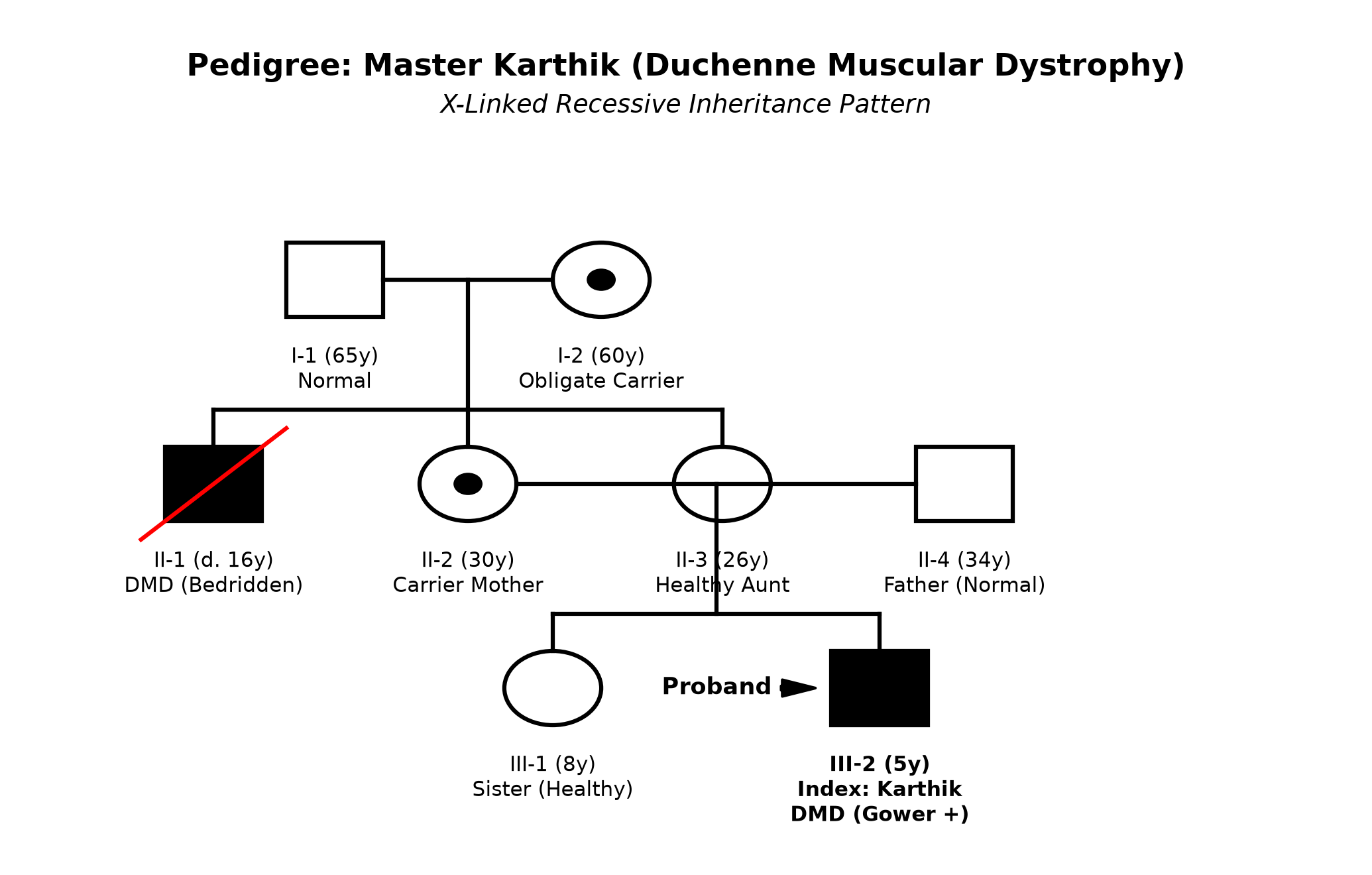
Immunization history
- Completely immunized for age according to the National Immunization Schedule (BCG, OPV, Pentavalent 1-3, fIPV, Rota, MR 1-2, DPT Booster).
- BCG scar is present over the left deltoid.
- Annual Influenza vaccine and Pneumococcal conjugate vaccines (PCV) were initiated on pediatrician's recommendation.
Dietary history
- Mixed diet from the family pot; feeds independently without swallowing difficulty.
| Food Item | Quantity | Calories (kcal) | Protein (g) |
|---|---|---|---|
| Boiled Rice with Sambar & Ghee | 1 medium plate (~150 g) | 260 | 4.5 |
| Idli with Chutney | 2 pieces (~80 g) | 130 | 3.5 |
| Boiled Egg (Whole) | 1 egg (~50 g) | 75 | 6.0 |
| Cow's Milk (Full cream) | 350 mL | 240 | 11.0 |
| Banana | 1 medium | 105 | 1.0 |
| Total Daily Intake | 810 | 26.0 |
| 24-Hour Recall | Expected (for Ideal Body Weight ~18 kg) | Observed | Deficit / Surplus |
|---|---|---|---|
| Calories | 1600 kcal (~90 kcal/kg) | 810 kcal | 790 kcal (49.4% deficit) |
| Protein | 18.0 g (1.0 g/kg) | 26.0 g | +8.0 g (Adequate) |
The expected calories and proteins should be calculated from the ideal body weight, not from current weight.
Socioeconomic and KAP
- Family resides in a pucca house with piped municipal water and sanitary latrine in Madurai.
- Father is a school teacher; Mother is a homemaker.
- Socioeconomic Status: Upper-middle class (Modified Kuppuswamy Score: 18).
- Parents are aware of the genetic basis from the maternal uncle's illness and are keen on definitive genetic diagnosis and multidisciplinary rehabilitation.
Summary of History
"Master Karthik, a 5-year-old male child, 2nd-order offspring of a non-consanguineous marriage from Madurai, with a positive maternal family history of an X-linked neuromuscular disorder, presented with insidious onset, slowly progressive, symmetrical proximal muscle weakness starting around 3.5 years of age.
The weakness predominantly involves the pelvic girdle muscles, manifesting as difficulty rising from the floor (Gowers' sign), waddling gait, frequent unprovoked falls, and prominent calf muscle enlargement, with recent mild shoulder girdle involvement, and with strictly preserved ocular, bulbar, sensory, and bladder-bowel functions.
In view of the male sex, age of onset, classical proximal-to-distal progression, calf pseudohypertrophy, and maternal family pedigree, I would like to consider a clinical diagnosis of a Primary Muscle Disease (Progressive Muscular Dystrophy), most probably Duchenne Muscular Dystrophy (DMD), currently in the Ambulatory Phase (Vignos Scale Grade 2)."
General head to toe examination
Pre-Examination Child Behavioral State
- Child State: Alert, cooperative, pleasant, fully interactive (Prechtl State 3: quiet wakefulness).
Vitals
- Pulse Rate: 96 bpm, regular, normal volume, peripheral pulses well felt.
- Respiratory Rate: 20/min, regular, abdominothoracic pattern, no respiratory distress.
- Blood Pressure: 98/62 mmHg (50th percentile for age and height).
- Capillary Refill Time: <2 seconds.
Anthropometry
| Parameter | Observed | Expected (50th percentile WHO) | Z-Score / Interpretation |
|---|---|---|---|
| Weight | 17.2 kg | 18.3 kg | Normal (-0.5 SD) |
| Height | 108 cm | 110 cm | Normal (-0.5 SD) |
| Body Mass Index (BMI) | 14.7 kg/m² | 15.3 kg/m² | Normal |
| Arm Span | 107.5 cm | ~108 cm | Symmetrical |
Head-to-Toe Markers
- Posture & Spine:
- Marked exaggerated lumbar lordosis with wide pelvic stance and protuberant abdomen on standing.
- Mild equinus posture at both ankles on stance; no fixed scoliosis.
- Calf Muscle Inspection & Palpation:
- Symmetrical, marked pseudohypertrophy of both calf muscles (Gastrocnemius and Soleus).
- Calf girth (maximum circumference): Right calf = 25.5 cm, Left calf = 25.5 cm (disproportionately bulky for age/height).
- Consistency on palpation: Firm, doughy, rubbery, and non-tender (representing replacement of muscle fibers by adipose and fibrous connective tissue).
- Other Muscle Bulk:
- Hypertrophy: Bilateral Deltoid muscles and Infraspinatus muscles show prominent bulking.
- Atrophy / Wasting: Visible thinning and wasting of Quadriceps femoris, Gluteus maximus, and the sternal head of Pectoralis Major.
- Contractures:
- Mild dynamic tightness of both Achilles tendons (dorsiflexion limited to 0° with knee extended, improving to 10° with knee flexed).
- No fixed contractures at hips, knees, or elbows.
Systemic Examination
CNS Examination
1. Higher Mental Functions & Cranial Nerves
- Consciousness & Cognition: Fully conscious, alert, age-appropriate receptive and expressive language.
- Cranial Nerves (CN I to XII):
- Normal visual acuity, fields, and extraocular movements (CN II, III, IV, VI).
- Facial muscle strength normal; no facial diplegia or ptosis (CN VII).
- Masseter power normal; palate moves symmetrically; gag reflex intact (CN V, IX, X).
- Tongue: Prominent bulk without true fasciculations; normal protrusion in midline (CN XII).
2. Motor System (Granular Power Charting)
| Muscle Group & Joint Movement | Right Upper Limb | Left Upper Limb | Right Lower Limb | Left Lower Limb |
|---|---|---|---|---|
| Shoulder Abduction (Deltoid) | 3+/5 | 3+/5 | - | - |
| Shoulder Adduction (Pectoralis) | 3/5 (wasted) | 3/5 (wasted) | - | - |
| Elbow Flexion (Biceps) | 4/5 | 4/5 | - | - |
| Elbow Extension (Triceps) | 4+/5 | 4+/5 | - | - |
| Wrist Flexion / Extension | 5/5 | 5/5 | - | - |
| Hand Grip / Intrinsic Hand Muscles | 5/5 (Normal) | 5/5 (Normal) | - | - |
| Hip Flexion (Iliopsoas) | - | - | 2/5 | 2/5 |
| Hip Extension (Gluteus Maximus) | - | - | 2/5 | 2/5 |
| Hip Abduction (Gluteus Medius) | - | - | 3/5 | 3/5 |
| Knee Extension (Quadriceps) | - | - | 3/5 | 3/5 |
| Knee Flexion (Hamstrings) | - | - | 4/5 | 4/5 |
| Ankle Dorsiflexion (Tibialis Anterior) | - | - | 4/5 | 4/5 |
| Ankle Plantarflexion (Gastrocnemius) | - | - | 5/5 (Preserved) | 5/5 (Preserved) |
3. Pathognomonic Clinical Signs Elicited
- Gowers' Sign (Classic "Climbing Up Oneself"): When placed supine on the floor and asked to stand, the child turns prone, rises on hands and feet into a quadrupedal position, extends the knees, and walks his hands back toward his feet and up along the shins, knees, and thighs to extend the hips into an upright position.
- Waddling Gait: Prominent lateral pelvic sway and trunk tilting during the stance phase of each leg (bilateral Trendelenburg sign).
- Valley Sign: Well-defined depression visible between the hypertrophied anterior axillary fold and the posterior deltoid-infraspinatus mass on arm abduction.
- Axillary Slipping: On attempting to lift the child vertically by the axillae, the child tends to slip through the examiner's hands due to severe shoulder girdle (serratus anterior/pectoralis) weakness.
4. Reflexes & Sensory System
- Deep Tendon Reflexes (DTRs):
- Biceps Jerk: Diminished (1+).
- Triceps & Supinator Jerks: Normal (2+).
- Knee Jerk: Absent (0) bilaterally (due to severe quadriceps weakness and fat replacement).
- Ankle Jerk: Brisk and easily elicitable (2+) bilaterally (characteristically preserved due to sparing of gastrocnemius-soleus contractility until late disease).
- Superficial Reflexes: Abdominal reflexes present bilaterally; Plantar response is flexor (down-going) bilaterally.
- Sensory System: Pain, light touch, temperature, joint position, and vibration senses are intact in all extremities.
- Cerebellar System: No dysmetria, intention tremor, dysdiadochokinesia, or nystagmus.
other systems
- Cardiovascular System: Heart rate 96 bpm, regular; S1, S2 heard normally; no S3 gallop or murmurs.
- Respiratory System: Bilateral symmetrical chest expansion; clear vesicular breath sounds; no paradoxical breathing or crackles.
- Abdomen: Soft, protuberant due to lumbar lordosis; no hepatosplenomegaly; no masses.
Summary
"Master Karthik, a 5-year-old male child, with a maternal family history of premature death in a wheelchair-bound maternal uncle, presented with insidious onset, slowly progressive, symmetrical proximal muscle weakness since 3.5 years of age.
Physical examination reveals exaggerated lumbar lordosis, waddling gait, positive Gowers' sign, 'valley sign', and bilateral symmetric pseudohypertrophy of the calf muscles (firm and rubbery). Neurological examination confirms a pure proximal-to-distal lower motor neuron-type weakness (lower limbs > upper limbs, power 2–3/5 proximally with preserved 5/5 distal hand grip and ankle plantarflexion), with characteristic absence of knee jerks but preserved ankle jerks, normal sensory modalities, normal cranial nerves, and no pyramidal tract signs.
Final Diagnosis: I formulate my diagnosis as a case of Primary Muscle Disease (Progressive Muscular Dystrophy), clinically consistent with Duchenne Muscular Dystrophy (DMD), currently in the Ambulatory Stage (Vignos Scale Grade 2), with Early dynamic Achilles tendon tightness, with Normal nutritional status, and No clinical evidence of cardiomyopathy or respiratory insufficiency."
Differential Diagnosis
| Disease Entity | Points in Favor in this Case | Points Against / Differentiating Features |
|---|---|---|
| Duchenne Muscular Dystrophy (DMD) | Male sex, onset 3–5 years, pelvic > shoulder proximal weakness, calf pseudohypertrophy, positive Gowers' sign, positive family pedigree, absent knee jerks with preserved ankle jerks. | Requires confirmatory genetic testing (MLPA for dystrophin gene deletion/duplication). |
| Becker Muscular Dystrophy (BMD) | Male child, X-linked inheritance, proximal weakness, calf pseudohypertrophy, elevated CK. | Onset is later (usually >7–12 years); milder disease course; patients remain ambulant beyond 16 years of age (often into adulthood). |
| Spinal Muscular Atrophy Type 3 (Kugelberg-Welander) | Proximal lower limb weakness, difficulty rising from floor, waddling gait, preserved sensation. | Muscle fasciculations (especially tongue/hands) are present; deep tendon reflexes are globally absent including ankle jerks; no pseudohypertrophy; EMG shows neurogenic rather than myopathic pattern. |
| Limb-Girdle Muscular Dystrophy (LGMD) | Symmetrical proximal pelvic and shoulder girdle weakness, Gowers' sign. | Autosomal recessive/dominant inheritance (affects males and females equally); calf pseudohypertrophy is uncommon (except in sarcoglycanopathies); serum CK elevations are generally lower. |
| Juvenile Dermatomyositis (JDM) / Polymyositis | Proximal muscle weakness, difficulty climbing stairs and rising from floor. | Features prominent muscle tenderness, pain, systemic constitutional signs, and pathognomonic cutaneous signs (heliotrope rash, Gottron's papules, calcinosis cutis). |
| Glycogen Storage Disease Type 2 (Late-onset Pompe Disease) | Proximal muscle weakness, pelvic girdle predilection, waddling gait. | Characterized by early and severe diaphragmatic/respiratory failure disproportionate to limb weakness; acid alpha-glucosidase (GAA) enzyme deficiency on dried blood spot. |
Investigation Protocol & Diagnostic Workup
flowchart TD
    A["Suspected Duchenne Muscular Dystrophy"] --> B["1. Serum Creatine Kinase (CK / CPK)"]
    B --> C["Serum CK Markedly Elevated (>10,000–30,000 IU/L)"]
    C --> D["2. Confirmatory Genetic Testing: MLPA for DMD Gene Deletions/Duplications"]
    D -->|Deletion / Duplication Detected (65-70%)| E["Definitive Genetic Diagnosis Confirmed"]
    D -->|Negative MLPA (30-35%)| F["3. Next Generation Sequencing (NGS) of DMD Gene (Point mutations/Stop codons)"]
    F -->|Mutation Found| E
    F -->|Negative NGS| G["4. Muscle Biopsy with Dystrophin Immunohistochemistry & Western Blot"]
    E --> H["5. Baseline Multidisciplinary Workup: 2D Echo, ECG, Spirometry, Bone Mineral Density"]
1. Biochemical Enzymes
- Serum Creatine Kinase (CK / CPK):
- Markedly elevated (typically 10,000 to 30,000+ IU/L, >50–100 times the upper limit of normal) in early stages of DMD.
- A normal or mildly elevated CK completely rules out DMD.
- Serum Transaminases (SGOT/AST, SGPT/ALT) & LDH:
- Concomitantly elevated (derived from damaged muscle tissue, not liver disease; essential to avoid misdiagnosing hepatitis).
2. Confirmatory Genetic Testing (First-Line Diagnostic Standard)
- Multiplex Ligation-dependent Probe Amplification (MLPA):
- Detects large exonic deletions (60–65%) and duplications (5–10%) across all 79 exons of the DMD gene on chromosome Xp21.2.
- Determines the reading frame rule: out-of-frame mutations cause premature truncation and zero dystrophin (DMD), while in-frame mutations produce shortened, partially functional dystrophin (BMD).
- Next Generation Sequencing (NGS) / Whole DMD Gene Sequencing:
- Indicated if MLPA is negative; detects nonsense (stop codon), frameshift, splice-site, and missense point mutations (25–30%).
3. Muscle Biopsy (Indicated ONLY if Genetic Testing is Inconclusive)
- Histopathology (H&E, Modified Gomori Trichrome): Marked variation in fiber size, muscle fiber necrosis, degeneration/regeneration, and massive endomysial and perimysial fibrofatty replacement.
- Dystrophin Immunohistochemistry & Western Blot: Complete absence (<3% of normal) of dystrophin staining on the sarcolemmal membrane.
4. Baseline Cardiopulmonary & Organ Monitoring
- Echocardiography & 12-Lead ECG: Baseline 2D Echo for left ventricular ejection fraction and myocardial strain; ECG may show tall R waves in V1-V2 and deep narrow Q waves in lateral leads (posterobasal LV fibrosis).
- Pulmonary Function Tests (PFTs / Spirometry): Forced Vital Capacity (FVC) baseline monitoring for restrictive lung disease.
- DEXA Scan & Spine Radiographs: Baseline Bone Mineral Density and screening for scoliosis prior to initiating chronic steroid therapy.
Management Plan
flowchart LR
    A["Comprehensive DMD Care"] --> B["1. Pharmacotherapy (Corticosteroids)"]
    A --> C["2. Gene-Targeted Therapies"]
    A --> D["3. Cardiopulmonary & Bone Care"]
    A --> E["4. Physical Therapy & Orthotics"]
1. Corticosteroid Pharmacotherapy (Gold Standard Disease-Modifying Therapy)
- Initiation: Recommended in the ambulatory phase once motor skills plateau or decline (typically between 4 to 6 years of age).
- Drug Regimens & Dosages:
- Option A (Deflazacort): $0.9\text{ mg/kg/day}$ orally once daily in the morning (associated with less weight gain and delayed loss of ambulation compared to prednisone, but slightly higher risk of asymptomatic cataracts).
- Option B (Prednisolone / Prednisone): $0.75\text{ mg/kg/day}$ orally once daily in the morning (Max: $35\text{–}40\text{ mg/day}$).
- Proven Clinical Benefits: Prolongs independent ambulation by 2–4 years, preserves upper limb and respiratory function, delays the onset and progression of scoliosis, and delays cardiomyopathy onset.
- Monitoring for Steroid Toxicity:
- Monitor weight, BMI, blood pressure, fasting blood glucose every 3 months.
- Annual ophthalmological examination (screen for posterior subcapsular cataracts).
- Calcium ($500\text{–}1000\text{ mg/day}$) and Vitamin D3 ($1000\text{–}2000\text{ IU/day}$) supplementation to prevent steroid-induced osteoporosis; annual DEXA scan.
2. Mutation-Specific Genetic & Molecular Therapies
- Exon-Skipping Antisense Oligonucleotides (ASOs) (for confirmed amenable deletions):
- Eteplirsen (Exondys 51): Weekly IV infusion for patients amenable to exon 51 skipping (~13% of all DMD patients).
- Golodirsen / Viltolarsen: For patients amenable to exon 53 skipping (~8%).
- Casimersen: For patients amenable to exon 45 skipping (~8%).
- Stop-Codon Readthrough Therapy:
- Ataluren (Translarna): For patients with confirmed nonsense point mutations (~13%).
3. Cardiac & Pulmonary Management
- Cardiomyopathy Prophylaxis:
- Routine annual 2D Echocardiography starting at diagnosis or $\ge 10$ years of age.
- Prophylactic Angiotensin-Converting Enzyme (ACE) Inhibitors (e.g., Enalapril $2.5\text{–}5\text{ mg/day}$) or Angiotensin Receptor Blockers (ARBs) initiated early (by 10 years of age or at first sign of subclinical LV strain) $\pm$ Beta-blockers.
- Respiratory Care & Infection Prevention:
- Annual influenza and 5-yearly pneumococcal conjugate vaccines.
- Serial upright and supine FVC measurements; initiate Nocturnal Non-Invasive Positive Pressure Ventilation (NIV / BiPAP) when nocturnal hypoventilation or FVC $<50\%$ develops.
4. Physical Therapy, Orthotics & Orthopedic Care
- Daily Physical Therapy: Gentle passive stretching exercises of heel cords (Achilles tendon), iliotibial bands, and hamstrings (20–30 minutes daily) to prevent fixed contractures. Avoid strenuous eccentric resistance training which accelerates muscle fiber breakdown.
- Orthotics: Night splints (Ankle-Foot Orthoses / AFOs) to prevent equinus contractures and maintain ankle flexibility.
- Spine Monitoring: Monitor for thoracolumbar scoliosis; prompt posterior spinal fusion surgery if progressive curve $>20\text{–}30^\circ$ develops in non-ambulatory children.
5. Psychosocial Support & Genetic Counselling
- Genetic Counselling: Carrier testing for mother and female siblings; prenatal diagnosis via chorionic villus sampling (CVS) in future pregnancies.
- School Accommodations: Wheelchair ramps, adaptive seating, and educational support for associated cognitive/ADHD difficulties.