
Master Bikash, a 6-month-old male infant, 3rd order child born to a 38-year-old mother from Siliguri, West Bengal, presented with complaints of inability to hold his neck, generalized floppiness and poor muscle tone since birth, slow feeding, recurrent episodes of cough and cold, and rapid breathing with excessive sweating over the forehead during breastfeeding for the past 2 months.
- Severe generalized floppiness (hypotonia) and joint laxity noted since the neonatal period
- Delayed developmental milestones (delayed neck holding, rolling over, social smile)
- Feeding difficulties (slow suckling, tongue protrusion, choking episodes)
- Recurrent lower respiratory tract infections (pneumonia, wheezing)
- Symptoms of Congestive Cardiac Failure secondary to Congenital Heart Disease (suck-rest-suck cycle, forehead sweating, tachypnea)
- Characteristic craniofacial dysmorphic features recognized by parents or health workers
HOPI
The history is dated back to the newborn period when the mother and grandmother first noticed that the baby felt unusually limp, heavy, and flexible like a "rag doll" when handled or bathed.
Always elicit Maternal Age at Conception (exponentially increases risk of meiotic nondisjunction $>35$ years). Meticulously screen for the Cardinal Complications of Down Syndrome: Congenital Heart Disease (present in 40-50%, most commonly Atrioventricular Septal Defect [AVSD]), congenital gastrointestinal anomalies (duodenal atresia, Hirschsprung disease), thyroid dysfunction (congenital or acquired hypothyroidism), infantile spasms, hematological malignancies (transient myeloproliferative disorder / leukemia), and obstructive sleep apnea.
- Generalized Hypotonia & Developmental Delay:
- Since birth, the baby felt abnormally loose; arms and legs rested flat on the bed in an abducted "frog-leg" position.
- When lifted under the axillae, the baby tended to slip through the mother's hands (slip-through sign) Points to severe axial and appendicular muscular hypotonia.
- At 6 months of age, the infant has not attained neck stability, cannot roll over from prone to supine, and has an inconsistent social smile Global developmental delay.
- Feeding Difficulties & Cardiac Failure Symptoms:
- Sucking was weak and disjointed from birth; tongue persistently thrust forward out of the mouth.
- Over the past 2 months, mother noted that during breastfeeding, the baby sucked for only 1 to 2 minutes, stopped to catch his breath, panting heavily, and broke into profuse sweat over the forehead and temple (suck-rest-suck cycle) Classic triad of pediatric Congestive Cardiac Failure (CCF) with diaphoresis driven by hyper-sympathetic tone.
- Feeds became interrupted and prolonged, lasting $>45$ minutes without satiety.
- Recurrent Respiratory Infections:
- Suffered two episodes of severe cough, fast breathing, and chest indrawing at 3 and 5 months of age, requiring hospital admissions and nebulized bronchodilators Reflects pulmonary overcirculation / pulmonary plethora secondary to a large left-to-right intracardiac shunt.
- Negative History:
- No history of persistent non-bilious or bilious vomiting Rules out duodenal atresia or annular pancreas.
- No history of delayed passage of meconium ($>48$ hours) or obstinate constipation Rules out Hirschsprung disease (increased prevalence in Down syndrome).
- No history of sudden, repetitive flexor spasms of neck and trunk occurring in clusters (infantile spasms / West syndrome) Rules out epileptic spasms.
- No history of easy bruising, petechiae, or pallor Rules out Transient Myeloproliferative Disorder (TMD) or acute leukemia (ALL / AMkL).
- No history of loud snoring, choking, or gasping episodes during sleep Rules out severe obstructive sleep apnea (OSA).
Past History
- Full-term male delivered by elective Cesarean section for cephalopelvic disproportion; birth weight 2.7 kg.
- Cried immediately; mild neonatal jaundice on Day 3 treated with phototherapy for 24 hours.
- No history of antenatal screening (triple or quadruple marker test or anomaly scan was not performed).
Family history
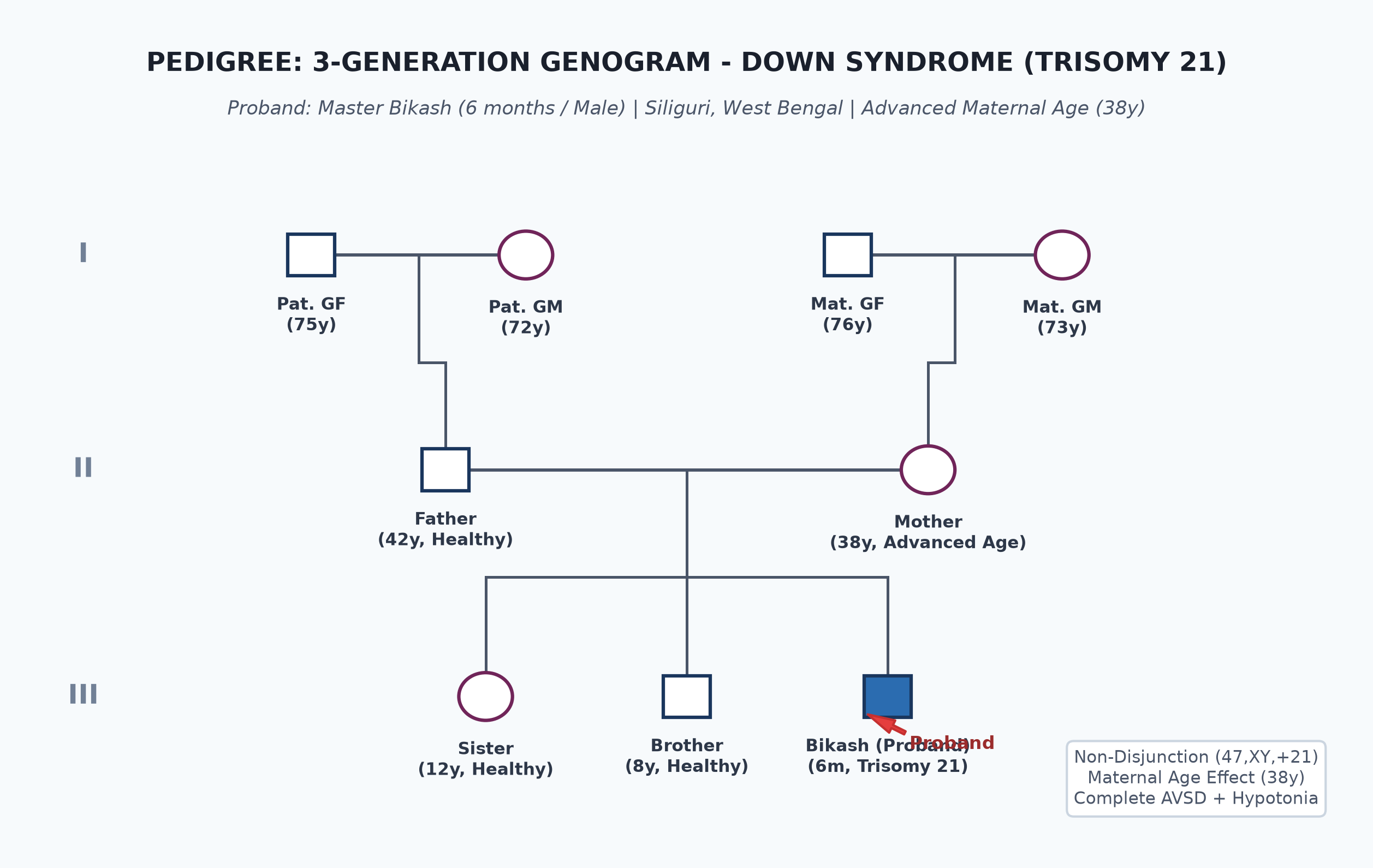
- Born of a non-consanguineous Hindu marriage.
- Maternal Age at Conception: 38 years; Father's age: 42 years Advanced maternal age is the primary risk factor for meiotic non-disjunction of chromosome 21.
- Siblings:
- Elder sister (12 years old): Completely normal, excellent academic record.
- Elder brother (8 years old): Completely normal.
- No family history of chromosomal anomalies, early abortions, or intellectual disability.
Immunization history
- Received BCG, OPV-0, Hepatitis B-0 at birth.
- Received primary UIP vaccines: Pentavalent (1-3), OPV (1-3), fIPV (1-2), Rotavirus (1-3), and PCV (1-2).
- Scheduled for MR-1 and PCV booster at 9 months.
Dietary history
- Exclusively breastfed; however, due to fatigue and breathlessness, feeds are fragmented.
- Weight gain has plateaued over the past 3 months.
24-Hour Recall Deficit Analysis
$$ \text{Ideal Body Weight (IBW for 6 months, 50th centile WHO)} = 7.9\text{ kg} $$| Nutrient | Expected Intake (ICMR-NIN 2024 for IBW 7.9 kg) | Observed Intake | Deficit | Inference |
|---|---|---|---|---|
| Energy (kcal) | $7.9\text{ kg} \times 82\text{ kcal/kg} = 648\text{ kcal}$ | 420 kcal | 228 kcal (35%) | Cardiac cachexia deficit |
| Protein (g) | $7.9\text{ kg} \times 1.15\text{ g/kg} = 9.1\text{ g}$ | 5.8 g | 3.3 g (36%) | Protein deficit |
Growth failure is multifactorial: hypotonia-related feeding difficulty combined with the hypermetabolic state of congestive heart failure.
Socioeconomic and KAP
- Modified BG Prasad Socioeconomic Class III (Middle Class).
- Parents aware that the child has "special Mongoloid features"; eager for comprehensive rehabilitation and cardiac treatment.
Summary of History
Master Bikash, a 6-month-old male infant born to a 38-year-old mother, presents with generalized hypotonia since birth, severe gross motor developmental delay, feeding fatigue with suck-rest-suck cycle, profuse forehead sweating, recurrent lower respiratory tract infections, and characteristic facial dysmorphism.
I would like to think of Down Syndrome (Trisomy 21), complicated by Acyanotic Congenital Heart Disease (most likely Atrioventricular Septal Defect / AVSD) with a large left-to-right shunt in active Congestive Cardiac Failure (Ross Class III), without cyanosis, acute pulmonary hypertension crisis, or seizures.
General head to toe examination
- Behavioral State: Awake, placid, non-irritable, poor spontaneous motor movements.
- Vitals:
- Heart Rate: 148 beats/minute (Tachycardia; resting $>140\text{ bpm}$ indicates heart failure).
- Respiratory Rate: 54 breaths/minute (Tachypnea; normal for 6m is $<50\text{ bpm}$).
- Blood Pressure: $84/52\text{ mmHg}$ (right arm, normal).
- Temperature: $36.8^\circ\text{C}$ (afebrile).
- Oxygen Saturation ($SpO_2$): $96\%$ on room air.
- Capillary Refill Time: $<2$ seconds.
- Anthropometry:
| Parameter | Observed | Expected (50th WHO) | Down-Specific Centile | Inference |
|---|---|---|---|---|
| Weight | 5.2 kg | 7.9 kg | $10^{\text{th}}\text{ centile}$ (Down chart) | Failure to thrive / Cardiac wasting |
| Length | 61.5 cm | 67.6 cm | $10^{\text{th}}\text{ centile}$ (Down chart) | Stunting (Short Stature) |
| Head Circumference | 39.8 cm | 43.0 cm | $< 3^{\text{rd}}\text{ centile}$ | Microcephaly with Brachycephaly |
- Comprehensive Dysmorphology Evaluation (Hall's Diagnostic Criteria for Down Syndrome):
| Hall's Sign | Observed in Master Bikash | Diagnostic Status |
|---|---|---|
| 1. Flat Facial Profile | Depressed nasal bridge, flat midface, hypoplastic maxilla | Present |
| 2. Slanted Palpebral Fissures | Upslanting palpebral fissures (Mongoloid slant) | Present |
| 3. Epicanthal Folds | Prominent bilateral inner epicanthic skin folds | Present |
| 4. Dysplastic / Low-Set Ears | Small ears ($<3\text{ cm}$), overfolded superior helix | Present |
| 5. Brushfield Spots | Tiny, white, speckled ring of spots in peripheral iris | Present |
| 6. Protruding Tongue | Large relative macroglossia thrusting through open mouth | Present |
| 7. Excess Skin on Nape of Neck | Redundant, loose, folded skin over posterior neck | Present |
| 8. Brachydactyly & Clinodactyly | Short stubby fingers; inward curvature of 5th finger | Present |
| 9. Single Transverse Palmar Crease | Bilateral complete Simian Crease across palms | Present |
| 10. Sandal Gap | Abnormally wide space between 1st and 2nd toes with deep plantar groove | Present |
| 11. Severe Hypotonia & Hyperflexibility | Marked axial/appendicular hypotonia, joint laxity | Present |
Inference: Meets 11 out of 10 Hall's criteria ($>6$ signs confirms Down syndrome with $>99\%$ clinical accuracy).
Systemic Examination
Cardiovascular System (CVS) - Evidence of Congenital Heart Disease
- Inspection & Palpation:
- Precordium hyperactive; active systolic heave palpable over left parasternal area (parasternal heave grade $2+$).
- Apex beat palpable in 5th left intercostal space, $1\text{ cm}$ lateral to midclavicular line, hyperdynamic.
- Systolic thrill palpable at left lower sternal border.
- Auscultation:
- First Heart Sound ($S_1$): Normal.
- Second Heart Sound ($S_2$): Wide, fixed split with an accentuated pulmonary component ($P_2$), indicating pulmonary arterial hypertension.
- Murmurs:
- Grade 3/6 Pansystolic Murmur heard best at the 3rd and 4th left intercostal spaces along the sternal border, radiating across precordium (Ventricular Septal Defect component).
- Grade 2/6 Mid-Diastolic Rumble at the apex (increased mitral/tricuspid flow).
- Suggests Complete Atrioventricular Septal Defect (AVSD / AV Canal Defect).
Abdomen
- Symmetrically full, soft, non-tender.
- Hepatomegaly: Liver palpable $3.5\text{ cm}$ below right costal margin, firm, smooth edge, span $8.0\text{ cm}$ (Confirms Congestive Cardiac Failure).
- Spleen not palpable.
Respiratory System
- Tachypneic (54/min) with mild subcostal and intercostal retractions; bilateral fine basal end-inspiratory crepitations (pulmonary congestion).
Central Nervous System (CNS)
- Alert, placid, socially responsive.
- Tone: Marked generalized hypotonia:
- Head lag on traction: Complete head lag.
- Ventral suspension: Inverted-U posture.
- Scarf sign: Elbow easily crosses contralateral anterior axillary line.
- Heelt-to-ear test: Heels touch ears without resistance.
- Deep Tendon Reflexes: Sluggish ($1+$ bilaterally); plantars flexor.
Summary
Master Bikash, a 6-month-old male infant born to a 38-year-old mother, presents with characteristic dysmorphic facies satisfying 11 Hall's criteria, severe generalized hypotonia, global developmental delay, failure to thrive, and symptoms and signs of active Congestive Cardiac Failure (tachypnea, tachycardia, hepatomegaly 3.5 cm, hyperdynamic precordium, grade 3/6 pansystolic murmur, and wide fixed split $S_2$).
Final Clinical Diagnosis: Down Syndrome (Trisomy 21), complicated by Acyanotic Congenital Heart Disease (Complete Atrioventricular Septal Defect / AVSD) with large left-to-right shunt in active Congestive Cardiac Failure (Modified Ross Class III) and secondary failure to thrive, without Eisenmenger syndrome or infantile spasms.
Differential Diagnosis
| Disorder | Points IN FAVOR | Points AGAINST |
|---|---|---|
| Down Syndrome (Trisomy 21) | Meets 11/10 Hall signs, advanced maternal age, hypotonia, AVSD, simian crease, sandal gap | Primary Diagnosis |
| Congenital Hypothyroidism | Severe hypotonia, delayed milestones, umbilical hernia, protruding tongue | Does not have upslanting eyes, Brushfield spots, simian crease, or sandal gap; Down syndrome has normal thyroid profile at birth (though screen routinely) |
| Zellweger Syndrome (Peroxisomal Disorder) | Severe neonatal hypotonia, flat face, wide fontanelles | Features severe hepatomegaly with liver dysfunction, renal cysts, chondrodysplasia punctata, and early neonatal demise |
| Prader-Willi Syndrome (PWS) | Severe infantile hypotonia, feeding difficulty, failure to thrive | Normal facial profile without mongoloid slant; features hypogenitalism (cryptorchidism, small scrotum) and normal heart |
| Noonan Syndrome | Short stature, cardiac murmur, low-set ears | Features pulmonary valve stenosis (not AVSD), pectus excavatum, webbed neck, and downward slanting palpebral fissures (anti-mongoloid) |
Investigation Protocol & Diagnostic Workup
flowchart TD
    A["Infant with Hypotonia & Dysmorphic Features Meeting Hall's Criteria"] --> B["Stat Transthoracic Echocardiography & ECG"]
    B --> C["Confirm Cardiac Lesion (AVSD / VSD / ASD / PDA)"]
    C --> D["Initiate Medical Heart Failure Therapy (Furosemide + Enalapril)"]
    D --> E["Cytogenetic Karyotype (G-Banded Metaphase): 47,XY,+21 vs Translocation"]
    E --> F["Endocrine Screen: Serum TSH & Free T4 (Rule out Congenital/Subclinical Hypothyroidism)"]
    F --> G["CBC with Peripheral Blood Smear (Screen for TMD & Leukemia)"]
    G --> H["Multidisciplinary Surveillance: Hearing (BERA), Ophthalmology, Atlantoaxial Screening"]
1. Cytogenetic Confirmation (The Gold Standard)
- High-Resolution Peripheral Blood Karyotype (G-Banding):
- Result: 47,XY,+21 in 100% of metaphase spreads examined.
- Confirms Free (Complete) Trisomy 21 due to meiotic nondisjunction (accounts for 95% of cases; recurrence risk $<1\%$, compared to $10-15\%$ for unbalanced Robertsonian translocation).
2. Cardiovascular Imaging
- 12-Lead Electrocardiogram (ECG):
- Extreme Superior / Left Axis Deviation (QRS axis $-60^\circ$ to $-120^\circ$) -> Hallmark ECG clue for AVSD due to postero-inferior displacement of the AV node and bundle of His.
- Biventricular hypertrophy and right atrial enlargement.
- Prolonged PR interval (first-degree AV block).
- Transthoracic Echocardiography:
- Confirms Complete Balanced Atrioventricular Septal Defect (Rastelli Type A): Primum ASD, large inlet VSD, and a common single five-leaflet atrioventricular valve with moderate regurgitation.
- Moderate pulmonary arterial hypertension ($PAH$) with predominantly left-to-right shunt.
3. Screening & Surveillance Biomarkers (AAP Guidelines)
- Complete Blood Count & Peripheral Smear:
- Normal total leukocyte count ($8400/\mu\text{L}$); platelets $280,000/\mu\text{L}$; absence of circulating blast cells or dysplastic megakaryocytes (excludes Transient Myeloproliferative Disorder).
- Thyroid Profile:
- TSH $3.2\text{ mIU/L}$, Free T4 $1.4\text{ ng/dL}$ (currently euthyroid; mandatory annual rescreening required).
- Brainstem Evoked Response Audiometry (BERA): Screen for conductive and sensorineural hearing impairment.
- Ophthalmology Evaluation: Screen for congenital cataracts, strabismus, and severe refractive errors.
Therapeutic Management Protocol
1. Management of Congestive Cardiac Failure
- Loop Diuretic: Oral Furosemide $1.0\text{ to } 2.0\text{ mg/kg/day}$ divided BID ($5\text{ mg}$ BID) plus Spironolactone $1.0\text{ mg/kg/day}$ (potassium-sparing synergy).
- Afterload Reduction: Oral Enalapril $0.1\text{ to } 0.3\text{ mg/kg/day}$ divided BID (titrated cautiously while monitoring blood pressure and renal function).
- Nutritional Support: High-calorie formula / expressed breast milk fortified with medium-chain triglycerides (MCT oil) to deliver $120\text{--}150\text{ kcal/kg/day}$.
- Definitive Cardiac Surgery: Early total surgical correction (two-patch or modified single-patch AVSD repair) recommended by 3 to 6 months of age to prevent irreversible pulmonary vascular obstructive disease (Eisenmenger syndrome develops much earlier in Down syndrome, within 6-12 months).
2. Comprehensive Health Supervision & Surveillance (AAP Guidelines)
- Thyroid Function: Retest TSH and FT4 at 6 months, 12 months, and annually for life (high lifetime risk of autoimmune hypothyroidism).
- Atlantoaxial Instability (AAI):
- Perform cervical spine radiographs (lateral flexion, extension, and neutral views) at 3 to 5 years of age or immediately if neurological symptoms develop (neck pain, gait change, hyperreflexia).
- Growth Monitoring: Plot strictly on Down Syndrome-Specific Growth Charts (CDC / WHO).
- Early Intervention: Enroll in specialized infant stimulation program (physiotherapy for hypotonia, occupational therapy, and speech therapy).