
Master Vivaan, a 6-year-old male child, 2nd order child born of a non-consanguineous marriage to healthy parents from Amritsar, Punjab, presented to the Pediatric Pulmonology & Chronic Respiratory Disease Clinic with chief complaints of chronic, daily, productive moist cough with purulent green sputum for 4 years, recurrent episodes of wheezing and severe lower respiratory tract infections requiring multiple hospital admissions and intravenous antibiotic courses (6 documented hospitalizations for bronchopneumonia), progressive exertional breathlessness with bilateral chest wall deformity and digital clubbing, ravenous appetite ('eats like a wolf') with paradoxically severe failure to thrive and growth arrest, chronic passage of foul-smelling, bulky, pale, greasy stools that float and leave an oily film in the toilet pan (steatorrhea) noticed since infancy, and two previous hospital admissions during hot summer months for acute dehydration with hypokalemic, hypochloremic metabolic alkalosis (Pseudo-Bartter Syndrome), whose quantitative pilocarpine iontophoresis sweat test demonstrated a pathognomonic Sweat Chloride Concentration of $94\text{ mEq/L}$, confirmed on molecular genetic testing to be Homozygous for the $\Delta\text{F508}$ Mutation in the CFTR Gene, with high-resolution chest CT demonstrating Bilateral Cylindrical and Varicose Bronchiectasis with Mucoid Impaction, and sputum cultures growing Mucoid Pseudomonas aeruginosa, diagnosed with Classical Cystic Fibrosis with Severe Exocrine Pancreatic Insufficiency and Chronic Suppurative Lung Disease, successfully initiated on Pancreatic Enzyme Replacement Therapy (PERT - Creon), Inhaled Dornase Alfa (Pulmozyme), $7\%\text{ Hypertonic Saline}$ Nebulization, and planned for CFTR Modulator Therapy (Trikafta).
When examining a child with Cystic Fibrosis, examiners expect a systematic, multisystem clinical approach:
- The Classic Multisystem Triad:
- Pulmonary: Chronic suppurative wet cough, recurrent wheeze, bronchiectasis, digital clubbing, colonization with Staph aureus (early) and Pseudomonas aeruginosa (older).
- Gastrointestinal: Exocrine pancreatic insufficiency (steatorrhea, failure to thrive despite ravenous appetite), meconium ileus at birth ($15-20\%$), Distal Intestinal Obstruction Syndrome (DIOS), and rectal prolapse.
- Metabolic: Recurrent hypokalemic, hypochloremic metabolic alkalosis (Pseudo-Bartter syndrome) due to uncompensated sodium chloride loss in sweat during fever or summer.
- Sweat Chloride Testing Protocol: Quantitative Pilocarpine Iontophoresis (Gibson-Cooke) remains the gold standard. Diagnostic cutoff is $\ge 60\text{ mEq/L}$ (tested on at least $75\text{ mg}$ of collected sweat).
- Pancreatic Enzyme Replacement Therapy (PERT): Dosed as Lipase units ($500-2500\text{ units/kg/meal}$). VIVA TRAP: Doses exceeding $10,000\text{ lipase units/kg/day}$ cause Fibrosing Colonopathy (irreversible colonic strictures)!
- Chronological Order of Inhaled Therapies: (1) Bronchodilator $\to$ (2) Mucolytic (Dornase alfa / 7% Hypertonic saline) $\to$ (3) Airway Clearance / Chest Physiotherapy $\to$ (4) Inhaled Antibiotics (Tobramycin / Colistin).
Chief Complaints
- Chronic daily wet, rattling cough with thick greenish sputum for 4 years.
- Recurrent episodes of chest congestion, wheezing, and fever requiring 6 hospitalizations for pneumonia since 1.5 years of age.
- Inability to gain weight and height despite an abnormally large, voracious appetite for 5 years.
- Passage of bulky, foul-smelling, oily stools that float in the toilet pan since early infancy.
- Progressive widening and rounding of fingernails and toenails (clubbing) for 2 years.
HOPI
Master Vivaan was born at term following an uncomplicated pregnancy. Immediately after birth, he passed meconium at 28 hours of life without signs of bowel obstruction:
- Evolution of Gastrointestinal Symptoms & Steatorrhea:
- Between 2 and 4 months of age, parents noticed that the infant passed 5 to 7 stools daily that were pale, yellowish-white, voluminous, and unusually foul-smelling.
- As complementary feeding started, stools became distinctly greasy, shiny, and difficult to flush, leaving an oily yellowish ring on the toilet pan and staining diapers/underwear (Steatorrhea).
- The child had an insatiable, ravenous appetite: he demanded feeds constantly and ate adult-sized portions ('wolf-like appetite'), yet his weight remained severely stagnant ($<-3\text{ SD}$), crossing down across growth percentiles.
- Experienced an episode of painless, spontaneous Rectal Prolapse at 2.5 years of age during defecation, which was manually reduced by parents.
- History of two hospitalizations during peak summer months (at 18 months and 3 years of age) where the child presented with severe weakness, lethargy, sunken eyes, and vomiting without major diarrhea; blood tests revealed profound hypokalemia, hyponatremia, and metabolic alkalosis, treated with IV saline and potassium (Pseudo-Bartter Syndrome).
- Evolution of Chronic Pulmonary Disease:
- Respiratory symptoms began around 1.5 years of age with persistent nasal congestion, snorting, and a recurrent loose, rattling cough.
- Cough was persistent, worse in the early morning upon waking, and accompanied by the expectoration of thick, tenacious, yellowish-green sputum.
- Over the past 4 years, he suffered from recurrent lower respiratory tract infections every 2-3 months, presenting with high fever, tachypnea, chest retractions, and bilateral wheezing, treated with oral and intravenous antibiotics (Cephalosporins, Amoxicillin-Clavulanate, and Azithromycin).
- Exercise tolerance has progressively declined: the child becomes breathless after walking 50 meters or climbing one flight of stairs, with audible chest rattling.
- Fingernails and toenails became visibly rounded, bulbous, and enlarged over the past 2 years (Digital Clubbing).
- Negative Inquiries:
- No gross hemoptysis, sudden pleuritic chest pain, or respiratory collapse (excludes massive hemoptysis or pneumothorax).
- No polyuria, polydipsia, or unexplained weight loss episodes indicative of Cystic Fibrosis-Related Diabetes (CFRD).
- No jaundice, clay-colored stools, or abdominal distension suggestive of CF-associated focal biliary cirrhosis or portal hypertension.
Past History
- Six previous hospitalizations for severe bronchopneumonia requiring IV antibiotics and supplemental oxygen.
- Two hospitalizations for hypochloremic metabolic alkalosis (Pseudo-Bartter syndrome).
- No history of contact with active pulmonary tuberculosis; Mantoux test was negative ($0\text{ mm}$).
Antenatal, Natal, and Developmental History
- Antenatal: Uneventful; full-term normal vaginal delivery; cried immediately; birth weight $2900\text{ grams}$.
- Neonatal: Passed meconium within 28 hours; no meconium ileus.
- Developmental: Gross motor milestones mildly delayed due to muscle wasting and recurrent infections (walked at 18 months); speech, fine motor, and cognitive development are age-appropriate. Currently enrolled in 1st grade with frequent school absenteeism.
Family History
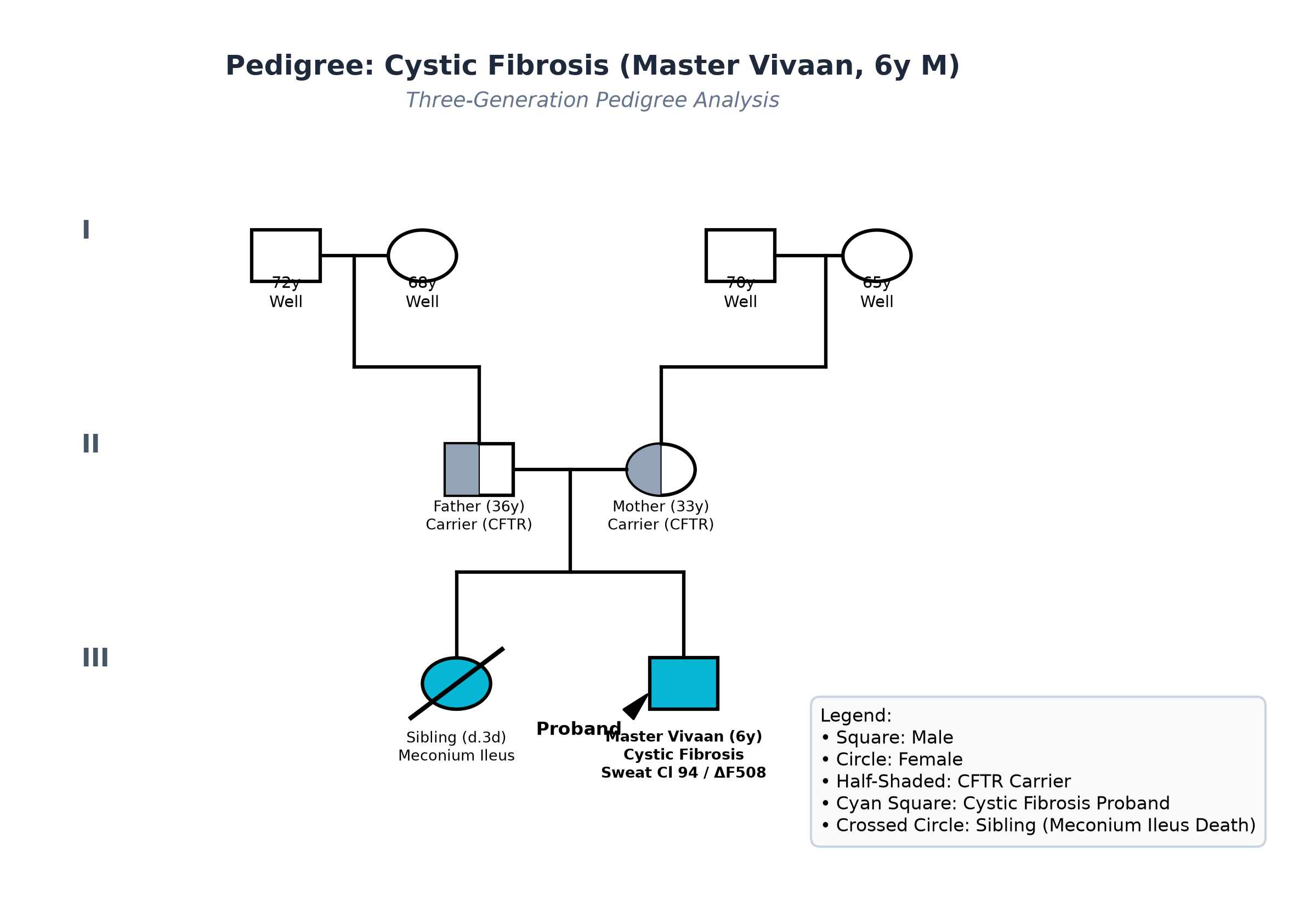
- Non-consanguineous marriage. Father is 36 years old; Mother is 33 years old.
- Prior Neonatal Sibling Death: The first child, a female infant, presented on Day 2 of life with bilious vomiting, abdominal distension, and failure to pass meconium, diagnosed with Meconium Ileus, who died following emergency exploratory laparotomy on Day 4 of life (retrospectively recognized as an affected sibling with Cystic Fibrosis!).
- Both parents are asymptomatic heterozygous carriers.
Immunization History
- Fully immunized up to age according to the National Immunization Schedule.
- Received optional vaccines: Annual Influenza vaccine, Pneumococcal Conjugate Vaccine (PCV13, 3 doses + booster), and Varicella vaccine.
Detailed Dietary History & 24-Hour Recall
The child has an enormous, hyperphagic appetite, consuming large portions of carbohydrate- and fat-rich foods, yet suffers from severe nutrient loss through steatorrhea:
| Food Item | Quantity | Calories (kcal) | Protein (g) | Fat Content |
|---|---|---|---|---|
| Cow's Milk (whole milk) | 500 mL | 330 | 16.5 | $18.0\text{ g}$ |
| Paratha (wheat flour + ghee) | 3 medium | 450 | 9.0 | $21.0\text{ g}$ |
| Boiled Rice | 2 cups | 320 | 6.4 | $1.0\text{ g}$ |
| Dal (Toor dal with extra ghee) | 2 katoris | 240 | 12.0 | $10.0\text{ g}$ |
| Potato & Pea Curry | 1 large bowl | 160 | 4.0 | $8.0\text{ g}$ |
| Banana | 2 medium | 180 | 2.2 | $0.6\text{ g}$ |
| Sweets / Biscuits | 4 pieces | 220 | 3.0 | $10.0\text{ g}$ |
| Total Observed Daily Intake | — | 1900 kcal | 53.1 g | 68.6 g |
24-Hour Recall Deficit Analysis (ICMR-NIN 2024 Standards)
$$ \text{Ideal Body Weight (IBW for 6 years, 50th centile WHO)} = 20.5\text{ kg} $$| Nutrient | Expected Intake (ICMR-NIN 2024 for IBW 20.5 kg) | Observed Intake | Caloric Surplus / Malabsorption |
|---|---|---|---|
| Energy (kcal) | $20.5\text{ kg} \times 65\text{ kcal/kg} = 1332\text{ kcal}$ | 1900 kcal | $+568\text{ kcal}$ (142% of normal RDA) |
| Protein (g) | $20.5\text{ kg} \times 1.0\text{ g/kg} = 20.5\text{ g}$ | 53.1 g | $+32.6\text{ g}$ (Adequate Intake) |
The expected calories and proteins should be calculated from the ideal body weight, not from current weight.
- The Hyperphagia Paradox: CF patients have resting energy expenditures $120-150\%$ of normal due to chronic work of breathing and lung inflammation, combined with a $50-80\%$ loss of ingested fats and proteins in feces due to absent pancreatic lipase and colipase. Unsupplemented, they waste away despite massive oral intake!
Socioeconomic & KAP
- Modified BG Prasad Socioeconomic Class II. Parents are dedicated and have been instructed on the complex daily regimen of inhaled bronchodilators, mucolytics, airway clearance techniques, and mealtime enzyme administration.
Summary of History
Master Vivaan, a 6-year-old male child with a family history of an infant sibling dying of meconium ileus, presents with chronic productive wet cough, recurrent pneumonia, bronchiectasis, and digital clubbing, associated with exocrine pancreatic insufficiency (voracious appetite with foul steatorrhea, rectal prolapse, severe growth arrest) and recurrent episodes of Pseudo-Bartter metabolic alkalosis, without active hemoptysis.
Provisional Clinical Diagnosis: Multisystem Genetic Disorder, clinically diagnostic of Classical Cystic Fibrosis, complicated by Chronic Suppurative Lung Disease with Bilateral Bronchiectasis, Exocrine Pancreatic Insufficiency with Severe Failure to Thrive, Digital Clubbing Grade 3, and Recurrent Pseudo-Bartter Syndrome.
General Physical Examination & Anthropometry
- General Appearance: Thin, frail, chronically ill-appearing boy with spindly limbs, prominent ribs, and barrel-shaped chest; alert, cooperative, coughs frequently expectorating thick greenish mucus; mild pallor; no jaundice or peripheral edema.
- Vitals:
- Heart Rate: 108 beats/minute, regular.
- Respiratory Rate: 28 breaths/minute (Mild tachypnea at rest).
- Blood Pressure: $92/58\text{ mmHg}$ (Normal).
- Temperature: $37.2^\circ\text{C}$ (Low-grade pyrexia).
- $\text{SpO}_2$: 93% in room air, drops to 89% on mild exertion.
- Comprehensive Anthropometry (Plotted on WHO Growth Charts):
| Parameter | Observed | Expected (50th WHO for 6y) | Z-score / Centile | Clinical Inference |
|---|---|---|---|---|
| Weight | 14.2 kg | 20.5 kg | $-3.1\text{ SD}$ ($<3^{\text{rd}}$ centile) | Severe Underweight |
| Height | 104.0 cm | 115.5 cm | $-2.8\text{ SD}$ ($<3^{\text{rd}}$ centile) | Moderate Stunting |
| BMI | $13.1\text{ kg/m}^2$ | $15.3\text{ kg/m}^2$ | $-2.5\text{ SD}$ | Moderate Thinness |
| MUAC | 12.8 cm | $>15.0\text{ cm}$ | Low | Muscle wasting |
Characteristic Stigmata & Clubbing Assessment
- Digital Clubbing (Grade 3 Clubbing):
- Grade 1: Softening and boggy fluctuation of the nail bed.
- Grade 2: Loss of the normal $160^\circ$ Lovibond angle between the nail plate and proximal nail fold (Schamroth's window sign positive: obliteration of diamond-shaped window when dorsal surfaces of terminal phalanges are opposed).
- Grade 3: Marked longitudinal and transverse curvature of the nail plate resembling a Parrot's Beak / Watch-Glass, with bulbous expansion of the distal fingertip (Drumstick Appearance) present in all 10 fingers and toes.
- Upper Airway & Facies:
- Anterior rhinoscopy reveals bilateral, pale, glistening, grape-like Nasal Polyps obstructing both nasal cavities (nasal polyps in a young child are pathognomonic of Cystic Fibrosis!).
- Mouth breathing with dark periorbital allergic shiners.
Detailed Systemic Examination
Respiratory System Examination (The Focal System)
Inspection
- Thoracic Cage: Symmetrical chest, but barrel-shaped with increased anteroposterior diameter; prominence of sternum; mild subcostal and intercostal indrawing at rest.
- Respiratory Rate: 28 breaths/minute, regular, abdominal-thoracic pattern.
- Sputum cup at bedside shows layered, thick, viscous, purulent greenish sputum ($>30\text{ mL/day}$).
Palpation
- Trachea is central; apex beat palpable in 5th left intercostal space at midclavicular line.
- Chest expansion is symmetrical but bilaterally reduced ($2.5\text{ cm}$, normal $>4\text{ cm}$).
- Tactile Vocal Fremitus (TVF): Coarsely increased over bilateral infrascapular and inframammary areas with palpable bronchial rhonchial fremitus.
Percussion
- Generalized hyper-resonant percussion note over anterior chest fields secondary to chronic air trapping and hyperinflation.
- Impaired resonance / patchy dullness over bilateral lower lung bases posteriorly (mucus plugging and consolidation).
Auscultation
- Breath Sounds: Harsh bronchovesicular breath sounds heard over bilateral middle and lower zones.
- Adventitious Sounds:
- Bilateral Coarse, Leathery, Moist Crackles (Crepitations): Audible throughout inspiration and early expiration, especially in the bilateral infrascapular and axillary zones; crackles alter in character and location following a vigorous bout of coughing (pathognomonic of bronchiectasis with mobile secretions!).
- Polyphonic Expiratory Wheezes: Scattered across bilateral lung fields.
- Vocal Resonance: Increased symmetrically over bilateral lower zones.
Abdomen & Gastrointestinal System
- Symmetrically rounded, slightly protuberant; soft, non-tender.
- Liver palpable $1.5\text{ cm}$ below right costal margin, soft, smooth (normal liver span $8.5\text{ cm}$, pushed down by hyperinflated lungs). Spleen not palpable.
- Digital rectal examination: Normal anal tone, no current rectal prolapse, no fecal impaction.
Cardiovascular System
- Precordium quiet; normal S1, S2; pulmonary component of second heart sound (P2) is sharp and loud (Early Pulmonary Arterial Hypertension secondary to chronic hypoxic pulmonary vasoconstriction); no murmur. Peripheral pulses equal.
Summary
Master Vivaan, a 6-year-old male child with an older infant sibling dying of meconium ileus, presents with classical features of Cystic Fibrosis: chronic suppurative lung disease with bilateral bronchiectasis, digital clubbing Grade 3, bilateral nasal polyps, and exocrine pancreatic insufficiency (steatorrhea, ravenous appetite, severe failure to thrive) with recurrent episodes of Pseudo-Bartter syndrome.
Final Clinical Diagnosis: Classical Cystic Fibrosis (Homozygous $\Delta\text{F508}$ CFTR Mutation), complicated by Severe Chronic Suppurative Lung Disease with Bilateral Bronchiectasis, Chronic Pseudomonas aeruginosa Airway Colonization, Severe Exocrine Pancreatic Insufficiency, Grade 3 Digital Clubbing, Bilateral Nasal Polyposis, and Secondary Pulmonary Hypertension.
Differential Diagnosis of Recurrent Wheezing & Malabsorption
| Disorder | Points IN FAVOR | Points AGAINST |
|---|---|---|
| Cystic Fibrosis (CF) | Wet cough, bronchiectasis, clubbing, nasal polyps, steatorrhea with hyperphagia, rectal prolapse, sibling meconium ileus death | Primary Diagnosis (Sweat Cl $94\text{ mEq/L}$) |
| Primary Ciliary Dyskinesia (PCD) | Bronchiectasis, chronic wet cough, sinusitis, otitis media, clubbing | No pancreatic insufficiency; no steatorrhea or failure to thrive; $50\%$ have Kartagener's dextrocardia/situs inversus; sweat chloride is normal |
| Celiac Disease | Steatorrhea, failure to thrive, abdominal distension | No chronic wet cough, bronchiectasis, or digital clubbing; appetite is poor/anorexic (unlike voracious CF hyperphagia); sweat test normal |
| Severe Persistent Asthma with GERD | Recurrent wheeze, cough, chest hyperinflation | Asthma does NOT cause severe steatorrhea, digital clubbing Grade 3, nasal polyps in a 6-year-old, or Pseudomonas colonisation |
| Severe Combined Immunodeficiency (SCID) / CVID | Recurrent pneumonias, bronchiectasis, failure to thrive | Quantitative serum immunoglobulins (IgG, IgA, IgM) are elevated or normal in CF; sweat chloride normal |
Investigation Protocol & Laboratory Workup
flowchart TD
    A["Child with Chronic Wet Cough, Bronchiectasis, Digital Clubbing & Steatorrhea"] --> B["Gold Standard: Quantitative Pilocarpine Iontophoresis Sweat Chloride Test"]
    B --> C{"Sweat Chloride Concentration ≥60 mEq/L?"}
    C -->|Yes (e.g. 94 mEq/L)| D["Confirm Cystic Fibrosis Diagnosis"]
    C -->|30-59 mEq/L (Borderline)| E["Perform Extended CFTR Gene Sequencing"]
    D --> F["Molecular Genetics: Targeted CFTR Mutation Panel (Identify F508del Alleles)"]
    F --> G["Multi-Organ Staging: HRCT Chest, Sputum Microbiology, Fecal Elastase-1"]
    G --> H["Multidisciplinary Therapy: PERT (Creon) + Inhaled Dornase Alfa + CFTR Modulators"]
1. Sweat Testing & Molecular Genetics
| Investigation | Observed Value | Biological Reference Range | Diagnostic Interpretation |
|---|---|---|---|
| Sweat Chloride (Pilocarpine Iontophoresis) | $94.0\text{ mEq/L}$ (Repeat: $98\text{ mEq/L}$) | $<30.0\text{ mEq/L}$ (Normal) | Definitive Positive ($\ge 60\text{ mEq/L}$) |
| Sweat Sample Weight | $92\text{ mg}$ of sweat | $\ge 75\text{ mg}$ required | Validated, adequate sweat sample |
| Molecular Genetics (CFTR Gene) | Homozygous for c.1521_1523delCTT (p.Phe508del / $\Delta\text{F508}$) | Wild Type | Classic Class II severe folding defect (Trikafta candidate) |
| Fecal Elastase-1 | $<15.0\text{ mcg/g stool}$ | $>200.0\text{ mcg/g stool}$ | Severe Exocrine Pancreatic Insufficiency |
2. Pulmonary & Microbiological Surveillance
- High-Resolution CT (HRCT) of Chest:
- Bilateral, symmetrical cylindrical and varicose bronchiectasis predominantly involving the upper lobes and middle lobe.
- Signet-ring sign (internal bronchial lumen diameter $>1.5\times$ adjacent pulmonary artery).
- Extensive mucoid impaction with 'tree-in-bud' nodular pattern, peribronchial thickening, and mosaic perfusion air-trapping.
- Sputum Culture & Susceptibility:
- Heavy growth of Mucoid Pseudomonas aeruginosa ($>10^6\text{ CFU/mL}$) and Staphylococcus aureus (MSSA).
- Sensitive to: Ceftazidime, Piperacillin-Tazobactam, Meropenem, Ciprofloxacin, Tobramycin, and Colistin.
- Spirometry / Pulmonary Function Test (PFT):
- FEV1: $54\%$ of predicted (Severe obstructive ventilatory defect with air trapping).
- FVC: $68\%$; FEV1/FVC ratio: $62\%$.
- Serum Electrolytes (Screening for Pseudo-Bartter):
- Serum Sodium: $136\text{ mEq/L}$, Potassium: $4.1\text{ mEq/L}$, Chloride: $101\text{ mEq/L}$ (Currently normal under oral salt supplementation).
Comprehensive Multidisciplinary Management Plan
1. Pancreatic Enzyme Replacement Therapy (PERT)
- Creon (Enteric-Coated Pancreatic Enzyme Microspheres):
- Starting Dose: $1,000\text{ lipase units/kg/meal}$ = $14,000\text{ units}$ taken with major meals, and $500\text{ units/kg}$ ($7,000\text{ units}$) with snacks.
- Administration Rules: Taken immediately before or mixed into acidic food (applesauce/puree); swallowed without chewing or crushing microspheres.
- Strict Safety Limit: Daily dose must NOT exceed $2,500\text{ lipase units/kg/meal}$ or $10,000\text{ lipase units/kg/day}$ to prevent Fibrosing Colonopathy!
- Fat-Soluble Vitamin Supplementation (ADEKs):
- Water-miscible specialized multivitamin formulations delivering high doses of Vitamin A ($5,000\text{ IU/d}$), D3 ($1,200\text{ IU/d}$), E ($200\text{ IU/d}$), and K1 ($2.5-5\text{ mg/week}$).
- High-Calorie, High-Salt Diet:
- Caloric target: $130-150\%$ of normal RDA ($1800-2000\text{ kcal/day}$) with $40\%$ calories from healthy fats.
- Extra table salt ($1-2\text{ grams/day}$) added to diet, especially during summer months, to prevent Pseudo-Bartter alkalosis.
2. Daily Inhaled Pulmonary Care Regimen (Strict Order)
- Nebulized Bronchodilator: Inhaled Salbutamol ($2.5\text{ mg}$) via jet nebulizer to dilate bronchi and prevent bronchospasm.
- Inhaled Mucolytics:
- Recombinant Human DNase (Dornase alfa / Pulmozyme $2.5\text{ mg}$ once daily): Cleaves free extracellular neutrophil DNA in purulent mucus, thinning bronchial secretions.
- Alternated with $7\%\text{ Hypertonic Saline}$ nebulization ($4\text{ mL}$ twice daily) to rehydrate airway surface liquid.
- Airway Clearance Techniques (ACT):
- Oscillating Positive Expiratory Pressure (PEP - Acapella / Flutter device) combined with active cycle of breathing techniques and huffing for 20 minutes twice daily.
- Targeted Maintenance Inhaled Antibiotics:
- Inhaled Tobramycin ($300\text{ mg}$ nebulized BID) on alternating 28-day cycles (28 days on, 28 days off) to suppress chronic Pseudomonas bioburden and arrest FEV1 decline.
3. Disease-Modifying Targeted CFTR Modulator Therapy
- Triple Combination Modulator (Trikafta / Kaftrio):
- Components: Elexacaftor + Tezacaftor + Ivacaftor.
- Indication: Approved for patients aged $\ge 2$ years with at least one F508del allele.
- Clinical Impact: Directly corrects protein misfolding and channel gating, increasing FEV1 by $>10-14\%$, decreasing sweat chloride to $<60\text{ mEq/L}$, and reducing pulmonary exacerbations by $>60\%$.