
Baby Ananya, a 3-month-old female infant, 2nd order child born of a second-degree consanguineous marriage from Patna, Bihar, presented with complaints of prolonged neonatal jaundice persisting up to 6 weeks of life, excessive sleepiness, poor suckling, hoarse cry, progressive abdominal distension with an umbilical swelling, severe constipation, and delayed motor milestones.
- Prolonged unconjugated or conjugated hyperbilirubinemia persisting beyond 2 to 3 weeks of life
- Severe lethargy, somnolence, and feeding difficulties (choking, slow feeding, falling asleep during feeds)
- Obstinate constipation (passing hard, pellet-like stools once in 3 to 5 days)
- Low-pitched, hoarse, raspy cry
- Abdominal distension and prominent umbilical hernia
- Cold, mottled, dry skin with hypothermia
- Macroglossia (large, thick tongue protruding from the mouth)
HOPI
The history is dated back to the first week of life when the infant developed physiological jaundice which, instead of subsiding by day 10 to 14, progressively deepened and persisted until 6 weeks of age.
In developed countries, >95% of infants are detected presymptomatically on universal heel-prick newborn screening (NBS). However, in resource-limited or unscreened settings, the clinical diagnosis is often tragically delayed until 2 to 4 months of age when neurocognitive damage has begun. Systematically inquire about the triad of delayed physiological milestones: delayed passage of meconium (>48 hours), prolonged jaundice, and open posterior fontanelle (>0.5 cm). Clarify maternal thyroid history, intake of anti-thyroid medications (carbimazole, PTU), and perinatal povidone-iodine antiseptic exposure.
- Prolonged Neonatal Jaundice:
- Jaundice appeared on Day 3 of life; remained visibly deep over face, trunk, and abdomen for 6 weeks Caused by delayed hepatic glucuronyl transferase enzyme maturation due to absence of thyroid hormone.
- Mother was reassured by a local health worker that it was "normal breast milk jaundice"; no phototherapy or screening was performed.
- Feeding Difficulties & Lethargy:
- From the second week of life, the baby was noted to be unusually quiet, placid, and "good" baby who rarely cried for feeds.
- Slept for 18 to 20 hours a day; had to be vigorously awakened for breastfeeding.
- Sucking was weak and slow; often choked or paused during feeds, taking >45 minutes to complete a feeding session Points to hypotonia of oropharyngeal and gastrointestinal musculature.
- Voice Change (Hoarse Cry):
- Cry became distinctly low-pitched, coarse, throaty, and raspy Secondary to myxedematous infiltration of the vocal cords and laryngeal mucosa with glycosaminoglycans.
- Abdominal Distension, Umbilical Hernia & Constipation:
- Abdomen appeared progressively swollen and protuberant.
- An umbilical swelling appeared at 4 weeks of age, increasing in size during crying or straining.
- Passed meconium late at 54 hours of life. Since 1 month of age, passes hard stools only once every 4 to 5 days with straining Caused by profound intestinal hypomotility, generalized smooth muscle hypotonia, and myxedematous bowel wall infiltration.
- Temperature Instability & Skin Changes:
- Extremities frequently felt cold to touch; required extra layers of clothing even in warm weather; skin became dry, rough, and mottled (cutis marmorata).
- Negative History:
- No history of fever, convulsions, or high-pitched shrill cry Rules out acute meningitis or bilirubin encephalopathy (kernicterus).
- No history of maternal thyroid disease, goiter, radioiodine exposure, or antithyroid drug intake during pregnancy Rules out transplacental maternal TRBAb or drug-induced transient hypothyroidism.
- No history of recurrent vomiting, loose stools, or dehydration.
- No history of maternal diabetes or gestational hypertension.
Past History
- Full-term female infant delivered vaginally at a primary health sub-center; birth weight 3.6 kg; cried immediately at birth.
- Gestational age 41 weeks (post-term delivery is common in congenital hypothyroidism due to delayed labor induction).
- Meconium passed at 54 hours of life (>48 hours is abnormal).
Family history
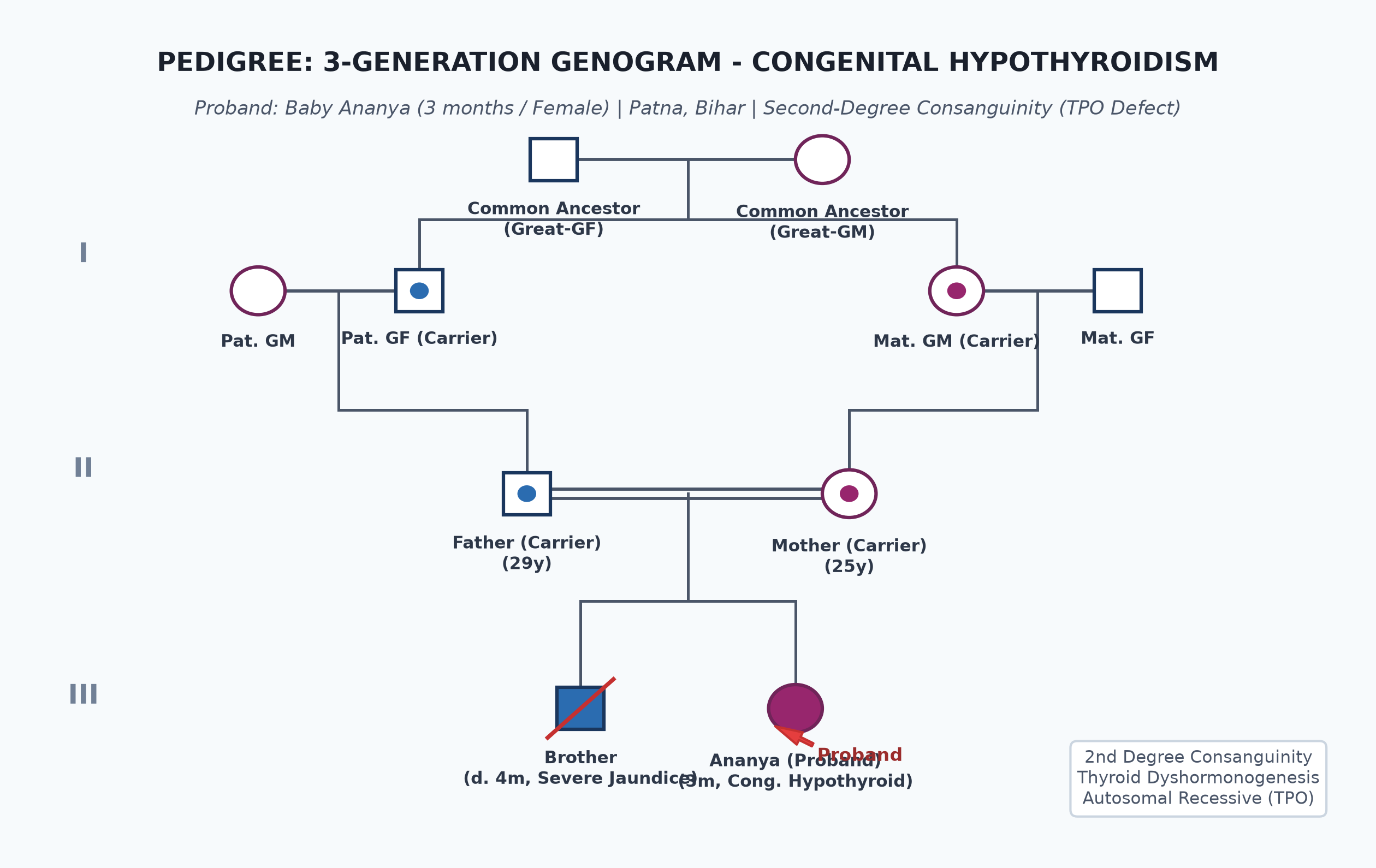
- Born of a second-degree consanguineous marriage (parents are second cousins).
- Father 29 years, shopkeeper; Mother 25 years, homemaker; both clinically euthyroid with no goiter.
- Elder Male Sibling: Died at 4 months of age with profound jaundice, failure to thrive, severe hypotonia, and pneumonia; no metabolic screening had been done.
- Family history strongly points to an Autosomal Recessive Thyroid Dyshormonogenesis (e.g., thyroid peroxidase [TPO] gene defect or DUOX2 mutation), unmasked by parental consanguinity.
Immunization history
- Received BCG and OPV-0 at birth.
- Received Pentavalent-1, OPV-1, and Rotavirus-1 at 6 weeks of age.
Dietary history
- Exclusively breastfed since birth. However, feeds are sluggish, lasting 45 minutes each, with mother feeding 5-6 times daily.
- Calculated intake meets ~70 kcal/kg/day, contributing to secondary weight deceleration.
24-Hour Recall Deficit Analysis
$$ \text{Ideal Body Weight (IBW for 3 months, 50th centile WHO)} = 5.8\text{ kg} $$| Nutrient | Expected Intake (ICMR-NIN 2024 for IBW 5.8 kg) | Observed Intake | Deficit | Inference |
|---|---|---|---|---|
| Energy (kcal) | $5.8\text{ kg} \times 95\text{ kcal/kg} = 551\text{ kcal}$ | 380 kcal | 171 kcal (31%) | Feeding fatigue deficit |
| Protein (g) | $5.8\text{ kg} \times 1.25\text{ g/kg} = 7.25\text{ g}$ | 5.2 g | 2.05 g (28%) | Mild protein deficit |
The expected requirements must be calculated on the Ideal Body Weight (5.8 kg) for age.
Socioeconomic and KAP
- Modified BG Prasad Socioeconomic Class III (Middle Class).
- Parents believed the baby was simply "very peaceful and calm"; delayed seeking medical care until the protruding tongue and severe constipation caused alarm.
Summary of History
Baby Ananya, a 3-month-old female infant born of second-degree consanguineous parentage, presented with prolonged neonatal jaundice, delayed passage of meconium, hoarse cry, poor feeding, somnolence, dry cold skin, obstinate constipation, and umbilical hernia, with a family history of an elder infant death under similar clinical circumstances.
I would like to think of Congenital Hypothyroidism, most likely Thyroid Dyshormonogenesis (Autosomal Recessive), presenting in late clinical stage with marked myxedematous and neuro-developmental manifestations, without acute encephalopathy.
General head to toe examination
- Behavioral State: Drowsy, sluggish wakefulness, dull apathetic facial expression, slow to respond to auditory or visual stimuli.
- Vitals:
- Pulse / Heart Rate: 92 beats/minute (Resting bradycardia; normal for 3m is $110-150\text{ bpm}$).
- Respiratory Rate: 24 breaths/minute, quiet, shallow.
- Blood Pressure: $76/46\text{ mmHg}$ (normal).
- Temperature: $35.8^\circ\text{C}$ (Axillary) -> Hypothermia present.
- Capillary Refill Time: 2.5 seconds; peripheral extremities cool with cutis marmorata.
- Anthropometry:
| Parameter | Observed | Expected (50th WHO) | Z-score / Centile | Inference |
|---|---|---|---|---|
| Weight | 4.6 kg | 5.8 kg | $-2\text{ to } -3\text{ SD}$ | Underweight / Growth arrest |
| Length | 56.0 cm | 60.0 cm | $-2\text{ to } -3\text{ SD}$ | Stunting (Linear growth failure) |
| Head Circumference | 40.5 cm | 40.0 cm | $50^{\text{th}}\text{ centile}$ | Normal HC (Cranial sparing) |
- Dysmorphic / Myxedematous Stigmata:
- Facies: Coarse, puffy, dull facies with periorbital edema and pseudohypertelorism.
- Eyes: Pale conjunctiva, swollen eyelids partially closing the eyes; sclera clear (jaundice resolved).
- Nose: Depressed, broad, flat nasal bridge with anteverted nostrils.
- Mouth: Macroglossia (large, thick, hypertrophied tongue persistently protruding between lips); normal palate.
- Cranial Sutures & Fontanelles:
- Anterior Fontanelle: Large and widely open, measures $4.5 \times 4.5\text{ cm}$ with widely patent sagittal and coronal sutures.
- Posterior Fontanelle: Widely open, measures $1.5 \times 1.5\text{ cm}$ (Pathognomonic sign; normal posterior fontanelle is closed or $<0.5\text{ cm}$ at birth).
- Skin & Hair: Generalized dry, rough, coarse, scaly skin; mottled marble-like appearance (cutis marmorata) over thighs and abdomen; scalp hair coarse, low-set hairline on forehead.
- Neck: Short, thick neck; thyroid gland is palpable and diffusely enlarged ($1.5 \times$ normal size, soft, smooth, non-tender) -> Goitrous Congenital Hypothyroidism (Dyshormonogenesis).
Systemic Examination
Abdomen
- Inspection: Protuberant, distended abdomen with prominent superficial veins; Umbilical Hernia present, measures $2.5 \times 2.0\text{ cm}$ with skin covering.
- Palpation: Soft, lax musculature with prominent divarication of recti ($2\text{ cm}$ separation); umbilical hernia is easily reducible with a distinct fascial ring defect; no tenderness.
- Liver: Palpable 2.0 cm below right costal margin, soft, regular edge, span 6.0 cm.
- Spleen: Not palpable.
- Auscultation: Sluggish bowel sounds (1-2/minute).
Central Nervous System (CNS) & Neuro-Development
- Posture: Marked "frog-leg" posture with abducted hips and limp, extended arms.
- Tone: Marked generalized hypotonia (head lag on pull-to-sit complete; scarf sign crosses contralateral axillary line easily; ventral suspension demonstrates floppy inverted-U drape).
- Reflexes: Deep tendon reflexes present with characteristically prolonged relaxation phase of biceps and knee jerks (Woltman sign).
- Developmental Milestones: Unable to achieve partial head control; social smile inconsistent and delayed (developmental age ~1 month vs chronological 3 months).
Cardiovascular & Respiratory Systems
- Precordium quiet, heart sounds distant and muffled ($S_1, S_2$ soft); no murmurs. Resting heart rate 92/min. Lungs clear.
Summary
Baby Ananya, a 3-month-old female infant born of second-degree consanguineous marriage, presents with a constellation of classical features of untreated Congenital Hypothyroidism: prolonged neonatal jaundice, lethargy, poor feeding, hoarse cry, macroglossia, obstinate constipation, dry skin, hypothermia, resting bradycardia, widely open anterior and posterior fontanelles, umbilical hernia, palpable goiter, and severe generalized hypotonia with developmental delay, with a family history of early sibling death.
Final Clinical Diagnosis: Primary Congenital Hypothyroidism, etiologically Thyroid Dyshormonogenesis (Autosomal Recessive) presenting with goiter, delayed diagnosis at 3 months of age, in active hypothyroid state with neurodevelopmental delay, without acute cardiac failure or myxedema coma.
Differential Diagnosis
| Disorder | Points IN FAVOR | Points AGAINST |
|---|---|---|
| Primary Congenital Hypothyroidism (Dyshormonogenesis) | Prolonged jaundice, constipation, macroglossia, open posterior fontanelle, umbilical hernia, palpable goiter, consanguinity | Primary Clinical Diagnosis |
| Thyroid Dysgenesis (Agenesis / Ectopy) | Identical clinical presentation of congenital hypothyroidism | Thyroid gland is palpable (goiter) in this patient; dysgenesis typically features an empty thyroid bed and absent cervical gland |
| Down Syndrome (Trisomy 21) | Hypotonia, macroglossia, umbilical hernia, developmental delay | Lacks cardinal dysmorphic signs of Trisomy 21 (no upslanting eyes, epicanthic folds, simian crease, sandal gap, or AVSD); constipation and large fontanelles favor hypothyroidism |
| Beckwith-Wiedemann Syndrome | Macroglossia, umbilical hernia / omphalocele | Infant has stunting/growth arrest and low weight, whereas BWS features macrosomia, hemihypertrophy, and ear creases |
| Hirschsprung Disease | Delayed meconium passage, obstinate constipation, abdominal distension | Does not account for macroglossia, coarse facies, hoarse cry, hypothermia, or open posterior fontanelle |
| Mucopolysaccharidosis (Hurler Syndrome) | Coarse facial features, macroglossia, hernia, stiff joints | Hurler signs usually manifest after 6-12 months; features joint contractures (not hypotonia), corneal clouding, and hepatosplenomegaly |
Investigation Protocol & Diagnostic Workup
flowchart TD
    A["Infant with Prolonged Jaundice, Constipation, Macroglossia, or Large Fontanelle"] --> B["Venous Blood Sample: Serum TSH & Free T4"]
    B --> C{"Biochemical Confirmation?"}
    C -->|TSH > 40 mIU/L & Low FT4| D["Confirmed Primary Congenital Hypothyroidism"]
    D --> E["Knee & Ankle AP X-Ray (Assess Epiphyseal Dysgenesis & Intrauterine Bone Age)"]
    D --> F["Immediately Initiate Oral Levothyroxine 10-15 mcg/kg/day (DO NOT DELAY)"]
    F --> G["Neck Ultrasonography & 99mTc-Pertechnetate Scintigraphy"]
    G -->|Palpable Goiter + Intense Cervical Uptake| H["Thyroid Dyshormonogenesis (Perchlorate Discharge Test / TPO Gene)"]
    G -->|Empty Bed + Sublingual Uptake| I["Ectopic Thyroid Gland (Dysgenesis)"]
    G -->|Absent Uptake + Empty Bed| J["Thyroid Agenesis / Athyreosis"]
1. Confirmatory Thyroid Function Tests
- Serum TSH: Markedly elevated ($> 100\text{ mIU/L}$, age-specific normal $0.5-5.0\text{ mIU/L}$).
- Serum Free T4 (FT4): Severely depressed ($0.28\text{ ng/dL}$, age-specific normal $1.0-2.2\text{ ng/dL}$).
- Serum Free T3 (FT3): Low ($1.2\text{ pg/mL}$).
- Confirms Severe Primary Congenital Hypothyroidism.
2. Skeletal Radiography (Biomarker of Intrauterine Hypothyroidism)
- AP Radiograph of Knee and Ankle:
- Absence of Distal Femoral Epiphysis (DFE): Normally ossifies by 36 weeks of gestation. Complete absence in a full-term 3-month-old proves profound prenatal, intrauterine thyroid hormone deficiency!
- Absence of Proximal Tibial Epiphysis (PTE): Normally ossifies at 38 weeks of gestation.
- Epiphyseal Dysgenesis: When ossification centers appear, they manifest as fragmented, multiple, stippled calcific puncta rather than a single homogeneous center.
- Skull Radiograph: Large anterior and posterior fontanelles, wide wormian bones, and delayed suture closure.
3. Thyroid Imaging & Etiological Differentiation
- Thyroid Ultrasonography: Confirms presence of a symmetrically enlarged, eutopic thyroid gland in the lower neck with homogeneous echotexture (excludes agenesis and ectopy).
- Technetium-99m ($^{99m}\text{Tc}$) Pertechnetate Scintigraphy:
- High, intense tracer uptake in a normal anatomical cervical position, confirming trapping intact.
- Perchlorate Discharge Test: $>15\%$ washout of tracer following potassium perchlorate administration, proving an iodide organification defect (TPO deficiency).
Therapeutic Management Protocol
1. Immediate Levothyroxine Replacement Therapy
- Drug of Choice: Oral Levothyroxine ($L\text{-T}_4$) sodium tablets.
- Starting Dose: $10\text{ to } 15\text{ mcg/kg/day}$ as a single daily dose.
- For this infant ($4.6\text{ kg}$), start at the high-normal dose: $50\text{ mcg/day}$ (approx. $11\text{ mcg/kg/day}$) to achieve rapid restoration of euthyroidism within 7 to 14 days.
- Administration Technique:
- Crush the tablet between two clean spoons into a fine powder.
- Mix with $2\text{ to } 3\text{ mL}$ of expressed breast milk or boiled and cooled water.
- Administer immediately via small spoon into the baby's mouth before a morning feed.
- Strict Rule: Never mix with soy formula, calcium supplements, or iron drops (binds and blocks T4 absorption).
2. Biochemical Monitoring Schedule & Target Values
- Check serum FT4 and TSH:
- At 2 weeks and 4 weeks after starting therapy.
- Every 1 to 2 months during the first 6 months of life.
- Every 2 to 3 months between 6 months and 3 years of age.
- Optimization Targets:
- Free T4: Maintain in the upper half of the normal reference range ($1.4\text{--}2.2\text{ ng/dL}$).
- TSH: Maintain in the target range of $0.5\text{ to } 2.0\text{ mIU/L}$ (avoid over-suppression $<0.05\text{ mIU/L}$ which causes premature craniosynostosis).
3. Developmental Support & Re-evaluation Trial
- Immediate enrollment in Early Intervention Developmental Therapy (physiotherapy, speech and occupational therapy).
- Hearing screening (OAE and BERA) to rule out Pendred syndrome (sensorineural deafness associated with dyshormonogenesis).