
Master Birju, a 5-year-old male child, 2nd order child born of a non-consanguineous marriage from a forested rural village in Ranchi, Jharkhand, presented to the pediatric emergency in an unarousable coma with rapid deep sighing respirations, high fever with chills and rigors for 5 days, passing dark cola-colored urine ("blackwater") for 2 days, and two episodes of generalized tonic-clonic convulsions in the emergency triage.
- Rapid deterioration in sensorium progressing from drowsiness to unarousable coma
- High-grade fever with shaking chills and rigors
- Multiple generalized convulsions (>2 episodes in 24 hours)
- Acidotic, deep, labored breathing (Kussmaul respiration)
- Dark red, burgundy, or cola-colored urine (blackwater fever / hemoglobinuria)
- Severe pallor and jaundice appearing within days
HOPI
The history is dated back to 5 days ago when the child acutely developed high-grade fever accompanied by severe shivering chills, cold rigors, and profuse drenching sweats occurring on alternate days.
Cerebral Malaria is the deadliest complication of Plasmodium falciparum infection, defined by WHO as unarousable coma (Blantyre Coma Score $\le 2$ or GCS $<8$) persisting for $>1$ hour after termination of a seizure, in the presence of asexual P. falciparum parasitemia, with exclusion of other encephalopathies (especially bacterial meningitis). Inquire meticulously about endemic residence, lack of bed nets, convulsions, acidotic breathing (lactic acidosis is the strongest predictor of death), dark urine, and previous antimalarial treatment.
- Fever with Chills & Rigors (5 Days Duration):
- High-grade fever ($104^\circ\text{F}$), occurring in paroxysms every 48 hours (tertian pattern), heralded by teeth-chattering chills and followed by burning heat and drenching sweats.
- Acute Deterioration in Consciousness & Seizures:
- Over the past 24 hours, the child became progressively drowsy, confused, ceased speaking, and lapsed into deep unresponsiveness.
- Experienced two generalized tonic-clonic seizures lasting 3 to 5 minutes each over the last 12 hours.
- Between seizures, the child remained completely comatose and unarousable to deep painful stimuli Reflects cytoadherence, rosetting, and sequestration of parasitized RBCs in cerebral microvessels, inducing blood-brain barrier disruption and cerebral edema.
- Acidotic Breathing (Lactic Acidosis):
- For the past 12 hours, breathing became deep, rapid, heavy, and sighing without cough, stridor, or wheezing Points to severe lactic acidosis driven by microvascular sequestration, tissue hypoperfusion, and parasite glycolysis.
- Hemoglobinuria (Blackwater Fever):
- For the last 2 days, the mother observed that the urine became remarkably dark, resembling strong tea or dark cola Massive intravascular hemolysis of parasitized and non-parasitized erythrocytes releasing free hemoglobin into the glomerular filtrate.
- Rapidly Worsening Pallor & Jaundice:
- Marked yellow discoloration of eyes and extreme pallor noted over the past 48 hours.
- Negative History:
- No history of neck rigidity, photophobia, or bulging fontanelle prior to coma Differentiates cerebral malaria from acute bacterial meningitis (CSF examination mandatory).
- No history of head trauma, animal bites, or ingesting toxic berries/pesticides.
- No history of previous blood transfusions or known hemoglobinopathy (sickle cell or thalassemia).
Past History
- Born full-term, birth weight 2.6 kg; no prior hospital admissions.
- Recurrent episodes of uninvestigated seasonal fevers treated with local herbal concoctions.
Family history
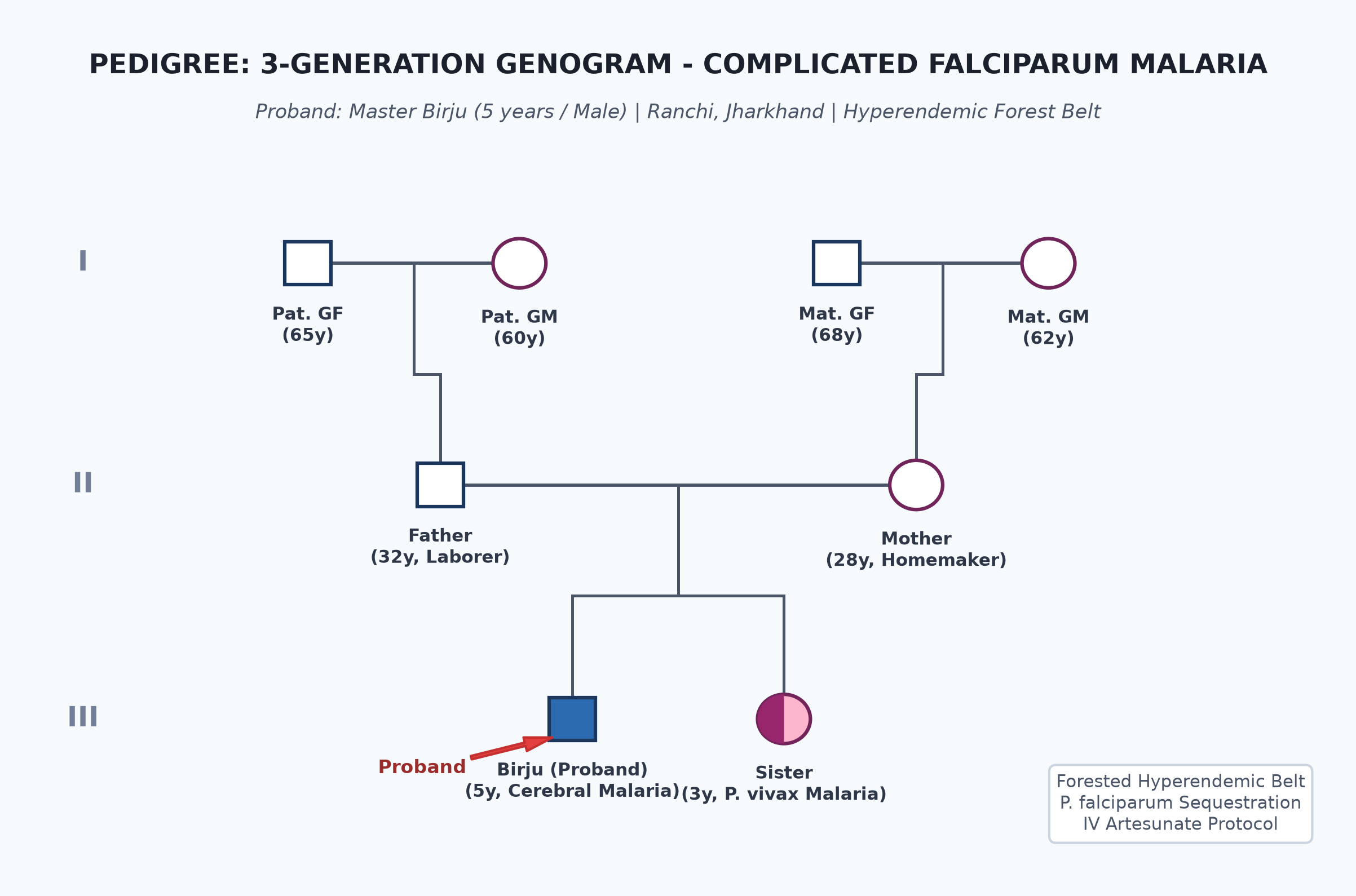
- Born of a non-consanguineous tribal family.
- Father 32 years, agricultural laborer; Mother 28 years, homemaker.
- Younger sister (3 years old) was treated for uncomplicated Plasmodium vivax malaria with chloroquine 1 month ago.
- Family resides in a mud-and-thatch home surrounded by dense forest; do not possess insecticide-treated bed nets (ITNs).
Immunization history
- Received BCG and primary UIP vaccines; has not received malaria vaccine (R21/Matrix-M).
Dietary history
- Consumes a rural home diet of rice and lentils; oral intake completely absent for the last 24 hours.
24-Hour Recall Deficit Analysis
$$ \text{Ideal Body Weight (IBW for 5 years, 50th centile WHO)} = 18.5\text{ kg} $$| Nutrient | Expected Intake (ICMR-NIN 2024 for IBW 18.5 kg) | Observed Intake | Deficit | Percentage Deficit |
|---|---|---|---|---|
| Energy (kcal) | $18.5\text{ kg} \times 75\text{ kcal/kg} = 1388\text{ kcal}$ | 0 kcal | 1388 kcal | 100% Deficit |
| Protein (g) | $18.5\text{ kg} \times 1.0\text{ g/kg} = 18.5\text{ g}$ | 0 g | 18.5 g | 100% Deficit |
Socioeconomic and KAP
- Modified BG Prasad Socioeconomic Class V (Lower Class / Below Poverty Line).
- Forested hyperendemic malaria zone in Jharkhand; high vector density of Anopheles culicifacies and An. fluviatilis.
- Delayed seeking hospital care due to reliance on traditional village healers.
Summary of History
Master Birju, a 5-year-old male child residing in a hyperendemic forested belt, presents with a 5-day history of tertian fever with rigors, acutely complicated by unarousable coma, multiple seizures, acidotic breathing, blackwater fever (hemoglobinuria), and severe pallor with jaundice.
I would like to consider a diagnosis of Complicated / Severe Malaria (Cerebral Malaria) caused by Plasmodium falciparum, presenting with multi-organ dysfunction (cerebral, severe anemia, hemoglobinuria, lactic acidosis), requiring immediate parenteral Artesunate resuscitation.
General head to toe examination
- Neurological Sensorium (Blantyre Coma Score):
- Motor Response: Decerebrate posturing or localized flexion to pain (1 point).
- Verbal Response: Inappropriate moaning or absent (0 points).
- Eye Movements: Does not watch mother's face (0 points).
- Blantyre Coma Score = 1 / 5 (Diagnostic of Cerebral Malaria; score $\le 2$ confirms coma).
- Glasgow Coma Scale (GCS): 6/15 ($E_1 V_2 M_3$).
- Vitals:
- Heart Rate: 152 beats/minute, rapid, bounding pulses.
- Respiratory Rate: 42 breaths/minute, deep, rapid, heavy sighing (Acidotic / Kussmaul-like breathing).
- Blood Pressure: $84/50\text{ mmHg}$ ($50^{\text{th}}$ centile; perfusion maintained).
- Temperature: $39.8^\circ\text{C}$ ($103.6^\circ\text{F}$).
- Capillary Refill Time: 2.0 seconds.
- Anthropometry:
| Parameter | Observed | Expected (50th WHO) | Centile | Inference |
|---|---|---|---|---|
| Weight | 16.0 kg | 18.5 kg | $-1.5\text{ SD}$ | Mild underweight |
| Height | 108.0 cm | 110.0 cm | $50^{\text{th}}\text{ centile}$ | Normal Stature |
- General Physical Findings:
- Severe Pallor: Extreme chalky pallor of conjunctiva, tongue, palmar creases, and nail beds.
- Icterus: Confluent, moderate yellow discoloration of bilateral sclerae and skin (hemolytic + hepatic jaundice).
- Ophthalmology (Malarial Retinopathy): Indirect fundoscopy reveals retinal whitening in the macular periphery, orange vessel discoloration, and flame-shaped retinal hemorrhages (Roth spots).
- Urine Color: A fresh urine sample collected by catheterization shows opaque, dark reddish-black "cola" urine (hemoglobinuria).
Systemic Examination
Central Nervous System (CNS)
- Unarousable coma; pupils equal, $3\text{ mm}$, briskly reactive to light; corneal reflexes present.
- Tone: Increased tone with bilateral extensor hypertonia; deep tendon reflexes brisk ($3+$ bilaterally); bilateral extensor plantar responses (Babinski positive).
- Meningeal Signs: Neck is supple; Kernig sign negative; Brudzinski sign negative.
Abdomen
- Symmetrically full, soft.
- Splenomegaly: Spleen palpable 4.0 cm below left costal margin, firm, smooth, moderately tender (acute malarial splenomegaly).
- Hepatomegaly: Liver palpable 2.5 cm below right costal margin, soft, regular edge, span 8.5 cm.
Respiratory & Cardiovascular Systems
- Respiratory: Deep Kussmaul-like acidotic hyperpnea; lungs clear bilaterally with vesicular breath sounds; no crackles.
- CVS: Tachycardia (152 bpm), hyperdynamic precordium, Grade 2/6 hemic systolic flow murmur at pulmonary area (anemia-induced flow murmur).
Summary
Master Birju, a 5-year-old boy from a hyperendemic tribal belt, presents in unarousable coma (Blantyre Coma Score 1/5, GCS 6/15), multiple generalized seizures, deep acidotic breathing (RR 42/min), extreme pallor, icterus, splenomegaly (4 cm), and dark cola-colored urine (blackwater fever).
Final Clinical Diagnosis: Severe / Complicated Falciparum Malaria manifesting as Cerebral Malaria with severe malarial anemia, blackwater fever (hemoglobinuria), and severe lactic acidosis, requiring immediate IV Artesunate therapy, blood transfusion, and neuro-intensive care.
Differential Diagnosis
| Disorder | Points IN FAVOR | Points AGAINST |
|---|---|---|
| Cerebral Malaria (P. falciparum) | Blantyre score $\le 2$, high fever with rigors, hyperendemic area, acidotic breathing, hemoglobinuria, malarial retinopathy | Primary Diagnosis |
| Acute Pyogenic / Bacterial Meningitis | Coma, seizures, high fever, altered sensorium | Meningitis typically features marked neck stiffness and Kernig sign (absent here); CSF in cerebral malaria is clear with normal protein/glucose; peripheral smear positive for falciparum |
| Viral Encephalitis (e.g., Japanese Encephalitis) | Coma, seizures, high fever, extensor plantars | JE lacks malaria parasitemia, blackwater fever, marked splenomegaly, or malarial retinopathy; CSF shows lymphocytic pleocytosis |
| Diabetic Ketoacidosis with Coma | Deep Kussmaul breathing, coma, dehydration | Blood glucose is severely low ($<40-54\text{ mg/dL}$) in severe malaria, NOT hyperglycemic; urine is dark due to hemoglobin, not ketones |
| Acute Viral Hepatitis with Hepatic Encephalopathy | Jaundice, hepatomegaly, coma | Jaundice in hepatitis is predominantly hepatocellular with high transaminases ($>1000\text{ U/L}$); lacks tertian shivering rigors, blackwater fever, or malaria rings |
Investigation Protocol & Diagnostic Workup
flowchart TD
    A["Comatose Child with Fever & Cola Urine in Malaria Endemic Area"] --> B["Stat Giemsa Peripheral Blood Smears & Malaria RDT (pLDH / HRP-2)"]
    B --> C{"P. falciparum Asexual Parasitemia Confirmed?"}
    C -->|Yes: Severe Malaria| D["STAT Bedside Blood Glucose: Check for Neuro-Hypoglycemia"]
    D --> E["Draw CBC, Blood Gas, Lactate, Creatinine, Bilirubin, Urine for Hb"]
    E --> F["MANDATORY Lumbar Puncture (CSF Analysis to Rule out Bacterial Meningitis)"]
    F --> G["IMMEDIATELY Administer IV Artesunate (3.0 mg/kg at 0, 12, 24 Hours)"]
    G --> H["Cautious Fluid Resuscitation (Prevent Pulmonary & Cerebral Edema)"]
    H --> I["Transfuse Packed RBCs for Severe Malarial Anemia (Hb < 5 g/dL)"]
1. Parasitological Confirmation
- Thick and Thin Peripheral Blood Smears (Giemsa Stain):
- Thin Smear: Abundant intracellular ring-form trophozoites of Plasmodium falciparum with double chromatin dots and appliqué/accole forms; crescent-shaped gametocytes identified.
- Parasite Density: $320,000\text{ parasites}/\mu\text{L}$ ($7.5\%$ parasitized RBCs $\rightarrow$ Hyperparasitemia).
- Rapid Diagnostic Test (RDT): Strongly positive for P. falciparum Histidine-Rich Protein 2 (HRP-2) and parasite lactate dehydrogenase (pLDH).
2. Emergency Metabolic & Gas Panel
- Bedside Blood Glucose: $38\text{ mg/dL}$ ($<40\text{ mg/dL}$ $\rightarrow$ Severe Neuro-Hypoglycemia).
- Venous Blood Gas: pH $7.14$, $HCO_3^-$ $8.6\text{ mEq/L}$, Base Excess $-16.4\text{ mEq/L}$, Venous Lactate $8.2\text{ mmol/L}$ (Severe high anion-gap lactic acidosis).
- Complete Blood Count:
- Hemoglobin: $4.2\text{ g/dL}$ (Severe Malarial Anemia; $<5.0\text{ g/dL}$).
- Platelet Count: $42,000/\mu\text{L}$ (Thrombocytopenia).
- TLC: $14,200/\mu\text{L}$.
3. Biochemical & Renal Workup
- Urinalysis: Dark reddish-black color; dipstick strongly positive for "blood" (hemoglobin); microscopy reveals absence of intact RBCs, confirming true Hemoglobinuria (Blackwater Fever).
- Liver Function Tests: Total Bilirubin $4.8\text{ mg/dL}$ (Indirect $3.4\text{ mg/dL}$, Direct $1.4\text{ mg/dL}$), AST $92\text{ U/L}$, ALT $64\text{ U/L}$.
- Renal Function: Serum Creatinine $1.1\text{ mg/dL}$ (elevated for 5y; acute tubular injury from free hemoglobin).
4. Cerebrospinal Fluid (CSF) Analysis (Rule Out Meningitis)
- Opening pressure $180\text{ mm } H_2O$ (mildly elevated).
- Appearance: Completely clear, colorless.
- Cytology: $2\text{ lymphocytes}/\mu\text{L}$ (Normal).
- Biochemistry: Protein $32\text{ mg/dL}$ (normal), Glucose $48\text{ mg/dL}$ (concordant with blood glucose). Gram stain and culture negative (definitively rules out bacterial meningitis).
Therapeutic Management Protocol (WHO 2022 Guidelines)
1. Emergency Antimalarial Therapy: Intravenous Artesunate
- Drug of Choice: Artesunate IV.
- Dose for Child $<20\text{ kg}$: $3.0\text{ mg/kg}$ per dose IV ($48\text{ mg}$ per dose for this $16\text{ kg}$ child).
- Dosing Schedule: Administered at 0 hours, 12 hours, and 24 hours, then once daily (every 24 hours) until the child wakes up and can swallow oral medication.
- Mandatory Rule: At least 3 full parenteral doses must be administered.
- Oral Follow-Through: Once conscious, complete a full 3-day course of Artemisinin-based Combination Therapy (ACT): Oral Artemether-Lumefantrine.
2. Emergency Resuscitation & Supportive Care
- Hypoglycemia Correction:
- Immediately push 10% Dextrose at $5\text{ mL/kg}$ IV ($80\text{ mL}$ stat), followed by a continuous $10\%\text{ Dextrose}$ maintenance infusion to keep blood glucose $>80\text{ mg/dL}$.
- Conservative Fluid Management:
- Do NOT give rapid large fluid boluses!
- Infuse maintenance fluids ($10\%\text{ Dextrose with } 0.45\%\text{ Saline}$) at a restrictive rate of $3\text{ mL/kg/hour}$ ($48\text{ mL/hr}$) to avoid triggering lethal cerebral edema or non-cardiogenic pulmonary edema.
- Blood Transfusion for Severe Anemia:
- Transfuse Packed Red Blood Cells at $10\text{ mL/kg}$ ($160\text{ mL}$) slowly over 4 hours with IV Furosemide ($1\text{ mg/kg}$) to prevent fluid overload.
- Seizure Control:
- IV Midazolam ($0.15\text{ mg/kg}$) or IV Lorazepam ($0.1\text{ mg/kg}$) for acute seizures; load with IV Levetiracetam ($30\text{ mg/kg}$) or IV Fosphenytoin ($20\text{ mg PE/kg}$) if recurrent.