
Master Harish, a 7 year old boy, 2nd order child born of a second-degree consanguineous marriage from Kochi, Kerala presented with complaints of chronic, daily productive cough with copious purulent sputum since 3 years of age, recurrent episodes of fever and wheezing requiring frequent hospitalizations, failure to gain weight, and foul-smelling greasy stools since early childhood.
- Daily, persistent moist/wet cough lasting $>8\text{ weeks}$ (unresponsive to standard antibiotics)
- Copious, purulent, three-layered sputum production (worse in the morning on waking)
- Recurrent lower respiratory infections / pneumonias requiring intravenous antibiotics
- Hemoptysis (ranging from blood-streaked sputum to life-threatening bleeding from bronchial arteries)
- Steatorrhea (foul-smelling, bulky, greasy stools) and severe failure to thrive in Cystic Fibrosis
HOPI
The history is dated back to 3 years of age when the child developed a chronic, continuous wet cough that failed to resolve completely between acute exacerbations.
In every child presenting with chronic wet cough $>8\text{ weeks}$, systematically investigate the underlying etiology:
- Cystic Fibrosis (CF): Early onset, recurrent pneumonia, malabsorption (steatorrhea, voracious appetite, meconium ileus history), salty sweat.
- Primary Ciliary Dyskinesia (PCD / Kartagener): Neonatal respiratory distress, chronic rhinosinusitis, situs inversus, chronic otitis media.
- Post-Infectious: Measles, pertussis, severe adenoviral necrotizing pneumonia, or post-primary tuberculosis.
- Immunodeficiency: Recurrent sinopulmonary infections, skin abscesses, fungal infections (hypogammaglobulinemia, CGD).
- Chronic Productive Cough:
- Present for the past 4 years, daily and continuous.
- Characteristically worse in the early morning after waking up and during postural changes (bending forward) Accumulation of purulent secretions in dilated dependent bronchi during sleep drains on postural changes.
- Expectoration is copious (~30-50 mL/day), thick, yellowish-green, and foul-smelling.
- Sputum separates into three distinct layers when collected in a clear container: upper frothy layer, middle cloudy serous layer, and lower thick purulent sediment with cellular debris.
- Hemoptysis:
- History of 3 episodes of blood-streaked sputum in the past 6 months during acute respiratory exacerbations; no massive hemoptysis ($>5\text{ mL/kg/day}$) Chronic transmural bronchial inflammation triggers hypertrophy and neovascularization of bronchial arteries prone to rupture under shear stress.
- Gastrointestinal Symptoms (Malabsorption):
- Mother reports that since 1 year of age, the child passes 3-4 bulky, pale, frothy, glistening, exceptionally foul-smelling stools daily that float in the toilet and are difficult to flush off the pot (steatorrhea) Exocrine pancreatic insufficiency secondary to inspissated mucous plugs occluding pancreatic ductules.
- Despite a voracious appetite ("always hungry"), the child fails to gain weight and shows severe wasting.
- History of rectal prolapse once at 2.5 years of age during defecation, spontaneously reduced.
- Salt-Losing Tendency / Sweat Characteristics:
- Mother observed white crystalline salt crusts on the child's forehead after sweating during hot weather, and noted that the child tastes unusually salty when kissed ("salty baby").
- History of severe dehydration with lethargy during a heatwave at 4 years requiring hospital admission (pseudo-Bartter syndrome / hyponatremic hypochloremic metabolic alkalosis).
- Upper Airway & Sinonasal Symptoms:
- Persistent bilateral nasal discharge, mouth breathing, and snoring since 4 years of age. Diagnosed with bilateral nasal polyposis by an ENT surgeon.
- Negative History:
- No history of foreign body aspiration (sudden choking or gagging while eating peanuts/nuts) Rules out retained radiolucent endobronchial foreign body as a cause of localized bronchiectasis.
- No history of contact with active pulmonary tuberculosis; completed full infant vaccinations including BCG.
- No history of recurrent deep-seated skin boils, suppurative lymphadenitis, or perianal abscesses Rules out Chronic Granulomatous Disease (CGD) and Hyper-IgE syndrome.
- No history of central cyanosis, syncope, or squatting equivalents.
Past History
- Born at term; history of delayed passage of meconium ($>48\text{ hours}$ post-birth) managed conservatively with enemas (mild meconium ileus equivalent).
- Recurrent admissions (6 times in past 3 years) for acute pulmonary exacerbations treated with broad-spectrum IV antibiotics (ceftazidime and amikacin).
Family history
- Parents are second-degree consanguineous (first cousins).
- Mother 32 years, Father 36 years; both healthy (obligate CFTR carriers).
- Elder sister died at 3 years of age from severe necrotizing bronchopneumonia and malnutrition.
- Younger sister (2 years) is asymptomatic; newborn screening not performed.
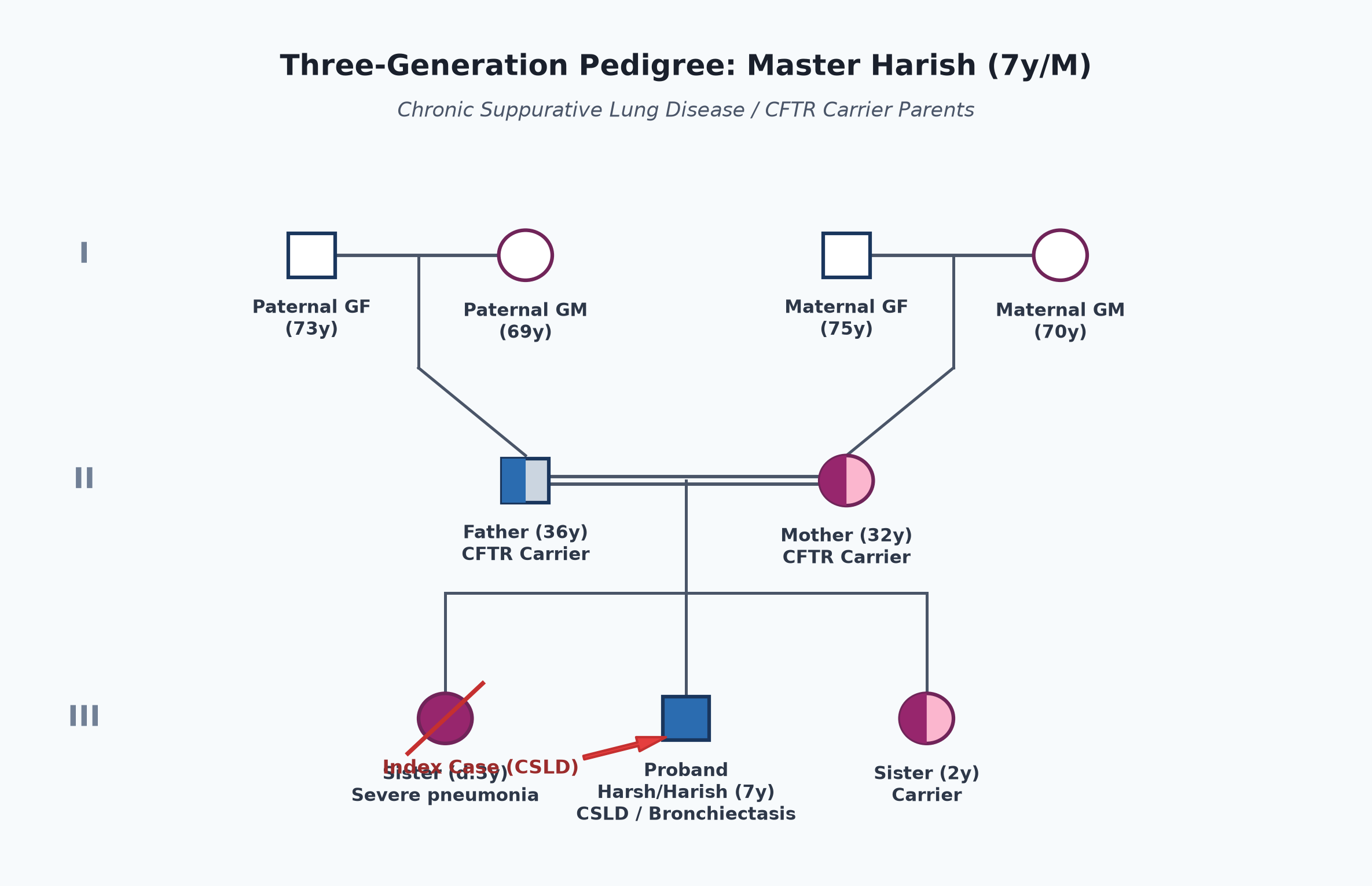
Immunization history
- Received all UIP vaccines up to date.
- Received Pneumococcal Conjugate Vaccine (PCV13) and annual Inactivated Influenza vaccine.
Dietary history
- High appetite, but poor intestinal absorption.
- Consumes ~1400 kcal/day, but experiences massive fecal fat and protein loss.
| Food Item | Quantity | Calories (kcal) | Protein (g) |
|---|---|---|---|
| Full cream milk | 400 mL | 280 | 13.0 |
| Rice with ghee & dal | 2 cups rice + thick dal | 520 | 14.2 |
| Boiled eggs (2) | 2 whole eggs | 140 | 12.0 |
| Banana & snacks | 2 bananas + biscuits | 210 | 2.5 |
| Total Observed Intake | — | 1150 kcal | 41.7 g |
24-Hour Recall Deficit Analysis
$$ \text{Ideal Body Weight (IBW for 7-year-old boy, 50th centile WHO)} = 23.0\text{ kg} $$In Cystic Fibrosis, energy requirements are 120% to 150% of the normal RDA (i.e. $110-130\text{ kcal/kg/day}$ of IBW) due to severe malabsorption, chronic work of breathing, and persistent endobronchial inflammation.
| Nutrient | Expected Intake (CF Guideline: 130 kcal/kg for IBW 23 kg) | Observed Intake | Deficit | Percentage Deficit |
|---|---|---|---|---|
| Energy (kcal) | $23\text{ kg} \times 130\text{ kcal/kg} = 2990\text{ kcal}$ | 1150 kcal | 1840 kcal | 61.5% Deficit |
| Protein (g) | $23\text{ kg} \times 2.5\text{ g/kg} = 57.5\text{ g}$ | 41.7 g | 15.8 g | 27.5% Deficit |
The expected calories and proteins should be calculated from the ideal body weight, not from current weight.
Socioeconomic and KAP
- Modified BG Prasad Class II (Urban middle class).
- Parents are motivated and perform regular daily chest physiotherapy at home using an oscillating positive expiratory pressure (Flutter) device.
Summary of History
Master Harish, a 7-year-old male child born of consanguineous marriage, presented with chronic, daily, copious purulent wet cough since 3 years of age, recurrent pulmonary exacerbations, blood-streaked sputum, steatorrhea, failure to thrive despite voracious appetite, salty sweat, bilateral nasal polyps, and an early sibling death from severe pneumonia.
I would like to think of Chronic Suppurative Lung Disease (CSLD) with Bilateral Bronchiectasis, secondary to Cystic Fibrosis (CFTR-related disease / Classic CF with Exocrine Pancreatic Insufficiency), complicated by acute-on-chronic pulmonary exacerbation, with severe acute-on-chronic malnutrition.
General head to toe examination
- Child Behavioral State: Alert, cooperative, coughing intermittently with audible wet rattled sounds (Prechtl State 3).
- Vitals:
- Heart Rate: 114 beats/minute, regular, normal volume; all pulses palpable.
- Respiratory Rate: 34 breaths/minute, tachypneic at rest, thoracoabdominal with mild intercostal retractions.
- Blood Pressure: Right arm supine: $96/60\text{ mmHg}$.
- Temperature: $37.8^\circ\text{C}$ (low-grade fever).
- Oxygen Saturation ($SpO_2$): 91% on room air; improves to 97% on $2\text{ L/min}$ oxygen via nasal prongs.
- Anthropometry:
| Parameter | Observed | Expected (50th WHO) | Z-score / Centile | Inference |
|---|---|---|---|---|
| Weight | 15.2 kg | 23.0 kg | $< -3\text{ SD}$ | Severe Underweight |
| Height | 108 cm | 122.0 cm | $< -3\text{ SD}$ | Severe Stunting |
| BMI | $13.0\text{ kg/m}^2$ | $15.5\text{ kg/m}^2$ | $< 3^{\text{rd}}\text{ centile}$ | Severe Wasting / Chronic Malnutrition |
- Head to Toe Findings:
- Digital Clubbing: Grade IV Digital Clubbing on all 20 digits (drumstick appearance with hypertrophic pulmonary osteoarthropathy [HPOA], wrist joint tenderness).
- Pallor: Moderate conjunctival and palmar pallor.
- Vitamin Deficiencies: Bitot spots (Vitamin A deficiency from fat malabsorption), dry scaly skin (follicular hyperkeratosis / phrynoderma), and mild cheilosis.
- Nasal Examination: Anterior rhinoscopy reveals bilateral, pale, translucent, glistening, polypoid masses filling the middle meatus (bilateral nasal polyps).
Systemic Examination
Respiratory System
- Inspection:
- Shape of Chest: Symmetrical, increased anteroposterior diameter (barrel-shaped chest with prominent sternum and hyperinflated lung fields).
- Respiratory movements: Symmetrical bilateral excursion; subcostal and intercostal indrawing present.
- Trachea: Central in position; suprasternal notch pulsations absent.
- Palpation:
- Trachea is central (confirmed by gentle index finger palpation in suprasternal notch).
- Chest Expansion: Reduced symmetrically bilaterally ($<2.5\text{ cm}$ total expansion).
- Tactile Vocal Fremitus (TVF): Asymmetrically altered; increased over the bilateral lower zones and right middle lobe, corresponding to areas of bronchiectatic bronchial dilation and peribronchial consolidation; rhonchial fremitus palpable over central airways.
- Percussion:
- Hyperresonant percussion note heard over the anterior chest and upper lung fields (air-trapping / compensatory hyperinflation).
- Impaired / dull percussion note over the bilateral infrascapular and right inframammary regions (confluent bronchiectatic packing with mucus and peribronchial fibrosis).
- Normal hepatic and cardiac dullness maintained (situs solitus; excludes dextrocardia / Kartagener).
- Auscultation:
- Breath Sounds: Harsh vesicular breath sounds with prolonged expiration bilaterally; tubular / cavernous bronchial breath sounds audible over the right middle lobe and bilateral infrascapular areas.
- Adventitious Sounds:
- Coarse, leathery, bubbly, post-tussive crackles (crepitations): Audible extensively over the bilateral lower zones and right middle lobe.Semiology Pearl: Post-Tussive Crepitations in Bronchiectasis
Unlike pneumonia crackles which remain constant, bronchiectatic crackles characteristically alter in pitch, intensity, or distribution immediately after a vigorous bout of coughing, as thick purulent secretions are shifted along the dilated bronchial tree.
- Wheezing: Bilateral polyphonic high-pitched expiratory wheezes audible diffusely due to small airway bronchomalacia and thick endobronchial mucous plugging.
- Coarse, leathery, bubbly, post-tussive crackles (crepitations): Audible extensively over the bilateral lower zones and right middle lobe.
- Vocal Resonance: Markedly increased with bronchophony and whispering pectoriloquy over the bilateral bases.
other systems
- Cardiovascular System: Tachycardia ($114\text{ bpm}$); $S_1$ and $S_2$ normal; $P_2$ is accentuated and palpable in the left $2^{\text{nd}}$ ICS (early Cor Pulmonale / secondary pulmonary hypertension); no murmurs.
- Abdomen:
- Distended, soft, non-tender.
- Liver: Palpable 2.5 cm below the right costal margin (firm, smooth, non-tender); span 9 cm. (Fatty infiltration / CF-related liver disease).
- Spleen not palpable; no ascites.
- Central Nervous System: Intact higher functions, cranial nerves normal, no focal deficits.
Summary
Master Harish, a 7-year-old male child born of consanguineous parents, presented with 4 years of daily copious purulent sputum production, recurrent acute pulmonary exacerbations, hemoptysis, steatorrhea, severe failure to thrive, bilateral nasal polyposis, and salty sweat.
On examination, he has Grade IV clubbing, barrel-shaped chest, bilateral cavernous breath sounds, coarse post-tussive crackles with polyphonic wheezes, loud $P_2$ signifying pulmonary hypertension, hepatomegaly, and severe stunting and wasting ($<-3\text{ SD}$).
Probable Clinical Diagnosis: Chronic Suppurative Lung Disease (CSLD) with Bilateral Widespread Cystic and Varicose Bronchiectasis, secondary to Classic Cystic Fibrosis (homozygous CFTR mutation with Pancreatic Exocrine Insufficiency), currently in Acute Infective Pulmonary Exacerbation (likely colonized with Pseudomonas aeruginosa / Staphylococcus aureus), complicated by early Cor Pulmonale, Bilateral Nasal Polyposis, and Severe Protein-Energy Malnutrition (SAM with Stunting).
Differential Diagnosis
| Disease | Points IN FAVOR | Points AGAINST |
|---|---|---|
| Cystic Fibrosis (CF) | • Onset in early childhood with CSLD • Steatorrhea + severe failure to thrive • "Salty baby" sign, rectal prolapse, nasal polyposis • Consanguinity, sibling death from pneumonia | Primary Diagnosis |
| Primary Ciliary Dyskinesia (PCD / Kartagener) | • Chronic wet cough, bronchiectasis • Recurrent sinusitis, nasal polyps, otitis | • Normal cardiac situs (no dextrocardia, situs inversus absent) • Does NOT cause steatorrhea or exocrine pancreatic insufficiency |
| Post-Tubercular Bronchiectasis | • Chronic cough, hemoptysis, bronchiectasis | • Typically unilateral and localized to upper lobes • Does not explain steatorrhea, salty sweat, or bilateral nasal polyposis |
| Common Variable Immunodeficiency (CVID) | • Recurrent sinopulmonary infections, bronchiectasis | • Usually presents in late childhood/adolescence; absent steatorrhea, normal sweat chloride |
Investigation Protocol & Diagnostic Workup
flowchart TD
    A["Suspected Bronchiectasis / CSLD (Master Harish)"] --> B["1. Confirmatory Diagnosis of Cystic Fibrosis"]
    B --> C["Quantitative Sweat Chloride Test (Pilocarpine Iontophoresis)"]
    B --> D["CFTR Gene Mutation Analysis (50-mutation panel / Sanger Sequencing)"]

    A --> E["2. Anatomical Staging of Lung Disease"]
    E --> F["High-Resolution Computed Tomography (HRCT Chest)"]
    E --> G["Chest Radiography (CXR PA: Bhalla / Brasfield Score)"]

    A --> H["3. Microbiological & Functional Surveillance"]
    H --> I["Deep Sputum Culture & Sensitivity (Pseudomonas, S. aureus, Burkholderia)"]
    H --> J["Spirometry / PFT (FEV1, FVC, FEF 25-75%: Obstructive Defect)"]
    H --> K["Fecal Elastase-1 (<100 mcg/g = Severe Exocrine Pancreatic Failure)"]
    H --> L["Fat-Soluble Vitamin Levels (A, D, E, PT/INR for K)"]
1. Confirmatory Diagnostic Test: Sweat Chloride Estimation
- Method: Pilocarpine Iontophoresis (Gibson and Cooke Technique) on at least 75-100 mg of collected sweat:
- Result: Sweat Chloride $= 88 ext{ mmol/L}$ (Positive: $\ge 60 ext{ mmol/L}$ is diagnostic of Cystic Fibrosis; normal $<30 ext{ mmol/L}$, borderline $30-59 ext{ mmol/L}$).
- CFTR Genetic Testing: Confirms homozygous $\Delta F508$ (p.Phe508del) mutation (Class II defect causing defective CFTR protein processing and trafficking).
2. High-Resolution Computed Tomography (HRCT Chest) - Gold Standard for Bronchiectasis
- Hallmark Findings:
- Signet Ring Sign: Bronchial internal lumen diameter significantly exceeds adjacent pulmonary artery diameter (Broncho-Arterial Ratio $>1.0$).
- Tram-Track Sign: Parallel thickened, non-tapering bronchial walls extending to within $1 ext{ cm}$ of the costal pleura.
- Bronchiectasis Type: Diffuse bilateral cylindrical, varicose, and saccular (cystic) bronchiectasis with mucous plugging and "tree-in-bud" nodular opacities.
- Air-Trapping: Mosaic lung attenuation on expiratory scans.
3. Sputum Microbiology & Fungal Profile
- Sputum Culture: Heavy growth of mucoid Pseudomonas aeruginosa and methicillin-sensitive Staphylococcus aureus (MSSA).
- Screen for ABPA: Total serum IgE elevated ($1400 ext{ IU/mL}$), positive specific IgE to Aspergillus fumigatus (monitored for Allergic Bronchopulmonary Aspergillosis).
4. Pancreatic & Nutritional Markers
- Fecal Elastase-1: $< 20 ext{ mcg/g}$ stool (normal $>200 ext{ mcg/g}$), confirming absolute exocrine pancreatic insufficiency.
- Fat-Soluble Vitamins: Serum 25-OH Vitamin D $= 14 ext{ ng/mL}$ (deficient), Serum Vitamin A $= 18 ext{ mcg/dL}$ (low).
Management Plan
1. Management of Acute Pulmonary Exacerbation
- Hospitalization & Isolation: Contact precautions to prevent cross-transmission of mucoid P. aeruginosa.
- Intravenous Dual Anti-Pseudomonal Antibiotic Therapy (14-21 Days):
- IV Ceftazidime: $150-200 ext{ mg/kg/day}$ divided every 8 hours (max 6 g/day), PLUS
- IV Tobramycin: $10 ext{ mg/kg}$ once daily IV infusion (with therapeutic drug monitoring to ensure peak $20-30 ext{ mcg/mL}$ and trough $<1 ext{ mcg/mL}$).
- Aggressive Airway Clearance Therapy (ACT):
- High-frequency chest wall oscillation (Vest therapy) or Positive Expiratory Pressure (PEP) device twice daily, preceded by nebulized bronchodilator.
- Inhaled Mucolytics:
- Nebulized Recombinant Human DNase (Dornase Alfa / Pulmozyme): $2.5 ext{ mg}$ once daily via jet nebulizer (digests extracellular DNA from degenerated neutrophils, dramatically reducing sputum viscosity).
- Nebulized Hypertonic Saline (7%): $4 ext{ mL}$ twice daily to rehydrate the airway surface liquid layer.
2. Chronic Maintenance & CFTR Modulator Therapy
- Long-term Anti-Pseudomonal Suppression: Inhaled Tobramycin ($300 ext{ mg}$ twice daily) in alternating cycles of 28 days on, 28 days off.
- Anti-inflammatory: Oral Azithromycin ($250 ext{ mg}$ 3 times weekly) for its immunomodulatory and anti-biofilm properties.
- CFTR Modulator Therapy:
- Trikafta / Kaftrio (Elexacaftor / Tezacaftor / Ivacaftor): Indicated for children $\ge 2$ years with at least one $\Delta F508$ mutation; directly restores CFTR channel gating and trafficking, leading to profound improvements in lung function ($FEV_1$) and sweat chloride normalization.
3. Pancreatic Enzyme Replacement & Nutritional Support (PERT)
- Pancreatic Enzyme Replacement Therapy (PERT):
- Enteric-coated microtablets/microspheres of Pancrelipase (Creon): Dose titrated to $1000-2000 ext{ units of Lipase/kg/meal}$ with snacks receiving half dose.
- Do not exceed $10,000 ext{ units of Lipase/kg/day}$ to prevent fibrosing colonopathy.
- Administer immediately prior to meals with acidic foods (applesauce/puree); never crush or chew beads.
- Dietary Optimization: Unrestricted high-calorie, high-fat, high-protein diet ($130-150\%$ RDA).
- Fat-Soluble Vitamin Supplementation: Water-miscible ADEK multivitamin formulation daily.
- Salt Supplementation: Add $1-2 ext{ g/day}$ extra table salt ($NaCl$), especially during summers and febrile episodes.