
🧠 Acute Post-Infectious Cerebellar Ataxia - Case Presentation
1. Patient Bio-Demographic Profile
- Name: Master Rohit
- Age / Sex: 4 Years / Male
- Informant: Mother (Reliable)
- Address: Urban residential area, New Delhi
- Socioeconomic Status: Modified Kuppuswamy Class II (Upper Middle Class)
- Handedness: Right-handed
- Date of Examination: 18th September 2024
2. Chief Complaints
1. Acute unsteadiness of gait and swaying while walking since 4 days
2. Shakiness / trembling of hands while reaching for toys since 4 days
3. Slurred, broken speech since 3 days
3. History of Present Illness (HPI)
"Master Rohit, a 4-year-old right-handed male child, born of a non-consanguineous marriage, fully immunized for age, residing in New Delhi, presented with acute-onset progressive swaying while walking, shakiness of hands on reaching for objects, and slurred speech for the past 4 days, preceded by chickenpox 10 days prior to the onset of neurological symptoms."
A. Chronological Elaboration of Complaints
1. Onset & Progression of Ataxia
- The child was apparently well until 4 days ago when parents noticed that while getting out of bed in the morning, he suddenly stumbled and had difficulty maintaining balance.
- Over the next 24 to 48 hours, the gait became progressively wide-based and staggering. He began swaying to both sides without a specific unilateral preference, requiring hand-holding or support of furniture to walk.
- When seated on a chair without back support, the child demonstrated rhythmic swaying of the head and trunk (titubation).
- There is no history of worsening in the dark or when closing eyes (rules out sensory ataxia).
2. Upper Limb Incoordination & Kinetic Tremors
- Noticed simultaneously since 4 days. While attempting to pick up small toys or hold a drinking cup, his hands develop marked trembling that increases in amplitude as his fingers approach the target (intention tremor).
- Parents noted overshooting and knocking over cups (hypermetria/dysmetria).
- Fine motor tasks like holding a crayon or turning pages of a book became clumsy and disorganized.
3. Speech Changes
- Since 3 days, his speech rhythm became broken, slow, and slurred with irregular volume variations (scanning / staccato speech). There is no history of nasal regurgitation, hoarseness, or loss of vocabulary.
B. Etiological & Negative History
Etiological & Localization Screen:
- [x] Preceding exanthem: 10 days prior to symptoms, had high-grade fever with a generalized, pleomorphic, itchy, vesicular rash on the trunk and face (diagnosed clinically as Varicella / Chickenpox; now crusted/healed).
- [ ] No history of headache, projectile vomiting, or early morning awakening (rules out raised ICT / posterior fossa space-occupying lesion).
- [ ] No history of seizures, altered sensorium, irritability, or lethargy (rules out acute meningoencephalitis or ADEM).
- [ ] No history of acute focal motor weakness, hemiparesis, or facial deviation (rules out acute ischemic stroke / MCA infarct).
- [ ] No history of accidental ingestion of medicines (sedatives, antiepileptics, antihistamines) or chemicals (rules out toxic cerebellar ataxia).
- [ ] No history of visual loss, hearing impairment, ear discharge, or rotatory vertigo (rules out acute labyrinthitis / vestibular neuritis).
- [ ] No history of rapid dancing eye movements or body jerks (rules out Opsoclonus-Myoclonus-Ataxia Syndrome / Kinsbourne syndrome).
- [ ] No history of recurrent sinopulmonary infections, chronic diarrhea, jaundice, or family history of unsteadiness (rules out Ataxia-Telangiectasia, Abetalipoproteinemia, Wilson disease, Friedreich ataxia).
4. Past, Birth, Developmental & Dietary History
A. Past Medical History
- No previous history of unsteadiness, seizures, or hospitalizations.
- No history of contact with active pulmonary tuberculosis.
B. Birth History
- Antenatal: Uneventful; regular antenatal checkups; no history of maternal fever with rash, gestational diabetes, or hypertension.
- Natal: Full-term normal vaginal delivery at a tertiary hospital; cried immediately at birth; birth weight: 3.1 kg.
- Postnatal: No neonatal jaundice, hypoglycemia, seizures, or NICU stay.
C. Developmental History
- Normal milestone acquisition across all domains:
- Gross Motor: Walked independently without support at 13 months; ran well by 20 months; climbed stairs by 2.5 years.
- Fine Motor: Scribbled by 18 months; copied a circle by 3 years; drew a cross by 4 years.
- Language: 2-word phrases by 2 years; spoke fluent sentences and told short stories by 3.5 years.
- Social: Interacted well with peers, played cooperatively, bowel and bladder trained by 3 years.
- Developmental Assessment: Age-appropriate milestones prior to current acute illness. Developmental Quotient (DQ) = 100%.
D. Dietary History & 24-Hour Recall
The child consumes a typical North Indian diet consisting of milk, roti, dal, rice, and seasonal fruits.
| Meal Time | Food Item & Composition | Quantity | Energy (kcal) | Protein (g) |
|---|---|---|---|---|
| Breakfast (8:30 AM) | Cow's milk + Sugar (1 tsp)<br>Stuffed Aloo Paratha with butter | 150 ml<br>1 medium (70 g) | 120<br>210 | 4.8<br>4.2 |
| Mid-Morning (11:00 AM) | Banana | 1 medium (100 g) | 90 | 1.1 |
| Lunch (1:30 PM) | Boiled Rice + Moong Dal<br>Curd (Plain) | 1 katori (120 g) + 1 katori (100 g)<br>1/2 katori (75 g) | 160 + 110<br>45 | 3.5 + 6.0<br>2.3 |
| Evening Snack (5:30 PM) | Milk with dry biscuit | 100 ml + 2 biscuits | 80 + 70 | 3.2 + 1.2 |
| Dinner (8:30 PM) | Wheat Phulka (with ghee)<br>Mixed vegetable curry | 2 small (60 g)<br>1 katori (100 g) | 180<br>75 | 5.0<br>2.0 |
| **Total Daily Intake** | | | **1140 kcal** | **33.3 g** |
| **RDA (ICMR-NIN 2024 for 4y)** | | | **1350 kcal** | **23.0 g** |
| **Deficit / Excess** | | | **-210 kcal (-15.5%)** | **+10.3 g (Adequate)** |
The child has an energy deficit of 210 kcal/day (15.5%) with adequate protein intake ($2.08\text{ g/kg/day}$ for $16\text{ kg}$ body weight, well above the recommended $1.44\text{ g/kg/day}$).
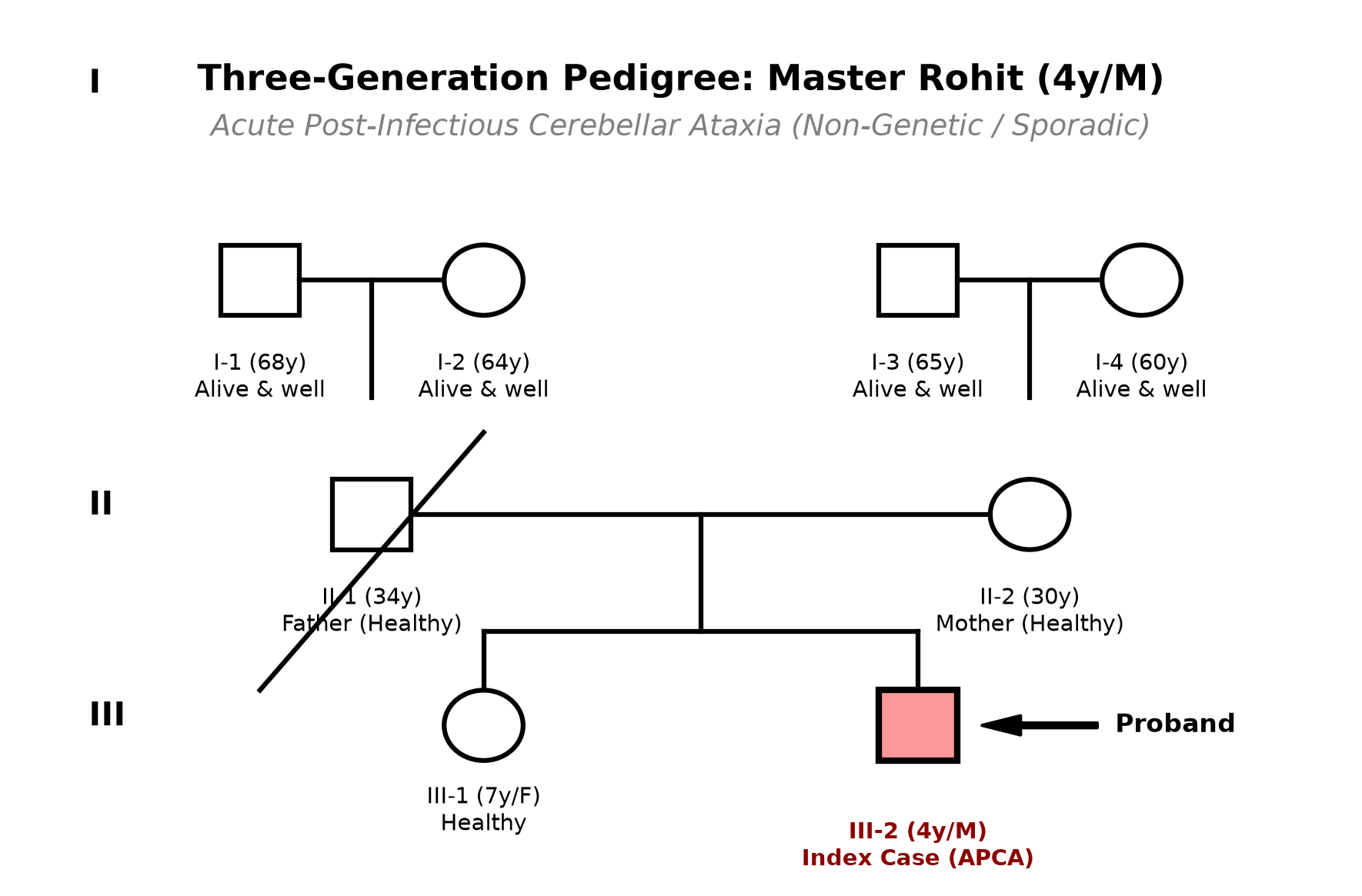
5. Family History & Pedigree
- Parents are non-consanguineous (Class 0 consanguinity).
- Father is 34 years old, Mother is 30 years old; both are healthy.
- Elder sister is 7 years old, studying in Class 2, healthy with no neurological complaints.
- No family history of childhood ataxia, cardiomyopathy, early sudden deaths, or neurodegenerative disorders.
6. General Physical Examination
- Child Behavioral State: Prechtl State 4 (Alert, cooperative, comfortable in mother's lap).
- Vitals:
- Heart Rate: 92 beats/min (regular, normal volume, no radio-femoral delay)
- Respiratory Rate: 22 breaths/min (regular, abdominothoracic)
- Blood Pressure: $96/62\text{ mmHg}$ ($50^{\text{th}}-75^{\text{th}}$ percentile for age, sex, and height centile)
- Temperature: $98.4^\circ\text{F}$ (Afebrile)
- Capillary Refill Time (CRT): $<2$ seconds, peripheral extremities warm
- General Signs:
- Pallor: Absent
- Icterus: Absent
- Cyanosis: Absent
- Clubbing: Absent
- Lymphadenopathy: Absent
- Edema: Absent
- Cutaneous Examination:
- Multiple hypopigmented crusted macules and healed excoriations scattered over the trunk, face, and back (consistent with resolving Varicella lesions).
- No oculocutaneous telangiectasia on bulbar conjunctiva or ear lobes.
- No café-au-lait spots, hypopigmented macules, or neurofibromas.
- Skeletal Survey:
- Spine: Normal lordosis, no scoliosis, no kyphosis, no midline spinal dysraphic defects.
- Feet: Normal plantar arch, no pes cavus, no hammer toes.
Anthropometry
| Metric | Patient Value | Expected (50th Centile WHO) | Z-Score | Classification |
|---|---|---|---|---|
| **Weight** | 16.0 kg | 16.3 kg | -0.22 SD | Normal |
| **Height** | 102.5 cm | 103.3 cm | -0.20 SD | Normal |
| **Weight-for-Height** | 100% | 100% | 0.0 SD | Normal |
| **Head Circumference**| 50.2 cm | 50.0 cm | +0.15 SD | Normocephalic |
| **MUAC** | 14.8 cm | — | >13.5 cm | Normal Nutrition |
7. Central Nervous System (CNS) Examination
A. Higher Mental Functions (HMF)
- Sensorium: Fully conscious, alert, oriented to parents and hospital setting.
- Behavior & Mood: Pleasant, interactive, no emotional lability or euphoria.
- Speech:
- Fluency: Intact, but speech is scanning and dysarthric (words broken into irregular syllables with unnatural pauses and explosive syllable emphasis).
- Comprehension: Age-appropriate; understands 3-step commands.
- Repetition and Naming: Intact.
- Memory & Cognition: Normal for age; remembers preschool rhymes and identifies primary colors.
B. Cranial Nerves
- CN I: Grossly intact (identifies familiar scents like banana/soap).
- CN II: Visual acuity intact (tracks small 5 mm objects at 3 meters); Visual fields full by confrontation; Fundoscopy: Bilateral normal disc margins, distinct physiological cups, no papilledema, no optic atrophy, no cherry-red spot.
- CN III, IV, VI:
- Extraocular movements: Full range in all directions without limitation.
- Saccades: Dysmetric saccades with small corrective catch-up saccades (ocular dysmetria).
- Nystagmus: Coarse, horizontal, bilateral gaze-evoked nystagmus (fast phase in the direction of gaze).
- Opsoclonus: Absent (no chaotic multidirectional saccades).
- Pupils: 3 mm, bilaterally round, regular, reactive to direct and consensual light.
- CN V: Sensation over $V_1, V_2, V_3$ intact; Corneal reflex present; Masseter strength normal.
- CN VII: Face symmetrical; nasolabial folds well-preserved; eye closure complete; smile symmetric.
- CN VIII: Responds to whispered words; Weber and Rinne normal.
- CN IX, X: Uvula central; palate elevates symmetrically; gag reflex present; swallowing normal.
- CN XI: Sternocleidomastoid and trapezius muscle power Grade 5/5.
- CN XII: Tongue protrudes in midline, no fasciculations, no atrophy.
C. Cerebellar Examination Battery
| Cerebellar Test | Clinical Technique | Right Side | Left Side | Anatomical Localization |
|---|---|---|---|---|
| **Titubation** | Observe head & trunk while sitting unsupported | **Present** (slow rhythmic $3\text{ Hz}$ anteroposterior swaying) | **Present** | Cerebellar Vermis |
| **Finger-to-Nose Test (FNT)** | Patient touches index finger to own nose, then examiner's moving finger | **Impaired** (pronounced intention tremor & overshooting) | **Impaired** (pronounced intention tremor & overshooting) | Bilateral Neocerebellum (Dentate / Superior Peduncle) |
| **Finger-to-Finger Test** | Pointing index fingers together in midline | Overshoots by $1.5\text{ cm}$ | Overshoots by $2.0\text{ cm}$ | Bilateral Cerebellar Hemispheres |
| **Dysdiadochokinesia** | Rapid alternating pronation and supination of forearms | **Impaired** (slow, irregular, arrhythmic) | **Impaired** (slow, irregular, arrhythmic) | Intermediate & Lateral Cerebellar Cortex |
| **Holmes Rebound Phenomenon** | Arm flexed against resistance, abruptly released | **Exaggerated** (rebound overshoot towards face) | **Exaggerated** (rebound overshoot towards face) | Loss of cerebellar antagonistic braking |
| **Stewart-Holmes Sign** | Resistance against flexed forearm suddenly removed | **Positive** (inability to check movement) | **Positive** (inability to check movement) | Cerebellar Hypotonia |
| **Pendular Knee Jerk** | Tapping patellar tendon with legs dangling freely | **Positive** (5-6 undamped oscillating swings) | **Positive** (5-6 undamped oscillating swings) | Lack of antagonistic muscle tone |
| **Heel-to-Shin Test (HKST)** | Slide heel down opposite anterior tibial crest | **Ataxic** (frequent slipping off shin bilaterally) | **Ataxic** (frequent slipping off shin bilaterally) | Spinocerebellum & Hemispheres |
| **Gait Assessment** | Spontaneous walking | **Wide-based ($>25\text{ cm}$), staggering, lurching, titubating** | | Vermis + Bilateral Hemispheres |
| **Tandem Walking** | Heel-to-toe walking along a straight line | **Unable** (falls to either side within 2 steps) | | Vermis / Midline |
| **Romberg's Test** | Feet together, arms by side, eyes open then closed | **Unsteady with eyes open; sways equally with eyes open & closed** | | **True Cerebellar Ataxia** (Romberg Negative) |
D. Motor System Examination
- Muscle Bulk / Nutrition: Normal bulk in all muscle groups; no focal atrophy, wasting, or pseudohypertrophy.
- Tone: Generalized hypotonia in all four limbs (increased passive range of motion at wrists, elbows, knees, and ankles).
- Power: MRC Grade 5/5 in all major muscle groups proximally and distally in upper and lower limbs.
- Reflexes:
- Biceps Jerk ($C_5-C_6$): $1+$ (Diminished / Pendular) bilaterally
- Triceps Jerk ($C_7-C_8$): $1+$ (Diminished / Pendular) bilaterally
- Supinator Jerk ($C_5-C_6$): $1+$ bilaterally
- Knee Jerk ($L_3-L_4$): Pendular Knee Jerk (dangling leg oscillates $>4$ times before coming to rest)
- Ankle Jerk ($S_1$): $1+$ bilaterally
- Superficial Reflexes:
- Abdominal Reflex: Present in all four quadrants.
- Plantar Response: Flexor bilaterally ($\downarrow / \downarrow$).
E. Sensory System Examination
- Superficial Sensation: Touch, pinprick pain, and temperature intact bilaterally in all dermatomes.
- Deep / Cortical Sensation:
- Joint Position Sense (Proprioception): Intact at distal interphalangeal joints of great toes and fingers ($10/10$ correct responses).
- Vibration Sense (128 Hz tuning fork): Intact over medial malleoli, tibial tuberosity, and anterior superior iliac spine bilaterally.
- Sensory exam conclusively rules out Sensory Ataxia / Posterior Column Disease.
F. Meningeal Signs, Spine & Cranium
- Neck Rigidity: Absent
- Kernig's Sign: Negative
- Brudzinski's Sign: Negative
- Cranium: Macewen's sign (cracked pot sound) negative; no cranial bruit.
8. Other Systemic Examination
- Cardiovascular System: Heart rate 92 bpm, regular; Apex beat in $4^{\text{th}}$ intercostal space, $1\text{ cm}$ medial to midclavicular line; normal $S_1, S_2$; no murmurs, no gallop, no signs of hypertrophic cardiomyopathy.
- Respiratory System: Bilateral vesicular breath sounds, no rales or rhonchi.
- Abdomen: Soft, non-tender, no hepatosplenomegaly; no palpable flank or retroperitoneal mass (rules out Neuroblastoma).
9. Comprehensive Localization & Diagnostic Formulation
A. Anatomical Localization
$$\text{Clinical Features} \implies \text{Pancerebellar Involvement (Vermis + Bilateral Hemispheres)}$$- Cerebellar Vermis (Paleocerebellum / Spinocerebellum): Evidenced by prominent truncal titubation, severe wide-based staggering gait, inability to perform tandem walking, and scanning dysarthric speech.
- Cerebellar Hemispheres (Neocerebellum / Cerebrocerebellum): Evidenced by bilateral symmetrical dysmetria (finger-nose, finger-finger, heel-shin tests), dysdiadochokinesia, exaggerated Holmes rebound phenomenon, and intention tremors.
- Vestibulocerebellum (Flocculonodular Lobe): Evidenced by horizontal gaze-evoked nystagmus and ocular dysmetria.
B. Pathophysiological Localization
- The acute onset (over 24–48 hours) occurring 10 days following Varicella infection with isolated cerebellar signs, normal sensorium, preserved power, absence of pyramidal signs, flexor plantars, and intact proprioception is characteristic of immune-mediated post-infectious demyelination / cerebellitis affecting Purkinje cells and cerebellar white matter.
C. Differential Diagnosis Matrix
| Condition | Points in Favor | Points Against / Differentiating Features |
|---|---|---|
| **Acute Post-Infectious Cerebellar Ataxia (APCA)** | • 4-year-old child<br>• Preceding Varicella 10 days ago<br>• Acute isolated pancerebellar signs<br>• Normal sensorium, flexor plantars | **Most Probable Diagnosis** (Benign, self-limiting course over 2–8 weeks) |
| **Acute Disseminated Encephalomyelitis (ADEM)** | • Post-infectious demyelination<br>• Acute neurological onset | • No encephalopathy / no altered sensorium<br>• No pyramidal tract signs (plantars flexor, no spasticity)<br>• No seizures or multifocal deficits |
| **Posterior Fossa Space Occupying Lesion (Medulloblastoma / Pilocytic Astrocytoma)** | • Ataxia, nystagmus, dysmetria | • No headache, no projectile morning vomiting<br>• No papilledema on fundoscopy<br>• Acute sudden onset rather than insidious progression over months |
| **Opsoclonus-Myoclonus-Ataxia Syndrome (Kinsbourne / Neuroblastoma)** | • Acute ataxia in a preschool child | • No chaotic saccadic opsoclonus<br>• No generalized myoclonic jerks<br>• No palpable abdominal/pelvic mass |
| **Miller Fisher Syndrome (Variant of GBS)** | • Acute ataxia, post-infectious onset<br>• Hyporeflexia | • No ophthalmoplegia (ocular movements full)<br>• Proprioception intact<br>• Post-varicella rather than post-Campylobacter/diarrheal prodrome |
| **Toxic Ingestion (Phenytoin, Benzodiazepines, Alcohol)** | • Acute hyperacute cerebellar ataxia | • No history of accidental ingestion<br>• Preceding Varicella exanthem provides clear immunogenic trigger |
| **Friedreich's Ataxia** | • Cerebellar incoordination, gait ataxia | • Early age (4y vs typical 8-15y)<br>• No extensor plantars, no loss of joint/vibration sense<br>• No pes cavus or cardiomyopathy |
10. Investigation Strategy
flowchart TD
    A["Master Rohit (4y/M) with Acute Post-Varicella Ataxia"] --> B["First-Line Diagnostic Evaluation"]
    B --> C["MRI Brain with Contrast (Posterior Fossa Protocol)"]
    B --> D["Routine Blood & Inflammatory Markers"]
    B --> E["Urine Toxic Screen & VMA/HVA"]

    C -->|Normal or mild cerebellar folial swelling/T2 hyperintensity| F["Confirms APCA; Rules out Posterior Fossa Tumor & ADEM"]
    D -->|CBC, ESR, CRP, LFT, RFT| G["Normal; Baseline evaluation"]
    E -->|Normal 24-hr urinary VMA / HVA| H["Rules out Occult Neuroblastoma"]

    F --> I["Lumbar Puncture (If diagnosis atypical or progressive)"]
    I --> J["CSF: Normal pressure, mild lymphocytic pleocytosis (<20 cells/µL), normal glucose, normal/mildly elevated protein, VZV PCR"]

    J --> K["Supportive Management & Clinical Monitoring"]
A. Neuroimaging (Gold Standard for Rule-Out)
- MRI Brain with Contrast (including Diffusion Weighted Imaging and Posterior Fossa coronal/sagittal views):
- Expected in APCA: Usually completely normal ($>70\%$ of cases) or shows subtle bilateral symmetrical T2/FLAIR hyperintensity in the cerebellar cortex/vermis with minimal swelling, without ring enhancement or mass effect.
- Purpose: Definitively rules out medulloblastoma, cerebellar astrocytoma, brainstem encephalitis, cerebellar hemorrhage, and multifocal white matter demyelination of ADEM.
B. Cerebrospinal Fluid (CSF) Analysis
- Typically deferred in classic post-varicella APCA if MRI is normal, but if performed:
- Opening pressure: Normal
- Cytology: Normal or mild lymphocytic pleocytosis ($<20\text{ cells}/\mu\text{L}$)
- Biochemistry: Protein normal or mildly elevated ($45-80\text{ mg/dL}$), normal glucose ($>60\%$ of blood glucose)
- VZV-DNA PCR & Oligoclonal bands: May be positive, reflecting immune-mediated intrathecal synthesis.
C. Neuroblastoma Rule-Out
- 24-hour Urinary Homovanillic Acid (HVA) and Vanillylmandelic Acid (VMA): Normal (mandatory rule-out in young children presenting with acute ataxia, even without classical opsoclonus).
- Ultrasound Abdomen & Pelvis: Normal adrenal glands and sympathetic chain.
11. Comprehensive Management Plan
A. Supportive & Inpatient Nursing Care
- Safety & Fall Prevention:
- Bed with side rails padded; supervised ambulation at all times; wheelchair / stroller assistance for hospital transfers.
- Avoid sedating medications (antihistamines, sedatives) that could worsen ataxia.
- Nutritional Support:
- Soft, easily swallowable diet; supervise feeding to prevent choking given mild scanning dysarthria.
- Address daily calorie deficit ($210\text{ kcal/day}$) with calorie-dense snacks (banana shakes, nut pastes, extra ghee).
B. Pharmacotherapy
- Conservative Approach (Standard of Care):
- In $>95\%$ of children with post-varicella APCA, the disease is self-limiting. No specific antiviral (Acyclovir is not indicated once exanthem has crusted and cerebellitis is post-infectious immune-mediated).
- Indications for Immunomodulatory Therapy:
- Reserved strictly for severe, disabling, progressive ataxia preventing independent sitting, severe intractable vomiting, or transition into ADEM: $$\text{IV Methylprednisolone: } 30\text{ mg/kg/day (Max 1 g/day) for 3 to 5 days}$$ $$\text{OR IVIG: } 2\text{ g/kg total dose over 2 to 5 days}$$
C. Physical & Occupational Rehabilitation
- Coordinate with pediatric physiotherapist for balance training, core stability exercises, weighted vests/walkers, and vestibular rehabilitation as recovery ensues.
D. Prognosis & Follow-Up
- Parents counseled that recovery typically begins within 2 to 3 weeks, with complete neurological recovery in $85-90\%$ of children within 2 to 3 months.
- Scheduled follow-up at 2 weeks, 6 weeks, and 3 months with repeat formal cerebellar scoring (SARA Score).
12. Final Spoken Diagnosis
"Master Rohit, a 4-year-old right-handed male child, presenting with acute-onset progressive ataxia 10 days post-varicella infection, has a clinical diagnosis of Acute Post-Infectious Cerebellar Ataxia (APCA). Anatomically, the lesion involves the pancerebellar axis (vermis and bilateral cerebellar hemispheres), characterized clinically by titubation, severe truncal ataxia, bilateral dysmetria, intention tremor, dysdiadochokinesia, and scanning dysarthria. There is no evidence of raised intracranial pressure, focal pyramidal weakness, sensory ataxia, or opsoclonus-myoclonus, and the child has normal nutritional status with age-appropriate prior development."