
Master Krrish, a 7 year old boy, 2nd order child born of a non-consanguineous marriage from Jaipur, Rajasthan presented with complaints of puffiness of the face and eyelids for 4 days, passing cola-colored smoky urine for 3 days, decreased frequency and volume of urine for 3 days, and severe throbbing headache with two episodes of vomiting since yesterday.
- Puffiness of the face (predominantly periorbital, non-dependent, firm)
- Macroscopic hematuria (cola-colored, smoky, black-tea, or rusty urine)
- Oliguria (abrupt reduction in urine volume and frequency)
- Headache, vomiting, and visual blurring (signs of severe acute systemic hypertension / encephalopathy)
- Breathlessness and orthopnea (acute pulmonary capillary congestion and circulatory overload)
HOPI
The history is dated back to 4 days ago when the mother noticed swelling around the child's eyes and face upon waking up.
Always establish the classical nephritic triad: Hematuria, Hypertension, and Oliguria with Edema. Elicit the specific latent period between the antecedent streptococcal infection and renal manifestations:
- Post-Streptococcal Pharyngitis: Latent period of 1 to 2 weeks (caused by nephritogenic strains 1, 4, 12, 25).
- Post-Streptococcal Pyoderma / Impetigo: Latent period of 3 to 6 weeks (caused by nephritogenic strains 2, 49, 55, 57, 60). Actively interrogate for signs of hypertensive emergency (headache, vomiting, convulsions, visual blurring) and circulatory congestion (dyspnea, orthopnea, cough). Inquire about hematuria characteristics: uniform smoky discoloration throughout micturition denotes glomerular origin, whereas bright red blood with clots indicates lower urinary tract bleeding.
- Periorbital & Facial Puffiness:
- Noticed 4 days ago, initially involving the eyelids, then spreading to the cheeks and forehead.
- Unlike nephrotic edema, the swelling did not fluctuate dramatically throughout the day, did not pit easily, and was not associated with gross scrotal or abdominal distension Points to acute nephritic fluid retention driven by decreased glomerular filtration rate and avid renal tubular sodium reabsorption.
- Macroscopic Glomerular Hematuria:
- Since 3 days ago, the child started passing dark, brownish, cola-colored / smoky red urine.
- Present uniformly from the beginning to the end of the urinary stream (total hematuria).
- Passed without dysuria, burning sensation, gravel, or blood clots Brownish-black cola color results from tubular oxidation of hemoglobin to acid hematin in an acidic, concentrated urinary environment; absence of clots is a hallmark of glomerular hemorrhage.
- Oliguria:
- Marked reduction in urine output noticed over the last 3 days; child voids only once or twice in 24 hours, passing less than half a small cup each time Signifies abrupt reduction in GFR secondary to endocapillary proliferative occlusion of glomerular capillary loops.
- Hypertensive Encephalopathy Symptoms:
- Since yesterday morning, the child developed a severe, continuous, throbbing frontal and occipital headache.
- Associated with two episodes of non-bilious, projectile vomiting not related to food intake.
- Mother reports the child appeared unusually dull, complained that objects looked "hazy and dim" (transient visual blurring), and preferred to lie quietly in a dark room Critical red-flag symptoms of acute hypertensive encephalopathy with loss of cerebral autoregulatory vasoconstriction.
- Antecedent Streptococcal Infection:
- Exactly 3 weeks ago, the child developed multiple honey-colored crusted sores and pustules over both legs and shins (impetigo contagiosa / pyoderma).
- Treated locally with antiseptic powder and homemade turmeric paste by parents without oral antibiotics; lesions healed with residual dark pigmented scars 1 week ago Confirms classical 3-week latent period characteristic of nephritogenic streptococcal pyoderma.
- Negative History:
- No history of gross hematuria occurring simultaneously with a sore throat or viral fever Rules out synpharyngitic hematuria of IgA nephropathy (Berger disease).
- No history of prior recurrent episodes of cola-colored urine or red urine in the past.
- No history of palpable purpura over the buttocks, knees, or thighs; no colicky abdominal pain or melena Rules out IgA vasculitis (Henoch-Schönlein purpura nephritis).
- No history of butterfly rash over cheeks, oral ulcers, alopecia, or joint swelling Rules out Systemic Lupus Erythematosus.
- No history of orthopnea, paroxysmal nocturnal dyspnea, or frothy pink sputum Rules out overt acute pulmonary edema.
- No history of sensorineural deafness or family members with renal failure Rules out Alport syndrome.
Past History
- No prior history of renal disease, facial swelling, hypertension, or hematuria.
- No history of bronchial asthma, cardiac disease, or epilepsy.
- No known drug allergies.
Family history
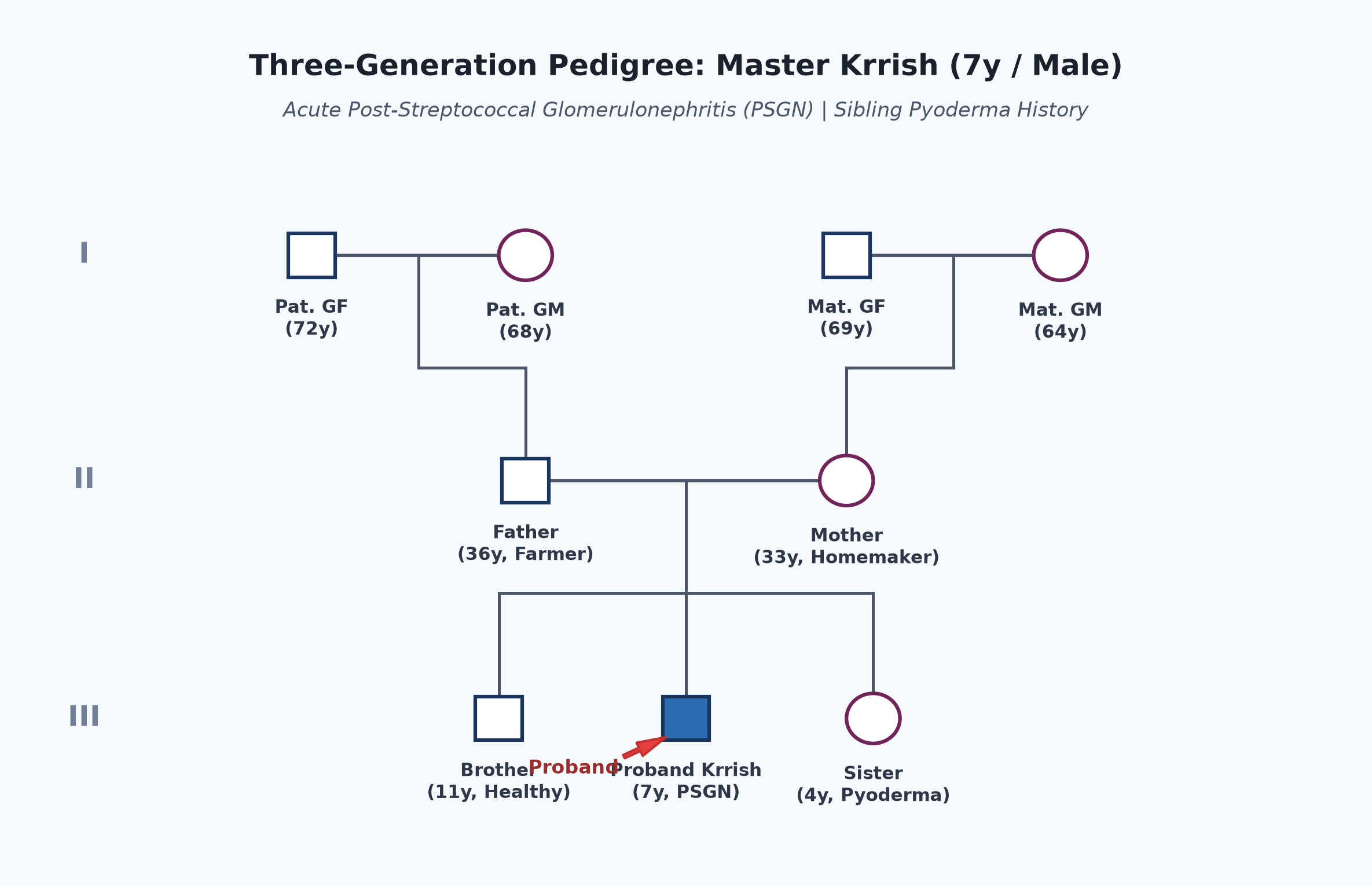
- Born of non-consanguineous marriage.
- Father 36 years, farmer; mother 33 years, homemaker; both healthy.
- Elder brother (11 years) is completely asymptomatic.
- Younger sister (4 years) developed similar pyoderma lesions over her knees 2 weeks ago and was recently treated with oral amoxicillin.
- No family history of hypertension, chronic glomerulonephritis, early dialysis, or early sudden deaths.
Immunization history
- Completely immunized up to date as per National Immunization Schedule (UIP), including BCG, OPV, Pentavalent, Rotavirus, PCV, fIPV, MR, and DPT boosters at 16-24 months and 5 years.
Dietary history
- Consumes a mixed rural diet consisting of bajra/wheat rotis, dal, and locally grown vegetables.
- Parents report adding extra raw salt to curries.
| Food Item | Quantity | Calories (kcal) | Protein (g) |
|---|---|---|---|
| Bajra / Wheat Roti (3) | 90 g flour | 306 | 9.8 |
| Moong Dal (1 bowl) | 35 g raw | 119 | 8.4 |
| Vegetable Sabzi (Potato & Gourd) | 1 bowl | 110 | 2.1 |
| Buttermilk (Chaas with salt) | 200 mL | 80 | 3.6 |
| Jaggery / Roasted Chana | 30 g | 115 | 4.2 |
| Total Observed Daily Intake | — | 730 kcal | 28.1 g |
24-Hour Recall Deficit Analysis
$$ \text{Ideal Body Weight (IBW for 7 years, 50th centile WHO)} = 23.0\text{ kg} $$| Nutrient | Expected Intake (ICMR-NIN 2024 for IBW 23.0 kg) | Observed Intake | Deficit | Percentage Deficit |
|---|---|---|---|---|
| Energy (kcal) | $23.0\text{ kg} \times 70\text{ kcal/kg} = 1610\text{ kcal}$ | 730 kcal | 880 kcal | 54.7% Deficit |
| Protein (g) | $23.0\text{ kg} \times 0.95\text{ g/kg} = 21.85\text{ g}$ | 28.1 g | Nil (Adequate) | 0% Deficit |
The expected calories and proteins should be calculated from the ideal body weight, not from current weight.
Socioeconomic and KAP
- Belongs to Modified BG Prasad Socioeconomic Class IV (Lower Middle Class).
- Resides in a semi-pucca rural house with open drainage outside and well-water supply.
- Parents were unaware that childhood skin sores could lead to kidney damage and high blood pressure; brought child to hospital due to persistent headache and dark urine.
Summary of History
Master Krrish, a 7-year-old boy, 2nd order child born of non-consanguineous parents from Jaipur, presented with acute onset of periorbital and facial puffiness for 4 days, cola-colored smoky hematuria and oliguria for 3 days, and severe headache with vomiting for 1 day, following a 3-week latent period after crusted pyoderma of both legs, without features of synpharyngitic hematuria, joint pains, skin purpura, or chronic hearing loss.
I would like to think of an Acute Nephritic Syndrome secondary to Acute Post-Streptococcal Glomerulonephritis (PSGN / PIGN), complicated by Stage 2 Systemic Hypertension with Hypertensive Encephalopathy and acute fluid overload, currently in the oliguric phase.
General head to toe examination
- Child Behavioral State: Child is alert but irritable, holding his head, photophobic, responding appropriately to verbal commands; no delirium or disorientation.
- Vitals:
- Pulse Rate: 108 beats/minute, regular, full volume, bounding peripheral pulses; no radio-femoral delay.
- Respiratory Rate: 24 breaths/minute, regular, abdominothoracic, no grunting, no deep acidotic Kussmaul breathing.
- Blood Pressure: Right upper limb (supine, seated, appropriate cuff covering 80% arm length): $142/96\text{ mmHg}$ ($>99^{\text{th}}\text{ centile} + 5\text{ mmHg}$ for age, sex, and height centile — Stage 2 Hypertension / Hypertensive Emergency).
- Temperature: $37.0^\circ\text{C}$ (afebrile).
- Capillary Refill Time: $<2\text{ seconds}$; extremities warm.
- Anthropometry:
| Parameter | Observed | Expected (50th WHO) | Z-score / Centile | Inference |
|---|---|---|---|---|
| Weight | 24.5 kg | 23.0 kg | Normal ($50^{\text{th}}-75^{\text{th}}$) | Mild fluid overload ~1.5 kg |
| Height | 122 cm | 122 cm | $50^{\text{th}}\text{ centile}$ | Normal stature |
| BMI | $16.4\text{ kg/m}^2$ | $15.5\text{ kg/m}^2$ | Normal | Age-appropriate |
- General Physical Findings:
- Edema: Moderate periorbital and facial puffiness; non-dependent, firm, non-pitting. Mild pretibial pitting edema ($1+$) over the lower third of both shins. Scrotal edema absent.
- Skin Lesions: Multiple (4-5) round-to-oval hyperpigmented macules with post-inflammatory scarring over both pretibial surfaces, representing healed impetiginous lesions.
- Pallor: Mild pallor in palpebral conjunctiva (dilutional).
- Icterus, Cyanosis, Clubbing, Lymphadenopathy: Absent.
- Fundoscopy: Bilateral arteriolar narrowing and tortuosity (Grade I–II Hypertensive Retinopathy); no papilledema, no flame hemorrhages, no cotton wool spots.
Systemic Examination
Abdomen
- Inspection: Flat, moves symmetrically with respiration; umbilicus inverted, normal; no dilated veins, no visible pulsations.
- Palpation:
- Soft, non-tender throughout; no guarding, no rigidity.
- Liver: Palpable 2.5 cm below right costal margin in midclavicular line, soft-to-firm, smooth surface, round edge, mildly tender to palpation; total liver span 10.0 cm (congestive hepatomegaly secondary to systemic venous fluid overload).
- Spleen: Not palpable.
- Kidneys: Non-ballotable bilaterally; renal angles non-tender.
- Percussion: Tympanitic throughout; shifting dullness and fluid thrill are absent (no clinically detectable ascites).
- Auscultation: Normal bowel sounds; no epigastric or renal artery bruits.
Cardiovascular System (CVS)
- Precordium normal, no precordial bulge.
- Apex beat: 5th intercostal space at midclavicular line, forceful and tapping in character.
- Heart Sounds: $S_1$ normal, $S_2$ shows a loud, accentuated aortic component ($A_2$) heard best over the right 2nd intercostal space (reflects elevated systemic arterial pressure).
- Murmurs: No organic murmurs, no $S_3$ gallop, no pericardial friction rub.
- JVP: Mildly elevated (3 cm above sternal angle at 45 degrees), non-pulsatile (fluid overload).
Respiratory System (RS)
- Bilateral symmetrical chest excursion, no retractions.
- Percussion: Resonant note bilaterally.
- Auscultation: Vesicular breath sounds bilaterally with fine, end-inspiratory crackles heard at bilateral lung bases that do not clear with coughing Points to early, incipient pulmonary capillary congestion from hypervolemic fluid overload.
Central Nervous System (CNS)
- Conscious, alert, oriented to time, place, and person; speech clear.
- Cranial nerves I-XII clinically intact; pupils equal and briskly reacting to light (3 mm bilaterally).
- Motor System: Normal muscle bulk; tone normal in all four limbs; power 5/5 throughout.
- Deep Tendon Reflexes: $2+$ in biceps, triceps, knee, and ankle jerks bilaterally; plantars flexor bilaterally.
- Meningeal Signs: Neck stiffness and Kernig sign absent (excludes meningitis).
other systems
- Musculoskeletal: No spinal deformity, no joint swelling, warmth, or tenderness.
- Genitalia: Normal male genitalia, circumcised, testes descended bilaterally; no scrotal swelling.
Summary
Master Krrish, a 7-year-old boy, 2nd order child born of non-consanguineous marriage from Jaipur, presented with a 4-day history of facial puffiness, cola-colored hematuria, and oliguria for 3 days, accompanied by severe headache, vomiting, and visual blurring for 1 day, developing 3 weeks after an episode of untreated cutaneous pyoderma. Examination reveals marked Stage 2 systemic hypertension ($142/96\text{ mmHg}$), accentuated $A_2$, mild congestive tender hepatomegaly (liver span 10 cm), bilateral basilar crackles, Grade I-II hypertensive retinopathy on fundoscopy, and healed scars of impetigo, in the absence of papilledema, gross ascites, or neurological deficits.
The clinical presentation is pathognomonic for Acute Post-Streptococcal Glomerulonephritis (PSGN / Post-Infectious GN) in the acute oliguric phase, complicated by Hypertensive Emergency with Hypertensive Encephalopathy and hypervolemic circulatory congestion.
Differential Diagnosis
| Disease | Points IN FAVOR | Points AGAINST |
|---|---|---|
| Acute Post-Streptococcal Glomerulonephritis (PSGN) | 3-week latent period after pyoderma, cola-colored urine, oliguria, Stage 2 hypertension, periorbital edema, hypervolemia | Primary Diagnosis |
| IgA Nephropathy (Berger Disease) | Macroscopic hematuria in a young school-age male | Recurrent episodes typical, hematuria occurs concurrently with sore throat (synpharyngitic, latent period <48-72 hrs), normal complement C3, no prolonged 3-week latency after skin infection |
| IgA Vasculitis (Henoch-Schönlein Purpura Nephritis) | Glomerulonephritis with hematuria and hypertension | Absence of pathognomonic non-thrombocytopenic palpable purpura over buttocks/extensor limbs, no colicky abdominal pain, no arthritis |
| Lupus Nephritis (Systemic Lupus Erythematosus) | Glomerular hematuria, hypertension, low C3 | Male child, absence of constitutional symptoms, malar rash, photosensitivity, arthritis, or leukopenia |
| Membranoproliferative Glomerulonephritis (MPGN) | Nephritic presentation, hematuria, persistent hypocomplementemia | Usually insidious, accompanied by nephrotic-range proteinuria, fails to resolve C3 at 8-12 weeks; PSGN is acute and typically resolves within weeks |
| Rapidly Progressive Glomerulonephritis (RPGN / ANCA-associated) | Severe oliguria, rapidly worsening azotemia | Rapid downhill course with uremic symptoms, gross proteinuria, and pulmonary hemorrhage; lacks the classic post-impetiginous benign course |
Investigation Protocol & Diagnostic Workup
flowchart TD
    A["Child with Acute Nephritic Syndrome & Cola-Colored Urine"] --> B["Urine Microscopy & Serum Creatinine"]
    B --> C["Confirm Glomerular Bleeding: Dysmorphic RBCs > 80% & RBC Casts"]
    C --> D["Serum Complement C3 & C4 Levels"]
    D --> E{"Is Serum C3 Markedly Depressed with Normal C4?"}
    E -->|Yes| F["Streptococcal Serology: ASO Titer & Anti-DNase B"]
    E -->|No / Both Low| G["Workup for Lupus Nephritis, MPGN, or Cryoglobulinemia"]
    F --> H{"Elevated Anti-DNase B / ASO?"}
    H -->|Positive| I["Confirm Acute PSGN: Initiate Antihypertensive & Diuretic Management"]
    H -->|Negative| J["Follow-up C3 at 8-12 Weeks; Plan Renal Biopsy if C3 Remains Low"]
1. Confirmatory Urinalysis
- Urine Routine & Microscopy:
- Macroscopic cola-colored, smoky appearance with specific gravity $>1.020$ (concentrated urine).
- Dysmorphic Erythrocytes: $>80\%$ of RBCs demonstrate distorted, ring-shaped, or acanthocytic morphology (confirms glomerular origin).
- Red Blood Cell (RBC) Casts: Positive (pathognomonic of acute glomerulonephritis / glomerular basement membrane disruption).
- Proteinuria: Moderate ($1+$ to $2+$, usually non-nephrotic, UPCR $<1.0\text{ mg/mg}$).
- Pus cells: $4-6/\text{hpf}$ without bacteriuria.
2. Streptococcal Serology & Complement Workup
- Serum Complement C3: Markedly depressed ($<30\text{ mg/dL}$, normal $80-160\text{ mg/dL}$) due to alternative complement pathway activation by nephritogenic streptococcal antigens (NAPlr / SPEB).
- Serum Complement C4: Normal (differentiates PSGN from classic pathway activation seen in SLE).
- Streptococcal Antibody Titers:
- Anti-DNase B (Deoxyribonuclease B): Markedly elevated ($>600\text{ U/mL}$) — highest sensitivity ($>90\%$) for post-pyodermal PSGN.
- ASO (Antistreptolysin O) Titer: Mildly elevated or borderline ($240\text{ Todd units}$, normal $<200$) — ASO titers are frequently low or blunted following skin pyoderma due to skin lipids inhibiting streptolysin O antigenicity.
3. Renal Function & Metabolic Assessment
- Serum Creatinine: $1.1\text{ mg/dL}$ (elevated for age; normal $0.4-0.6\text{ mg/dL}$ for 7y).
- Blood Urea Nitrogen (BUN): $44\text{ mg/dL}$ (azotemia secondary to decreased GFR).
- Serum Electrolytes: Serum Sodium $134\text{ mEq/L}$; Serum Potassium $4.8\text{ mEq/L}$ (monitor closely for hyperkalemia in oliguria); Serum Calcium $9.2\text{ mg/dL}$.
- Complete Blood Count: Hb $10.4\text{ g/dL}$ (normocytic normochromic, dilutional pseudoanemia), TLC $8,400/\mu\text{L}$, Platelets $260,000/\mu\text{L}$.
4. Radiological Imaging
- Renal Ultrasonography: Symmetrically normal to slightly enlarged kidneys with increased bilateral cortical echogenicity; corticomedullary differentiation preserved; no hydronephrosis or renal calculi.
- Chest Radiograph: Mild cardiomegaly with prominent pulmonary vascular markings and subtle bilateral perihilar congestion (pulmonary capillary plethora).
Management Plan
1. Emergency Management of Hypertensive Emergency & Encephalopathy
- Immediate Blood Pressure Reduction:
- Goal: Reduce mean arterial pressure (MAP) by $20-25\%$ over the first 6–8 hours, avoiding sudden precipitous drops that could induce cerebral ischemia.
- Intravenous Labetalol: Administer IV bolus at $0.2-0.5\text{ mg/kg}$ slowly over 5 minutes; if inadequate response, start continuous IV infusion at $0.25-1.0\text{ mg/kg/hour}$, titrating against continuous intra-arterial or automated oscillometric BP.
- Alternative oral/sublingual agent: Oral Amlodipine ($0.1-0.2\text{ mg/kg/day}$) or Nicardipine infusion. Avoid ACE inhibitors (Enalapril) during the acute oliguric phase due to the risk of hyperkalemia and acute drop in GFR.
- Diuretic-Driven Volume Offloading:
- Intravenous Furosemide: Administer at $2.0-4.0\text{ mg/kg/dose}$ IV push slowly over 5–10 minutes.
- Furosemide induces brisk natriuresis and venodilation, directly tackling the root pathophysiological mechanism of hypervolemia, lowering blood pressure and resolving pulmonary congestion.
2. Fluid & Dietary Restriction (Oliguric Phase)
- Strict Fluid Balance:
- Total fluid allowance per 24 hours = Insensible Water Loss ($400\text{ mL/m}^2/\text{day}$) + Previous Day's Urine Output + Any extra losses (emesis).
- For a BSA of $0.9\text{ m}^2$, insensible loss is $\approx 360\text{ mL/day}$.
- Fluids administered as $5\%$ Dextrose in water or $0.45\%$ saline; avoid potassium-containing solutions (Ringer lactate contraindicated).
- Strict Sodium Restriction:
- Restrict dietary sodium to $<1\text{ mEq/kg/day}$ (no added salt in food).
- Dietary Potassium & Protein:
- Restrict dietary potassium (avoid citrus fruits, coconut water, bananas) while oliguric. Provide adequate calories ($100-120\text{ kcal/kg}$) via carbohydrates to prevent endogenous protein catabolism.
3. Eradication of Nephritogenic Streptococcus
- Administer oral Amoxicillin ($50\text{ mg/kg/day}$ divided q8h for 10 days) OR a single intramuscular dose of Benzathine Penicillin G ($600,000\text{ Units}$ for $<27\text{ kg}$).
- Clinical Rationale: Antibiotic therapy does not alter the clinical course, severity, or resolution of the established glomerulonephritis, but is strictly indicated to eradicate carriage of nephritogenic strains and prevent spread to household contacts (such as his younger sister).
4. Monitoring & Indications for Renal Replacement Therapy (Dialysis)
- Daily Monitoring: Measure strict intake-output charting, twice-daily body weight on the same scale, 4-hourly blood pressure, and daily serum electrolytes/creatinine.
- Indications for Urgent Hemodialysis / Peritoneal Dialysis:
- Refractory severe hyperkalemia ($>6.5\text{ mEq/L}$) unresponsive to medical therapy (calcium gluconate, salbutamol, insulin-glucose).
- Intractable pulmonary edema / severe fluid overload unresponsive to high-dose IV furosemide.
- Uremic encephalopathy, uremic pericarditis, or intractable severe metabolic acidosis ($pH < 7.15, HCO_3^- < 10\text{ mEq/L}$).
5. Natural History & Mandatory Long-Term Follow-Up
- Diuresis typically begins within 5 to 10 days; blood pressure normalizes within 2 to 4 weeks; gross hematuria clears in 1 to 3 weeks.
- Microscopic hematuria can persist normally for up to 1 to 2 years.
- The C3 Rule (VIVA High-Yield): Serum complement C3 levels MUST normalize within 8 to 12 weeks. Failure of C3 to normalize at 12 weeks is a mandatory indication for Renal Biopsy to diagnose Membranoproliferative Glomerulonephritis (MPGN) or C3 Glomerulopathy.