
Miss Sneha, a 10-year-old female child, 1st order child born of a second-degree consanguineous marriage (parents are first cousins) from Kolkata, West Bengal, presented to the Pediatric Hepatology and Neurology Clinic with chief complaints of progressive yellowish discoloration of eyes and dark urine for 6 months, recurrent episodes of right upper quadrant abdominal pain and progressive abdominal distension with pedal edema for 3 months, subtle neurological symptoms manifested by slurring of speech (dysarthria), drooling of saliva, fine hand tremors noticed during handwriting, and marked academic deterioration over the past 4 months, whose ophthalmic slit-lamp biomicroscopy revealed a pathognomonic, bilateral, golden-brown Kayser-Fleischer (KF) Ring in Descemet's membrane, with laboratory investigations demonstrating an extraordinarily low Serum Ceruloplasmin ($6.2\text{ mg/dL}$), markedly elevated 24-Hour Urinary Copper Excretion ($286\text{ mcg/day}$), and features of decompensated cirrhosis with portal hypertension, scoring 8 points on the Leipzig / Ferenci Scoring System, confirming Definitive Wilson Disease (Hepatolenticular Degeneration), successfully initiated on active decoppering therapy with D-Penicillamine, oral Zinc Acetate, and Pyridoxine, with screening of younger siblings initiated.
When examining a child with Wilson Disease, the examiner will evaluate candidates across five critical axes:
- Age-Dependent Clinical Divergence: Emphasize that in children $<10$ years, Wilson disease presents almost exclusively as Hepatic Disease (acute hepatitis, cirrhosis, or acute liver failure). In children $>10$ years, Neuropsychiatric Symptoms (tremors, dysarthria, dystonia, chorea, academic decline) emerge alongside hepatic involvement.
- The KF Ring Nuance (Classic Viva Trap):
- The Kayser-Fleischer ring is present in $>95-98\%$ of patients with neurological Wilson disease, but in only $50\%$ of pure hepatic cases!
- Absence of a KF ring NEVER excludes hepatic Wilson disease.
- Slit-lamp biomicroscopy is mandatory because naked-eye or pen-torch evaluation is unreliable in dark-brown Asian irises.
- The Copper Paradox: Explain why Serum Ceruloplasmin can be falsely normal during acute liver inflammation (ceruloplasmin is an acute-phase reactant!).
- Wilsonian Acute Liver Failure Triad: Characterized by Coombs-negative hemolytic anemia, paradoxically low Alkaline Phosphatase (ALP to Total Bilirubin ratio $<4.0$), and high AST:ALT ratio ($>2.2$).
- Emergency Decision Point: Calculate the Revised King's College / Nazer Prognostic Index (score $\ge 11$ points predicts 100% mortality without emergent liver transplantation).
Chief Complaints
- Progressive yellowish discoloration of sclera and dark urine for 6 months.
- Progressive abdominal swelling and swelling of both feet for 3 months.
- Slurring of speech, difficulty in pronouncing words clearly, and drooling of saliva for 4 months.
- Trembling of both hands while writing and progressive deterioration in school grades for 4 months.
HOPI
Miss Sneha was apparently healthy until 6 months ago, when her mother first noticed mild yellowish discoloration of her eyes accompanied by high-colored urine:
- Evolution of Hepatic Symptoms:
- The jaundice was insidious in onset, gradually progressive, not associated with severe itching, clay-colored stools, or high-grade fever with chills.
- Intermittent dull aching pain in the right upper abdomen, accompanied by loss of appetite, easy fatigability, and nausea.
- Three months ago, her abdomen began swelling progressively, becoming tense and protuberant.
- Developed bilateral pitting edema over both ankles and feet, worsening towards the evening.
- Mother noted two episodes of spontaneous nosebleeds (epistaxis) and easy bruising over the shins after minor bumps, indicating impaired hepatic synthesis of coagulation factors.
- Onset of Neuropsychiatric Manifestations:
- Approximately 4 months ago, her class teacher contacted the parents regarding a sudden decline in school performance: the child, previously an above-average student, began struggling with mathematics, concentration, and reading comprehension.
- Developed a distinct changes in speech: her voice became soft, nasal, slow, and slurred (Dysarthria), with occasional drooling of saliva from the corners of her mouth while sleeping and speaking.
- Handwriting became progressively shaky, illegible, and small (Micrographia).
- Fine resting tremors noticed in both hands, which became prominent and coarse when she attempted to hold a cup or write (Intention and Wing-Beating Tremors).
- Parents noted emotional lability: frequent unprovoked crying spells and inappropriate laughing.
- No history of seizures, altered sensorium, flapping tremors (asterixis), or reversal of sleep-wake cycle (excludes advanced overt hepatic encephalopathy).
- Negative Inquiries:
- No history of blood transfusions, tattooing, unsterile injections, or dental procedures (reduces Hepatitis B and C likelihood).
- No history of ingestion of indigenous medications, herbal remedies, or overdoses of paracetamol.
- No history of joint pains, malar rash, or hematuria (excludes autoimmune hepatitis and lupus).
Past History
- No prior hospitalizations or history of acute hepatitis in early childhood.
- No history of chronic drug intake or surgery.
Antenatal, Natal, and Developmental History
- Antenatal: Uneventful; full-term normal vaginal delivery; cried immediately; birth weight $3000\text{ grams}$.
- Developmental: Normal motor, language, and cognitive developmental milestones in early childhood; walked at 12 months, spoke sentences fluently by 2.5 years.
Family History
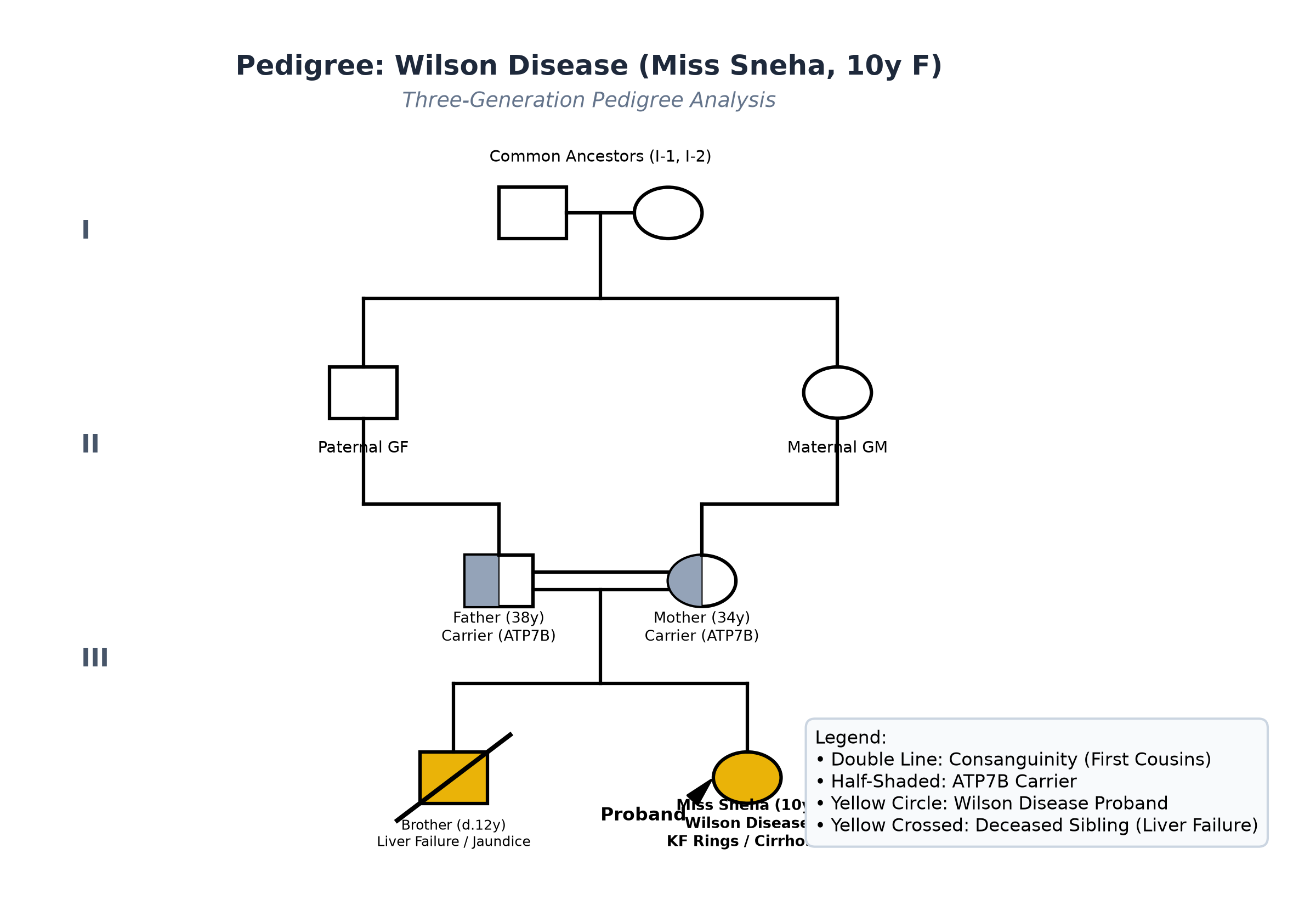
- Consanguinity: Parents are second-degree relatives (first cousins: Father is Mother's maternal first cousin).
- Prior Sibling Death: The elder brother presented at 12 years of age with jaundice, ascites, and sudden upper gastrointestinal bleeding (hematemesis), who died within 3 weeks of admission in a district hospital with a presumed diagnosis of 'cryptogenic cirrhosis' (retrospectively recognized as undiagnosed Wilson disease!).
- Younger brother (6 years old) is currently asymptomatic; requires immediate familial screening.
Immunization History
- Fully immunized up to age according to the National Immunization Schedule, including Hepatitis B (3 doses) and Hepatitis A (2 doses).
Detailed Dietary History & 24-Hour Recall
The child consumes a traditional Bengali home diet. Since copper is excreted exclusively through the biliary tract (which is severely impaired in Wilson disease), dietary copper restriction is essential:
| Food Item | Quantity | Calories (kcal) | Protein (g) | Copper Content |
|---|---|---|---|---|
| Boiled Rice | 2 cups | 320 | 6.4 | Low |
| Moong Dal (watery) | 1.5 katoris | 150 | 9.0 | Moderate |
| Fish Curry (Rohu fish) | 1 small piece | 120 | 14.0 | Moderate |
| Cooked Potato / Gourd (Lau) | 1 katori | 60 | 1.2 | Low |
| Cow's Milk | 250 mL | 160 | 8.0 | Low |
| Chocolates / Nuts (prior habit) | Stopped | — | — | VERY HIGH (Eliminated) |
| Total Observed Daily Intake | — | 810 kcal | 38.6 g | Controlled |
24-Hour Recall Deficit Analysis (ICMR-NIN 2024 Standards)
$$ \text{Ideal Body Weight (IBW for 10 years, 50th centile WHO)} = 32.0\text{ kg} $$| Nutrient | Expected Intake (ICMR-NIN 2024 for IBW 32 kg) | Observed Intake | Deficit | Percentage Deficit |
|---|---|---|---|---|
| Energy (kcal) | $32.0\text{ kg} \times 55\text{ kcal/kg} = 1760\text{ kcal}$ | 810 kcal | 950 kcal | 54.0% Deficit |
| Protein (g) | $32.0\text{ kg} \times 1.0\text{ g/kg} = 32.0\text{ g}$ | 38.6 g | Nil (Adequate) | 0% Deficit |
The expected calories and proteins should be calculated from the ideal body weight, not from current weight.
- Dietary Copper Restrictions: Strict avoidance of copper-rich foods: organ meats (liver), shellfish, crustaceans, mushrooms, nuts, legumes/soy, cocoa/chocolates, and dried fruits. Avoid cooking or storing food in unlined copper or brass vessels.
Socioeconomic & KAP
- Modified BG Prasad Socioeconomic Class III. Parents were counseled on the genetic autosomal recessive basis of the disease, the fatal outcome of the older brother, and the imperative of lifelong compliant chelation therapy.
Summary of History
Miss Sneha, a 10-year-old female child born of consanguineous parents with a family history of an older brother dying of undiagnosed cirrhosis, presents with progressive jaundice, ascites, and coagulopathy for 6 months, associated with progressive neurological deterioration (dysarthria, drooling, tremors, and academic decline) for 4 months, without history of neurotoxin exposure or viral hepatitis.
I would like to formulate a provisional clinical diagnosis of: Chronic Liver Disease with Portal Hypertension and Decompensation (Ascites and Coagulopathy), with Extrapyramidal Neurological Involvement (Dysarthria and Tremors), clinically diagnostic of Wilson Disease (Hepatolenticular Degeneration).
General Physical Examination & Ophthalmic Signs
- General Appearance: Conscious, cooperative, slightly slow to respond; sits with mouth slightly open and intermittent drooling of saliva; moderate icterus visible in sclera; mild pallor; no cyanosis or clubbing.
- Vitals:
- Heart Rate: 84 beats/minute, regular.
- Respiratory Rate: 20 breaths/minute.
- Blood Pressure: $104/68\text{ mmHg}$ (Normal for age).
- Temperature: $37.0^\circ\text{C}$ (Afebrile).
- Anthropometry:
- Weight: 26.5 kg (Observed, including ascites) vs 32.0 kg (Expected 50th centile WHO, $Z$-score: $-1.6\text{ SD}$).
- Height: 131.0 cm vs 138.5 cm (Expected 50th centile WHO, $Z$-score: $-1.2\text{ SD}$).
- BMI: $15.4\text{ kg/m}^2$ (Normal centile).
- Peripheral Stigmata of Chronic Liver Disease:
- Spider Nevi: Two discrete spider angiomas ($3\text{ mm}$) over the upper chest wall and right shoulder with central pulsating arterioles blanching on glass slide pressure.
- Palmar Erythema: Symmetrical erythema over the thenar and hypothenar eminences of both palms.
- Bilateral Pitting Pedal Edema: Moderate pitting edema extending up to the lower one-third of both shins.
- Bruising: Multiple ecchymoses ($2-3\text{ cm}$) over both anterior tibial surfaces.
- Ophthalmic Examination (Slit-Lamp Biomicroscopy):
- Direct pen-torch inspection shows faint brownish discoloration at the upper corneal rim.
- Slit-Lamp Biomicroscopy (Confirmed by Ophthalmologist):
- Pathognomonic, bilateral, symmetrical golden-greenish-brown Kayser-Fleischer (KF) Rings located in Descemet's Membrane at the corneal limbus, forming a complete $360^\circ$ band.
- No anterior subcapsular 'sunflower cataract'.
Detailed Systemic Examination
Abdominal Examination (Hepato-Portal System)
Inspection
- Abdomen is symmetrically distended, everted, full in the flanks, with everted umbilicus.
- Multiple dilated, tortuous superficial abdominal veins visible over the flanks and epigastrium; direction of flow is cephalad away from the umbilicus (Portal Hypertension).
- No surgical scars or striae.
Palpation
- Abdomen is tense but non-tender; no localized guarding.
- Liver: Palpable $1.5\text{ cm}$ below right costal margin; firm consistency, irregular nodular surface, sharp edge, non-tender (total liver span $7.5\text{ cm}$, indicating a small, shrunken, cirrhotic liver with compensatory left lobe hypertrophy).
- Spleen: Palpable $4.5\text{ cm}$ below left costal margin along its long axis; firm in consistency, smooth surface, prominent notch palpable, non-tender (Congestive Splenomegaly secondary to Portal Hypertension).
Percussion
- Flanks are dull to percussion; tympanitic resonance over the central umbilical area.
- Shifting Dullness: Distinct shifting dullness demonstrated (shifts $>3\text{ cm}$ upon turning to the lateral position).
- Fluid thrill: Positive across the lower abdomen, confirming Moderate-to-Severe Free Ascites.
Auscultation
- Bowel sounds present, normal frequency ($6-8/\text{min}$).
- No venous hum heard over the epigastrium (Cruveilhier-Baumgarten sign negative); no arterial bruits over liver or renal vessels.
Central Nervous System & Neurological Examination
Higher Functions & Speech
- Mental Status: Alert, oriented to time, place, and person; response time is mildly prolonged; Mini-Mental State Examination (MMSE) score $24/30$.
- Speech: Nasal, monotonic, slow, and slurred (Extrapyramidal Dysarthria); vocal volume is low (hypophonia); no aphasia.
- Facial Expression: Mask-like, hypomimic facies with a fixed, slightly open-mouth smile (Risus Sardonicus); spontaneous blinking rate decreased ($8-10\text{ blinks/min}$).
Motor System
- Tone: Mild 'cogwheel' rigidity palpable at both wrist and elbow joints bilaterally.
- Power: $5/5$ in all four extremities.
- Involuntary Movements:
- Resting Tremor: Low-frequency ($3-5\text{ Hz}$) pill-rolling tremors of both hands.
- Wing-Beating Tremor: When arms are abducted to $90^\circ$ with elbows flexed and hands placed in front of the chest, coarse, violent, rhythmic, flapping tremors are provoked at the shoulders and elbows (Classical Wing-Beating Tremor).
- Handwriting demonstrates marked tremor with small, cramped lettering (Micrographia).
- Reflexes: Deep tendon reflexes are normal ($2+$) and symmetrical; plantars are flexor bilaterally.
- Coordination & Gait: Finger-to-nose test shows mild terminal intention tremor; tandem walking is slightly unsteady; Romberg test is negative.
Summary
Miss Sneha, a 10-year-old female child born of consanguineous parents with a family history of sibling death from cirrhosis, presents with chronic decompensated liver disease (cirrhosis, portal hypertension, splenomegaly, ascites, coagulopathy), bilateral Kayser-Fleischer rings on slit-lamp, and extrapyramidal neurological signs (dysarthria, wing-beating tremor, cogwheel rigidity, micrographia).
Final Clinical Diagnosis: Wilson Disease (Hepatolenticular Degeneration, ATP7B Gene Mutation), presenting with Hepato-Neurological Phenotype, complicated by Decompensated Cirrhosis, Portal Hypertension with Ascites and Splenomegaly, and Extrapyramidal Movement Disorder, fulfilling the Leipzig / Ferenci Criteria for Definitive Wilson Disease (Score: 8/8).
Differential Diagnosis of Hepato-Neurological Disease in Older Children
| Disorder | Points IN FAVOR | Points AGAINST |
|---|---|---|
| Wilson Disease (ATP7B Mutation) | Age 10y, consanguinity, family history of cirrhosis, KF rings, low ceruloplasmin, high 24h urine copper, cirrhosis + tremors/dysarthria | Primary Diagnosis (Ferenci Score 8) |
| Autoimmune Hepatitis (Type 1 or 2) | Chronic liver disease, jaundice, splenomegaly, high transaminases, female sex | KF rings are ABSENT; copper studies normal; autoimmune markers (ANA, ASMA, LKM-1) negative; does not cause wing-beating tremors or dysarthria |
| Juvenile Parkinsonism / Dystonia | Tremors, rigidity, dysarthria, micrographia | No hepatic involvement, no cirrhosis, normal liver functions, clear corneas without KF rings |
| Viral Hepatitis (Chronic B or C) | Cirrhosis, portal hypertension, ascites | HBsAg, Anti-HCV negative; copper markers normal; no neurological extrapyramidal signs |
| Alpha-1-Antitrypsin Deficiency | Cirrhosis, portal hypertension in childhood | Serum alpha-1-antitrypsin levels normal; PiZZ phenotype absent; does not cause KF rings or basal ganglia copper storage |
Investigation Protocol & Laboratory Confirmation
flowchart TD
    A["Child >5 Years with Unexplained Liver Disease and/or Movement Disorder"] --> B["Mandatory Ophthalmic Slit-Lamp Biomicroscopy: Identify KF Rings"]
    B --> C["Serum Ceruloplasmin + 24-Hour Urinary Copper Excretion (Copper-Free Container)"]
    C --> D["Liver Function Tests: Bilirubin, AST/ALT, ALP, Total Protein/Albumin, PT/INR"]
    D --> E["Calculate Leipzig / Ferenci Diagnostic Score (Clinical + Biochemical + Genetic)"]
    E --> F{"Ferenci Score ≥4 Points?"}
    F -->|Yes| G["Confirm Definitive Wilson Disease"]
    G --> H["Assess Disease Severity: Calculate Revised King's / Nazer Score (OLT vs Chelation)"]
    H -->|Nazer <11| I["Initiate D-Penicillamine + Zinc Acetate + Pyridoxine"]
    H -->|Nazer ≥11| J["Emergency Evaluation for Orthotopic Liver Transplantation (OLT)"]
1. Copper Metabolic & Biochemical Profile
| Investigation | Observed Value | Biological Reference Range | Clinical Significance |
|---|---|---|---|
| Serum Ceruloplasmin | $6.2\text{ mg/dL}$ | $20.0-40.0\text{ mg/dL}$ | Severely Low ($<10\text{ mg/dL}$, 2 Ferenci Points) |
| 24-Hour Urinary Copper | $286.0\text{ mcg/day}$ | $<40.0\text{ mcg/day}$ ($<0.6\text{ mcmol/d}$) | Markedly Elevated ($>2\times$ ULN, 2 Ferenci Points) |
| KF Rings on Slit-Lamp | Bilateral Present | Absent | Definitive Positive (2 Ferenci Points) |
| Neurological Symptoms | Moderate Dysarthria / Tremors | Absent | Present (1 Ferenci Point) |
| Serum Free (Non-Ceruloplasmin) Copper | $24.5\text{ mcg/dL}$ | $5.0-15.0\text{ mcg/dL}$ | Elevated toxic non-bound circulating copper |
| Direct Antiglobulin Test (DAT) | Negative | Negative | Coombs-negative profile |
| Total Ferenci Score | 7 Points | $\ge 4 = \text{Definitive}$ | Definitive Wilson Disease Established |
- Serum Free Copper Calculation: $$\text{Free Copper (mcg/dL)} = \text{Total Serum Copper (mcg/dL)} - [3.15 \times \text{Serum Ceruloplasmin (mg/dL)}] = 44 - [3.15 \times 6.2] = 24.5\text{ mcg/dL}$$ (Normal free copper is $<10-15\text{ mcg/dL}$; elevated level indicates active systemic copper toxicity).
2. Hepato-Metabolic & Coagulation Profile
| Investigation | Observed Value | Biological Reference Range | Clinical Inference |
|---|---|---|---|
| Total Serum Bilirubin | $4.2\text{ mg/dL}$ | $0.2-1.0\text{ mg/dL}$ | Conjugated Hyperbilirubinemia ($2.6\text{ mg/dL}$) |
| Serum AST / ALT | $124\text{ IU/L} / 56\text{ IU/L}$ | AST $<45$, ALT $<40\text{ IU/L}$ | AST : ALT Ratio = $2.2$ (Mitochondrial injury) |
| Alkaline Phosphatase (ALP) | $112\text{ IU/L}$ | $150-380\text{ IU/L}$ | Paradoxically Low ALP (ALP:TBil = 26.6) |
| Serum Albumin | $2.6\text{ g/dL}$ | $3.8-5.0\text{ g/dL}$ | Impaired hepatic synthetic function |
| Prothrombin Time / INR | $21.5\text{ s} / \mathbf{1.85}$ | PT $11-13\text{ s}$, INR $0.9-1.2$ | Severe coagulopathy |
| Hemoglobin | $9.8\text{ g/dL}$ | $11.5-14.0\text{ g/dL}$ | Normocytic anemia (mild hemolysis + hypersplenism) |
| Platelet Count | $88,000/\mu\text{L}$ | $150,000-450,000/\mu\text{L}$ | Thrombocytopenia secondary to congestive hypersplenism |
- Revised King's College / Nazer Prognostic Index Calculation:
- Bilirubin $4.2\text{ mg/dL}$ ($72\text{ mcmol/L} \to 1\text{ pt}$) + INR $1.85$ ($1\text{ pt}$) + AST $124\text{ IU/L}$ ($1\text{ pt}$) + WBC $6,200$ ($0\text{ pt}$) + Albumin $26\text{ g/L}$ ($1\text{ pt}$) = Total Score: 4 Points ($<11\text{ points} \to$ Predicts good response to medical chelation therapy; emergent liver transplant not required currently).
3. Neuroimaging & Abdominal Sonography
- Brain MRI (T2-Weighted & FLAIR):
- Bilateral, symmetrical hyperintensities in the putamen, globus pallidus, caudate nuclei, and thalamus.
- Classic 'Face of the Giant Panda' sign in the midbrain (hyperintense tegmentum preserving the normal hypointense red nuclei and substantia nigra).
- Abdominal Doppler Ultrasound:
- Shrunken, nodular liver with coarsened echotexture (Cirrhosis).
- Splenomegaly ($13.5\text{ cm}$). Dilated portal vein ($11.5\text{ mm}$) with hepatopetal flow.
- Moderate-to-severe free peritoneal fluid (ascites).
Comprehensive Multidisciplinary Management Plan
1. Active Chelation Therapy (Decoppering Regimen)
- D-Penicillamine (First-Line Chelator):
- Dose: Start at low dose $5-10\text{ mg/kg/day}$ ($125-250\text{ mg/day}$) orally to prevent paradoxical initial neurological deterioration, gradually titrated upwards by $125\text{ mg}$ every 2 weeks to target maintenance dose of $20\text{ mg/kg/day}$ ($500\text{ mg}$ twice daily).
- Administration: Administer strictly on an empty stomach (1 hour before or 2 hours after meals).
- Mandatory Co-Therapy: Pyridoxine (Vitamin B6) at $25-50\text{ mg/day}$ orally (penicillamine is a pyridoxine antagonist).
- Monitoring: Monitor for penicillamine toxicity: CBC and urine protein every 2 weeks for the first 2 months (risk of drug-induced leukopenia, thrombocytopenia, aplastic anemia, or membranous nephropathy).
- Zinc Acetate (Decoppering & Maintenance):
- Dose: Elemental Zinc $50\text{ mg}$ two times daily ($100\text{ mg/day}$).
- Crucial Timing Rule: Administer Zinc at least 2 hours apart from D-Penicillamine (avoid simultaneous administration to prevent mutual chelation).
2. Ascites & Cirrhosis Management
- Diuretic Therapy: Oral Spironolactone ($2\text{ mg/kg/day}$) titrated up to $4\text{ mg/kg/day}$, combined with low-dose Furosemide ($0.5-1.0\text{ mg/kg/day}$).
- Sodium Restriction: Strict dietary salt restriction ($<2\text{ g NaCl/day}$).
- Upper Endoscopy Surveillance: Scheduled diagnostic upper GI endoscopy to screen for esophageal varices; initiate non-selective beta-blockers (Propranolol) or endoscopic variceal ligation (EVL) if high-risk varices are identified.
3. Family Screening Protocol (Imperative Mandate)
- Screening of All First-Degree Relatives:
- 6-year-old younger brother: Immediate ophthalmic slit-lamp exam, serum ceruloplasmin, liver function tests, and 24-hour urinary copper.
- Identify and treat pre-symptomatic siblings with Zinc or penicillamine, preventing irreversible liver cirrhosis and brain damage!
- Genetic Counseling: Autosomal recessive inheritance explained (25% recurrence risk in future pregnancies).