
Master Kabir, a 6-year-old male child, 1st order child born of a non-consanguineous marriage from Jaipur, Rajasthan, presented with complaints of high-grade spiking fever with chills for the past 4 weeks, an intermittent pinkish rash appearing predominantly during fever spikes for 3 weeks, swelling, pain, and morning stiffness in both knees and ankles for 2 weeks, and progressive abdominal distension with loss of weight and appetite.
- High-grade spiking quotidian or double-quotidian fever lasting $>2$ weeks
- Evanescent, fleeting salmon-pink macular rash coinciding with temperature spikes
- Polyarthritis or oligoarthritis with marked morning stiffness
- Generalized lymphadenopathy and hepatosplenomegaly
- Pleuritic chest pain or breathlessness (serositis / pericarditis)
- Sudden clinical deterioration with bleeding tendency (Macrophage Activation Syndrome)
HOPI
The history is dated back to 4 weeks ago when the child acutely developed high-grade fever associated with chills and rigors.
Systemic JIA is a systemic autoinflammatory disorder driven by IL-1, IL-6, and IL-18 hypersecretion. The single most pathognomonic historical feature is the Quotidian Fever Pattern: the temperature spikes rapidly to $103-104^\circ\text{F}$ once or twice daily (usually late afternoon/evening), returning completely to baseline ($98.4^\circ\text{F}$) or subnormal between spikes. Contrast this with the continuous remittent fever of Kawasaki disease and typhoid. Inquire strictly about the fleeting nature of the rash (evanescent), Koebner phenomenon, morning limp, and early symptoms of Macrophage Activation Syndrome (bruising, epistaxis, sudden lethargy).
- High-Grade Quotidian Spiking Fever:
- Characteristically spikes once daily in the late afternoon, reaching up to $104^\circ\text{F}$ ($40.0^\circ\text{C}$), preceded by chills and shivering.
- Between spikes, the temperature drops spontaneously or with antipyretics to normal or subnormal levels ($97.8-98.4^\circ\text{F}$) Points to intermittent surge of pyrogenic cytokines (IL-1, IL-6, TNF-alpha) resetting the hypothalamic thermostat.
- During the fever paroxysm, the child appears toxic, prostrated, irritable, and curled in bed; during defervescence between spikes, he sits up, smiles, and plays actively.
- Evanescent Salmon-Pink Rash:
- Appeared 3 weeks ago, coinciding strictly with the fever spikes.
- Described as discrete, pale salmon-pink, non-itchy macules measuring 2 to 5 mm, localized to the chest, back, axillae, and proximal thighs.
- Fades and disappears completely within 1 to 2 hours as the temperature normalizes.
- Mother observed that rubbing or light scratching of the skin induced linear streaks of erythema (Koebner phenomenon) Pathognomonic cutaneous hallmark of active systemic JIA.
- Joint Symptoms (Arthritis):
- Developed progressive swelling, warmth, and aching pain in both knees and both ankles 2 weeks ago.
- Marked morning stiffness: upon waking, the child is stiff and reluctant to walk, requiring 45 to 60 minutes of gentle movement before he can bear weight.
- Joint swelling is persistent and does not migrate from joint to joint Differentiates JIA from the fleeting, migratory polyarthritis of Acute Rheumatic Fever.
- Abdominal Fullness & Weight Loss:
- Mother noted progressive fullness in both upper quadrants of the abdomen.
- Child lost 1.5 kg over the past month with marked anorexia.
- Negative History:
- No history of spontaneous bruising, petechiae, gum bleeds, or dark tarry stools Argues against overt Macrophage Activation Syndrome (MAS) or leukemia.
- No history of chronic cough, evening pyrexia with night sweats, or contact with an adult TB patient Rules out disseminated tuberculosis.
- No history of bilateral non-purulent red eyes, strawberry tongue, or BCG scar erythema Rules out Kawasaki Disease.
- No history of malar butterfly rash, oral ulcers, or photosensitivity Rules out Pediatric SLE.
- No history of unprovoked bone pain awakening the child at night Rules out Acute Lymphoblastic Leukemia / Neuroblastoma.
- No history of travel to forested tribal belts or mosquito-dense zones.
Past History
- No prior history of prolonged fever, joint pains, or skin rashes.
- No history of recurrent pyogenic infections or hospital admissions.
Family history
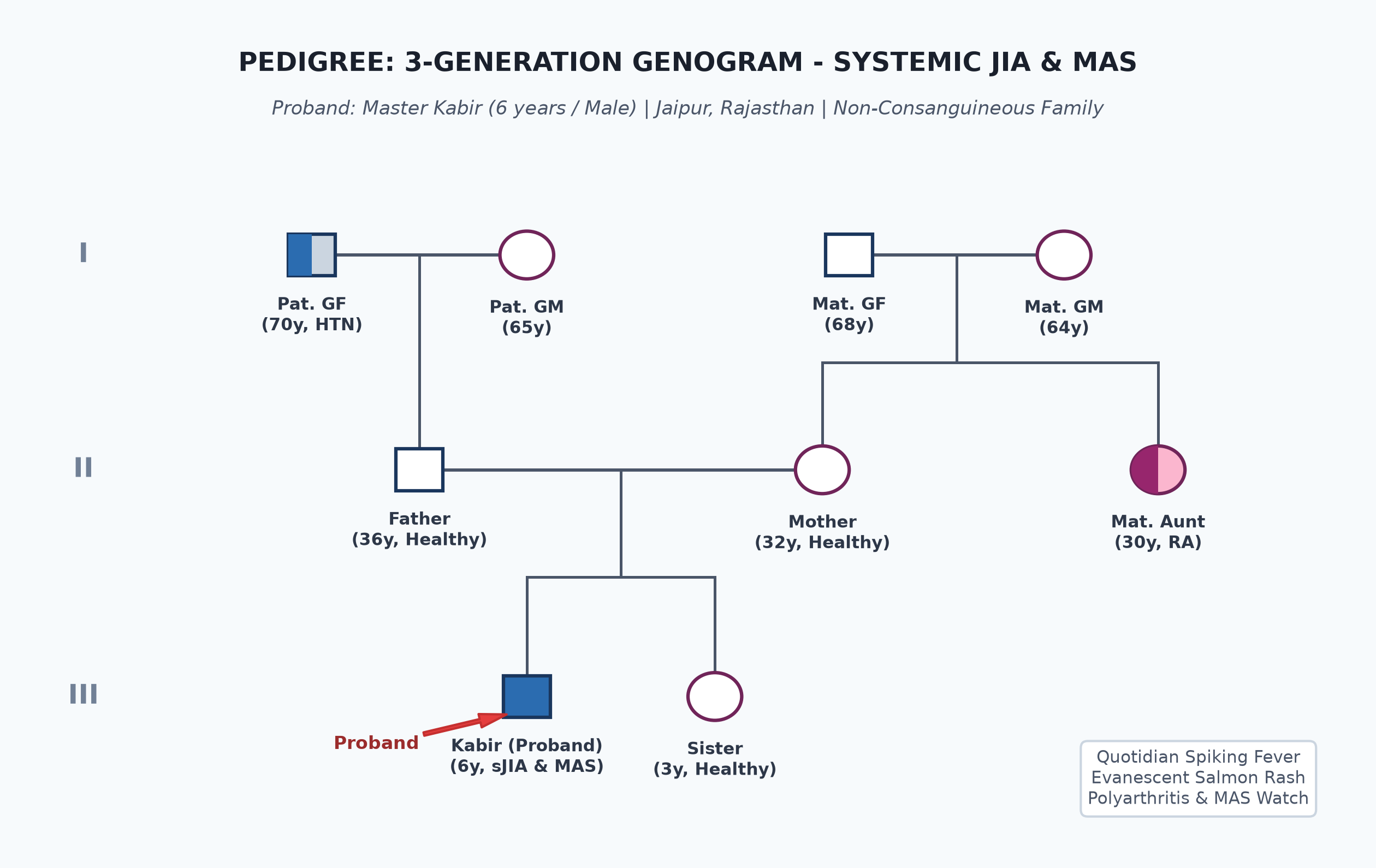
- Born of a non-consanguineous Hindu marriage.
- Father 36 years, bank officer, healthy; Mother 32 years, teacher, healthy.
- Younger sister (3 years old) is completely healthy.
- Maternal Aunt (30 years old): Diagnosed with Seropositive Rheumatoid Arthritis, currently on Methotrexate.
- Paternal grandfather has essential hypertension on Amlodipine.
Immunization history
- Fully immunized up to age as per the National Immunization Schedule, including MMR and typhoid conjugate vaccine.
Dietary history
- Prior to acute illness, consumed an age-appropriate vegetarian diet. Over the past month, intake decreased by 40% due to systemic illness.
24-Hour Recall Deficit Analysis
$$ \text{Ideal Body Weight (IBW for 6 years, 50th centile WHO)} = 20.5\text{ kg} $$| Nutrient | Expected Intake (ICMR-NIN 2024 for IBW 20.5 kg) | Observed Intake | Deficit | Percentage Deficit |
|---|---|---|---|---|
| Energy (kcal) | $20.5\text{ kg} \times 68\text{ kcal/kg} = 1394\text{ kcal}$ | 880 kcal | 514 kcal | 36.9% Deficit |
| Protein (g) | $20.5\text{ kg} \times 1.0\text{ g/kg} = 20.5\text{ g}$ | 12.8 g | 7.7 g | 37.6% Deficit |
Socioeconomic and KAP
- Modified BG Prasad Socioeconomic Class II (Upper Middle Class).
- Lives in an independent pucca house with municipal treated water and sanitation.
- Parents anxious regarding long-term joint deformities and prolonged fever.
Summary of History
Master Kabir, a 6-year-old male child born of non-consanguineous parentage, presented with a 4-week history of high-grade quotidian spiking fever, evanescent salmon-pink rash, symmetrical polyarthritis involving knees and ankles with morning stiffness, and hepatosplenomegaly, in the absence of bleeding diathesis, night bone pain, or tuberculosis contact.
I would like to consider a provisional diagnosis of Systemic Juvenile Idiopathic Arthritis (sJIA / Still's Disease) presenting in active systemic and polyarticular phase, without clinical evidence of Macrophage Activation Syndrome (MAS) or serositis.
General head to toe examination
- Behavioral State: Prechtl State 3 (quiet wakefulness, alert, cooperative during defervescence).
- Vitals:
- Heart Rate: 118 beats/minute, regular, normal volume.
- Respiratory Rate: 22 breaths/minute, regular.
- Blood Pressure: $96/60\text{ mmHg}$ ($50^{\text{th}}$ centile, normotensive).
- Temperature: $37.0^\circ\text{C}$ (Recorded between spikes); documented spike to $39.8^\circ\text{C}$ in ward at 5:00 PM.
- Capillary Refill Time: $<2$ seconds.
- Anthropometry:
| Parameter | Observed | Expected (50th WHO) | Z-score / Centile | Inference |
|---|---|---|---|---|
| Weight | 19.0 kg | 20.5 kg | $-0.5\text{ to } -1.0\text{ SD}$ | Weight loss of 1.5 kg (~7.3%) |
| Height | 115.5 cm | 115.5 cm | $50^{\text{th}}\text{ centile}$ | Normal Stature (No stunting) |
| BMI | $14.2\text{ kg/m}^2$ | $15.3\text{ kg/m}^2$ | $-1.0\text{ SD}$ | Normal BMI |
- General Physical Findings:
- Cutaneous Rash: During fever peak ($39.8^\circ\text{C}$), multiple discrete, pale salmon-pink, non-itchy macules (3 to 6 mm) appeared over the anterior chest, abdomen, and thighs; completely vanished within 90 minutes as temperature settled. Koebner phenomenon positive.
- Lymphadenopathy: Generalized, non-tender, discrete, mobile, rubbery lymphadenopathy involving bilateral cervical ($1.0 \times 1.0\text{ cm}$), axillary ($1.5 \times 1.0\text{ cm}$), and inguinal ($1.0 \times 1.0\text{ cm}$) chains.
- Pallor: Moderate pallor present in conjunctiva and nail beds (anemia of chronic disease / inflammation).
- Icterus, Cyanosis, Clubbing, Edema: Absent.
Musculoskeletal Examination (Joint Assessment)
- Knees (Bilateral): Symmetrical swelling with obliteration of parapatellar hollows; local warmth present; tenderness along joint line; active and passive flexion limited to $100^\circ$ (normal $135^\circ$); Patellar Tap test positive (moderate synovial effusion).
- Ankles (Bilateral): Symmetrical fullness anterior to malleoli; tender on dorsiflexion and plantar flexion.
- Wrists & Small Joints of Hand: Mild tenderness over bilateral radiocarpal joints; no swelling or deformities of MCP or PIP joints.
- Spine & Sacroiliac Joints: Cervical spine range of motion normal; Schober test normal; sacroiliac joint tenderness absent.
- Gait: Antalgic, stiff-legged gait with reduced stride length.
Systemic Examination
Abdomen
- Symmetrically full, soft, non-tender.
- Hepatomegaly: Liver palpable 3.0 cm below right costal margin in midclavicular line, soft-to-firm, smooth surface, non-tender, span 9.5 cm.
- Splenomegaly: Spleen palpable 2.5 cm below left costal margin, firm, non-tender.
- Free fluid: No shifting dullness.
Cardiovascular & Respiratory Systems
- Normal heart sounds ($S_1, S_2$ normal), no murmurs, no pericardial friction rub (rules out active pericarditis); lungs clear bilaterally.
Central Nervous System
- Conscious, oriented, cranial nerves intact, normal tone and power (5/5), deep tendon reflexes $2+$ symmetrical, plantars flexor.
Summary
Master Kabir, a 6-year-old male child born of non-consanguineous marriage, presents with a 4-week history of high-grade quotidian spiking fever, evanescent salmon-pink macular rash with positive Koebner sign, symmetrical polyarthritis (knees, ankles), generalized lymphadenopathy, and hepatosplenomegaly. Physical examination confirms active synovitis with effusion in bilateral knees and ankles, moderate hepatosplenomegaly, and absence of serositis, leukemic bone tenderness, or bleeding.
Final Clinical Diagnosis: Systemic Juvenile Idiopathic Arthritis (sJIA / Still's Disease) by ILAR criteria, presenting in active systemic and polyarticular phase, without evidence of Macrophage Activation Syndrome (MAS) or pericarditis.
Differential Diagnosis
| Disorder | Points IN FAVOR | Points AGAINST |
|---|---|---|
| Systemic Juvenile Idiopathic Arthritis (sJIA) | Quotidian fever $>2$ weeks, evanescent salmon rash, polyarthritis, hepatosplenomegaly, lymphadenopathy, high ESR/ferritin | Primary Diagnosis |
| Acute Lymphoblastic Leukemia (ALL) | Prolonged fever, hepatosplenomegaly, lymphadenopathy, anemia, joint pain | Absence of severe unprovoked bone tenderness, thrombocytopenia, petechiae, or blast cells; quotidian fever and evanescent rash strongly favor sJIA |
| Incomplete Kawasaki Disease | Prolonged fever, lymphadenopathy, rash, high inflammatory markers | Fever in KD is continuous/remittent (not quotidian); rash is fixed and polymorphous; lacks periungual desquamation, conjunctival injection, or strawberry tongue |
| Pediatric Systemic Lupus Erythematosus | Polyarthritis, fever, lymphadenopathy, hepatosplenomegaly | Rash in SLE is fixed and malar (not evanescent); ANA and anti-dsDNA are typically negative in sJIA; complement is normal/elevated in sJIA |
| Disseminated Tuberculosis | Prolonged fever, lymphadenopathy, hepatosplenomegaly, weight loss | Absence of pulmonary findings or TB contact; chest X-ray normal; tuberculin skin test (Mantoux) negative |
| Occult Pyogenic Abscess / Osteomyelitis | Spiking fever, leukocytosis, high CRP | Multiple symmetrical joint involvement; absence of localized exquisite bone tenderness; negative blood cultures |
Investigation Protocol & Diagnostic Workup
flowchart TD
    A["Child with Quotidian Fever ≥ 2 Weeks & Evanescent Rash"] --> B["CBC, ESR, CRP, Ferritin & Blood Cultures"]
    B --> C{"Extreme Leukocytosis, Thrombocytosis, High Ferritin & Sterile Cultures?"}
    C -->|Yes| D["Bone Marrow Aspiration (MANDATORY: Exclude Leukemia / Neuroblastoma)"]
    D --> E{"Marrow Blasts Negative?"}
    E -->|Yes| F["Confirm Systemic JIA (ILAR Criteria)"]
    F --> G["Monitor for MAS: Platelets, Fibrinogen, AST, Triglycerides, Ferritin"]
    G --> H{"Fibrinogen Dropping < 360 & Ferritin > 684?"}
    H -->|Yes| I["Diagnose MAS: Pulse Methylprednisolone + Cyclosporine / Anakinra"]
    H -->|No| J["Initiate Systemic Corticosteroids + Biologic DMARDs (IL-1 / IL-6 Inhibitor)"]
1. Hematological & Inflammatory Biomarkers
- Complete Blood Count (CBC):
- Hemoglobin: $9.2\text{ g/dL}$ (Normocytic normochromic anemia of chronic inflammation).
- Total Leukocyte Count (TLC): $28,400/\mu\text{L}$ (Marked neutrophilic leukocytosis with toxic granulation; $82\%$ neutrophils, no blasts).
- Platelet Count: $680,000/\mu\text{L}$ (Marked reactive thrombocytosis).
- Inflammatory Markers:
- Erythrocyte Sedimentation Rate (ESR): $112\text{ mm/hr}$ (Sky-high).
- C-Reactive Protein (CRP): $146\text{ mg/L}$ (Markedly elevated; normal $<6\text{ mg/L}$).
- Serum Ferritin: $2480\text{ ng/mL}$ (Markedly elevated; sensitive marker of systemic inflammation and macrophage activity).
2. Bone Marrow Aspiration (Mandatory Protocol)
- Cellular marrow with granulocytic and megakaryocytic hyperplasia; absence of leukemic blasts, malignant cells, or hemophagocytosis (definitively excludes acute leukemia prior to initiating immunosuppressive therapy).
3. Autoantibodies & Baseline Chemistry
- Antinuclear Antibodies (ANA): Negative ($<1:40$).
- Rheumatoid Factor (RF): Negative ($<10\text{ IU/mL}$).
- Renal & Liver Function Tests: AST $38\text{ U/L}$, ALT $32\text{ U/L}$, Total Bilirubin $0.6\text{ mg/dL}$, Albumin $3.2\text{ g/dL}$; Creatinine $0.4\text{ mg/dL}$.
- Serum Fibrinogen: $580\text{ mg/dL}$ (Markedly elevated acute-phase reactant; baseline established to monitor for sudden drop in MAS).
- Serum Triglycerides: $110\text{ mg/dL}$ (Normal).
4. Imaging & Cardiac Evaluation
- Echocardiography: Normal ventricular function, absence of pericardial effusion or coronary artery dilation.
- X-Ray of Knees (AP & Lateral): Soft tissue swelling, periarticular osteopenia, absence of joint space narrowing or bony erosions.
Therapeutic Management Protocol (ACR 2021 Guidelines)
1. Systemic Anti-Inflammatory & Corticosteroid Therapy
- Induction Therapy:
- Oral Prednisolone at $1.5\text{ to } 2.0\text{ mg/kg/day}$ ($30-40\text{ mg/day}$) divided BID.
- For severe, disabling systemic toxicity or serositis: Pulse IV Methylprednisolone at $30\text{ mg/kg/day}$ (max $1000\text{ mg/day}$) infused over 2 hours for 3 consecutive days.
- Tapering Strategy: Once clinical fever resolves and CRP normalizes (usually 2–4 weeks), taper oral steroids gradually over 2 to 3 months to minimize growth retardation and cushingoid toxicity.
2. Targeted Biologic DMARD Therapy (First-Line in Modern Protocols)
- IL-1 Antagonists (Preferred for Systemic Features):
- Anakinra: Recombinant IL-1 receptor antagonist, $2.0\text{ to } 4.0\text{ mg/kg/day}$ subcutaneously daily. Produces rapid defervescence within 48–72 hours and enables rapid steroid weaning.
- Canakinumab: Long-acting monoclonal anti-IL-1$\beta$ antibody, $4.0\text{ mg/kg}$ SC every 4 weeks.
- IL-6 Antagonist (Preferred for Persistent Polyarthritis):
- Tocilizumab: Monoclonal anti-IL-6 receptor antibody, $12\text{ mg/kg}$ IV (if weight $<30\text{ kg}$) every 2 weeks. Highly effective for both systemic spikes and chronic destructive synovitis.
3. Surveillance & Emergency Protocol for Macrophage Activation Syndrome (MAS)
- Monitor weekly: Complete blood count, ESR, Ferritin, AST/ALT, Fibrinogen, and Triglycerides.
- Red Flag for MAS: If the child develops sudden continuous fever, bleeding, or if ESR precipitously drops while Ferritin skyrockets ($>5000\text{ ng/mL}$) and Fibrinogen falls $<360\text{ mg/dL}$:
- Immediately admit to PICU.
- Administer High-dose Pulse Methylprednisolone ($30\text{ mg/kg/day} \times 3$ days).
- Add Cyclosporine A ($3-5\text{ mg/kg/day}$ IV/oral) targeting trough level $150-250\text{ ng/mL}$.