
Master Rahul, a 4 month old boy, 2nd order child born of a non-consanguineous marriage from Indore, Madhya Pradesh presented with complaints of sudden onset of fast breathing and chest retractions since 5 days, severe feeding difficulty with forehead diaphoresis since 4 days, cold clammy extremities since 1 day, and a preceding history of viral upper respiratory infection 10 days ago.
- Tachypnea at rest and significant chest wall indrawing (decreased lung compliance)
- Feeding fatigue (suck-rest-suck cycle) taking >40 minutes per feed
- Profuse cold sweating over the forehead and scalp (sympathetic hyperactivation)
- Poor peripheral perfusion, lethargy, and oliguria (low forward cardiac output)
HOPI
The history is dated back to 10 days ago when the child developed a low-grade fever, runny nose, and dry cough, which lasted for 3 days and resolved with over-the-counter medications.
Always distinguish acute myocardial dysfunction (myocarditis / DCM) from left-to-right shunt. In acute myocarditis, symptom onset is rapid (days), often preceded by a viral prodrome (enterovirus, adenovirus), with profound cardiogenic shock features (poor pulses, cool peripheries, oliguria) rather than a chronic history of recurrent pneumonia and long-standing failure to thrive.
- Fast Breathing & Respiratory Distress:
- Began 5 days ago, acute in onset, rapidly progressive.
- Fast breathing present persistently, even while sleeping.
- Associated with deep subcostal and intercostal indrawing and grunting respiration Expiratory grunting acts as an autologous PEEP mechanism to prevent alveolar collapse from interstitial pulmonary edema.
- Feeding Fatigue (Cardiogenic Satiety):
- Started 4 days ago; infant unable to latch for more than 30-45 seconds at a stretch.
- Sucks weakly, becomes breathless, gasps, and cries in distress (suck-rest-suck pattern).
- Complete refusal of feeds over the past 24 hours.
- Associated with profuse cold sweating exclusively over the forehead and hairline during feeding attempts.
- Low Cardiac Output & Perfusion Failure:
- Since 24 hours, the mother noticed that the child's hands and feet turned cold and pale.
- Child became progressively lethargic, weak, and drowsy.
- Marked reduction in urine output: Only 2 lightly wet diapers in the past 24 hours (oliguria $< 1 ext{ mL/kg/hr}$) Reflects low renal perfusion pressure and compensatory renin-angiotensin-aldosterone axis activation.
- Facial Puffiness:
- Mother noted morning puffiness of eyes and swollen eyelids over the past 2 days In infants, systemic venous congestion manifests predominantly as facial and periorbital edema rather than dependent pedal edema.
- Negative History:
- No history of central cyanosis at rest or on crying Rules out cyanotic congenital heart disease with ductal closure.
- No history of heart murmur detected at birth or during routine immunization visits Favors acquired acute myocardial pathology over large congenital left-to-right shunts.
- No history of seizures, vomiting, altered sensorium, or bulging fontanelle Rules out CNS infection / meningitis.
- No history of foul-smelling loose stools or severe dehydration.
- No family history of early infant deaths, metabolic disorders, or maternal gestational diabetes.
Past History
- Born at term (39 weeks) via normal vaginal delivery; birth weight 3.1 kg. Uneventful neonatal period; cried immediately at birth.
- No history of prior hospital admissions, oxygen requirement, or known congenital defects.
Family history
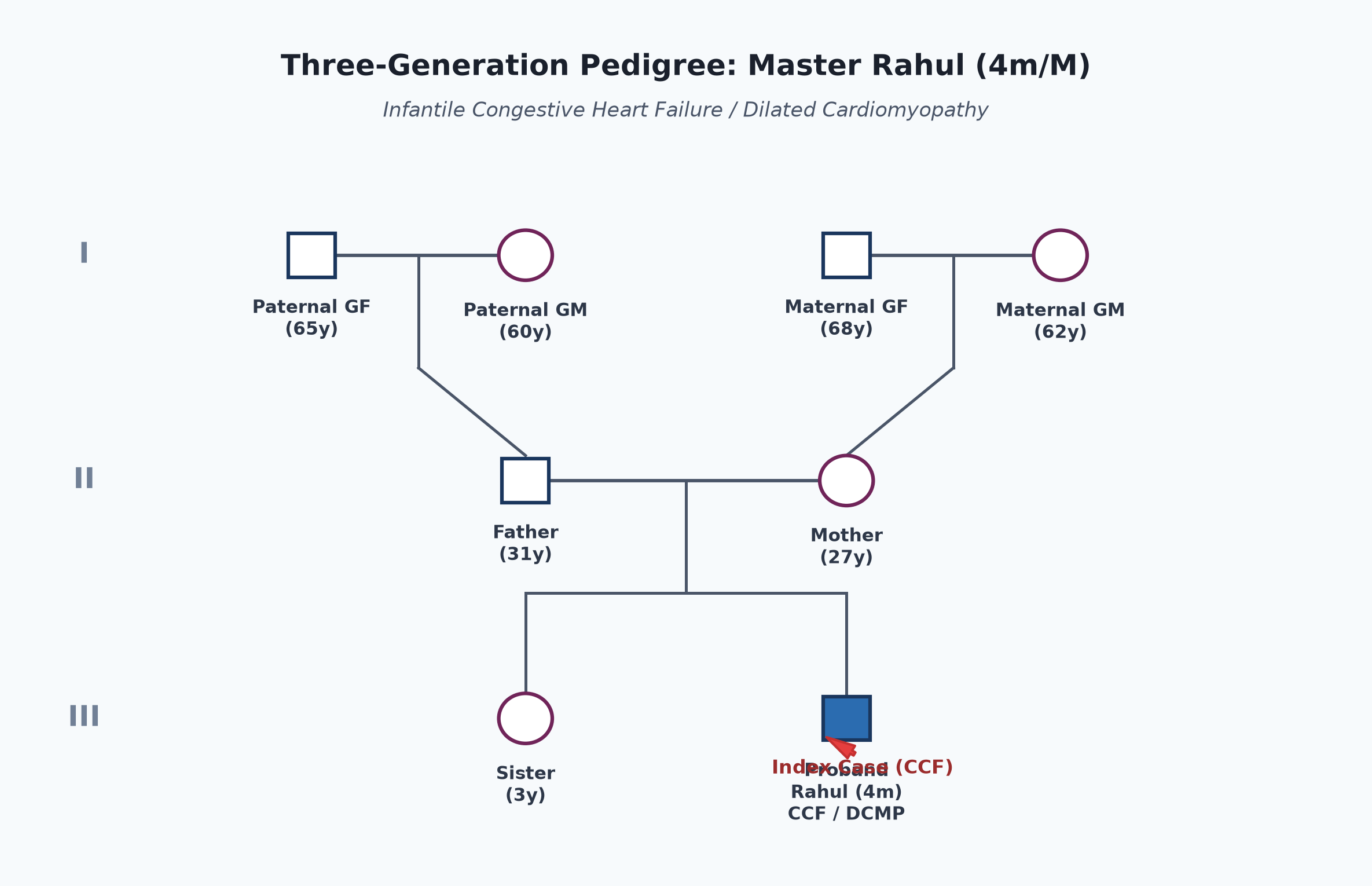
- Parents are non-consanguineous.
- Father 31 years, shop owner; mother 27 years, homemaker.
- Elder sibling (female, 3 years) is healthy and fully vaccinated.
- No family history of cardiomyopathy, sudden unexplained death in young relatives, or deafness.
Immunization history
- Received BCG, OPV-0, Hepatitis B at birth; Pentavalent-1, 2, 3, Rotavirus, and PCV at 6, 10, and 14 weeks.
Dietary history
- Exclusively breastfed since birth. Prior to 5 days ago, feeding was normal with 8-10 feeds/day lasting 15 minutes each.
- In the past 4 days, feeding collapsed due to acute breathlessness.
| Food Item | Quantity | Calories (kcal) | Protein (g) |
|---|---|---|---|
| Breast milk | ~250 mL effective | 168 | 2.7 |
| Total Observed Intake | — | 168 kcal | 2.7 g |
24-Hour Recall Deficit Analysis
$$ ext{Ideal Body Weight (IBW for 4 months, 50th centile WHO)} = 6.4 ext{ kg} $$| Nutrient | Expected Intake (ICMR-NIN 2024 for IBW 6.4 kg) | Observed Intake | Deficit | Percentage Deficit |
|---|---|---|---|---|
| Energy (kcal) | $6.4 ext{ kg} imes 100 ext{ kcal/kg} = 640 ext{ kcal}$ | 168 kcal | 472 kcal | 73.8% Deficit |
| Protein (g) | $6.4 ext{ kg} imes 1.1 ext{ g/kg} = 7.04 ext{ g}$ | 2.70 g | 4.34 g | 61.6% Deficit |
The expected calories and proteins should be calculated from the ideal body weight, not from current weight.
Socioeconomic and KAP
- Belongs to Modified BG Prasad Class III.
- Pucca house with adequate sanitation. Parents recognized the acute distress and brought the infant directly to the pediatric emergency.
Summary of History
Master Rahul, a 4-month-old male infant born of non-consanguineous marriage, presented with acute onset of severe tachypnea, grunting, suck-rest-suck feeding difficulty, forehead diaphoresis, facial puffiness, oliguria, and cold peripheries over 5 days, following a viral prodromal illness 10 days ago, without central cyanosis or previous heart murmurs.
I would like to think of Acute Congestive Cardiac Failure (CCF) with Low Cardiac Output Syndrome (Cardiogenic Shock), secondary to Acute Viral Myocarditis / Dilated Cardiomyopathy (DCM), in a previously well infant.
General head to toe examination
- Child Behavioral State: Lethargic, irritable on handling, tachypneic with grunting (Prechtl State 4/5 turning to dullness).
- Vitals:
- Heart Rate: 172 beats/minute (marked tachycardia), regular, thready/low volume in all peripheral pulses; pulses paradoxus absent.
- Capillary Refill Time (CRT): 4 seconds over the sternum (delayed peripheral perfusion).
- Respiratory Rate: 68 breaths/minute (severe tachypnea), thoracoabdominal, with deep subcostal, intercostal retractions and expiratory grunting.
- Blood Pressure: Right upper limb: $70/44 ext{ mmHg}$ ($< 5^{ ext{th}} ext{ centile}$ for age, indicating hypotensive cardiogenic shock; mean arterial pressure $= 52 ext{ mmHg}$).
- Temperature: $36.4^\circ ext{C}$ (cool extremities).
- Oxygen Saturation ($SpO_2$): 90% on room air; improves to 96% with $4 ext{ L/min}$ humidified high-flow oxygen.
- Anthropometry:
| Parameter | Observed | Expected (50th WHO) | Z-score / Centile | Inference |
|---|---|---|---|---|
| Weight | 5.8 kg | 6.4 kg | $-0.8 ext{ SD}$ | Normal Weight (Mild acute loss masked by fluid retention) |
| Length | 62 cm | 63.8 cm | Normal | Normal Linear Growth |
| Head Circumference | 41.2 cm | 41.6 cm | Normal | Normal Head Circumference |
- Head to Toe Findings:
- Periorbital Puffiness: Prominent bilateral eyelid edema.
- Pallor with mottled, cool extremities extending up to mid-forearms and mid-calves.
- No central cyanosis, no clubbing.
- Anterior fontanelle flat, soft.
Systemic Examination
Cardiovascular System
- Inspection:
- Precordium quiet or mildly hyperdynamic; no visible skeletal deformity.
- Apical Impulse: Visible in the left $5^{ ext{th}}$ intercostal space, $2 ext{ cm}$ lateral to the midclavicular line (cardiomegaly).
- Palpation:
- Apical Impulse: Palpable in the left $5^{ ext{th}}$ intercostal space, $2 ext{ cm}$ lateral to the midclavicular line; diffuse, hypodynamic / sluggish in character (marked systolic pump dysfunction).
- Parasternal heave: Grade 1/3 present along left lower sternal border.
- Heart sounds not palpable; thrills absent.
- Percussion:
- Cardiomegaly confirmed; left heart border percussed outside the midclavicular line in the $5^{ ext{th}}$ intercostal space.
- Auscultation:
- First & Second Heart Sounds ($S_1, S_2$): Soft and muffled heart sounds.
- Gallop Rhythm ($S_3 / S_4$ Summation Gallop): Prominent triple rhythm / summation gallop audible at the apex and left lower sternal border at $172 ext{ bpm}$ (hallmark of severe decompensated heart failure with elevated LV end-diastolic pressure).
- Murmur: Soft Grade 2/6 blowing pansystolic murmur heard at the apex radiating to the axilla (functional Mitral Regurgitation secondary to mitral annular dilatation from ventricular cavity enlargement).
Modified Ross Heart Failure Score
| Clinical Parameter | Finding in Patient | Ross Score Assigned |
|---|---|---|
| Feeding History | Feeds <30 seconds, severe fatigue | 2 |
| Respiratory Rate | 68 breaths/min ($>60 ext{ bpm}$) | 2 |
| Respiratory Pattern | Severe retractions with grunting | 2 |
| Heart Rate | 172 beats/min ($>150 ext{ bpm}$) | 2 |
| Hepatomegaly | Liver 4.0 cm palpable below right costal margin | 2 |
| Peripheral Perfusion | CRT 4 seconds, cool clammy extremities | 2 |
| Total Modified Ross Score | — | 12 / 12 (Critical Heart Failure / Shock) |
Score Interpretation: 10–12 = Severe Heart Failure.
other systems
- Respiratory System:
- Severe tachypnea with grunting.
- Auscultation: Bilateral harsh vesicular breath sounds with diffuse fine inspiratory crackles (crepitations) heard over all lung fields (acute pulmonary edema).
- Abdomen:
- Distended abdomen; no dilated veins.
- Liver: Palpable 4.0 cm below the right costal margin; span 8.5 cm; soft, smooth, rounded margin, acutely tender (acute congestive hepatomegaly).
- Spleen not palpable; no ascites.
- Central Nervous System: Lethargic, responds to noxious stimuli, normal tone in all four limbs, pupils equal and reactive.
Summary
Master Rahul, a 4-month-old male infant, presented with acute onset of severe tachypnea, grunting, feeding failure, cold clammy extremities, oliguria, and periorbital edema over 5 days, following a viral prodrome 10 days ago.
On examination, the infant is in cardiogenic shock with tachycardia ($172 ext{ bpm}$), hypotension ($70/44 ext{ mmHg}$), CRT of 4 seconds, cool mottled peripheries, diffuse hypodynamic displaced apex, muffled heart sounds with a prominent summation gallop ($S_3$), functional mitral regurgitation murmur, severe congestive hepatomegaly ($4.0 ext{ cm}$), diffuse pulmonary crackles, and a Modified Ross Score of 12/12.
Probable Clinical Diagnosis: Acute Decompensated Congestive Cardiac Failure (Modified Ross Score 12/12) with Cardiogenic Shock and Pulmonary Edema, secondary to Acute Viral Myocarditis / Idiopathic Dilated Cardiomyopathy (DCM), in a previously healthy term infant.
Differential Diagnosis
| Disease | Points IN FAVOR | Points AGAINST |
|---|---|---|
| Acute Viral Myocarditis / DCM | • Acute onset in previously well infant • Preceding viral prodrome 10 days ago • Tachycardia, gallop rhythm, muffled sounds • Cardiogenic shock + severe CCF (Ross 12/12) • Global LV hypokinesia on examination | Primary Diagnosis |
| Large VSD with CCF | • Infantile heart failure, tachypnea, hepatomegaly | • Onset is acute at 4 months with shock, not gradual from 6-8 weeks • Murmur is soft functional MR, not loud harsh pansystolic murmur with systolic thrill at LLSB |
| Anomalous Left Coronary Artery from PA (ALCAPA) | • Presents at 2-4 months with heart failure and DCM • Severe LV systolic dysfunction | • Classically presents with episodic crying during feeds (angina / Bland-White-Garland syndrome) • ECG typically shows anterolateral myocardial infarction ($Q$ waves in I, aVL, V5-V6) |
| Severe Sepsis / Septic Shock | • Tachycardia, tachypnea, poor perfusion, lethargy | • Marked cardiomegaly, gallop rhythm, and tender hepatomegaly ($4 ext{ cm}$) point definitively to primary cardiogenic pump failure rather than distributive septic shock |
Investigation Protocol & Diagnostic Workup
flowchart TD
    A["Infant in CCF & Cardiogenic Shock (Master Rahul)"] --> B["1. Immediate Emergency Bedside Tests"]
    B --> C["ABG & Blood Lactate (Assess Tissue Hypoxia & Acidosis)"]
    B --> D["Point-of-Care Echocardiography (POCUS: LV Function)"]
    B --> E["12-Lead Electrocardiogram (ECG: Arrhythmias & Ischemia)"]
    B --> F["Chest X-Ray (CXR Portable)"]

    A --> G["2. Biomarkers & Cardiac Enzymes"]
    G --> H["High-Sensitivity Cardiac Troponin-I / T (Myocardial Necrosis)"]
    G --> I["NT-proBNP / BNP (Myocardial Wall Stress)"]

    A --> J["3. Comprehensive 2D Echocardiography"]
    J --> K["Assess LVEDD, LVESD, Fractional Shortening (FS), and LVEF"]
    J --> L["Rule out ALCAPA, CoA, and Congenital Shunts"]

    A --> M["4. Etiological Workup"]
    M --> N["Multiplex PCR for Respiratory Viruses (Enterovirus, Adenovirus, Parvovirus B19)"]
1. Arterial Blood Gas (ABG) & Serum Lactate
- Findings: Decompensated metabolic acidosis with respiratory compensation: $$ ext{pH} = 7.22, \quad PaCO_2 = 32 ext{ mmHg}, \quad PaO_2 = 68 ext{ mmHg}, \quad HCO_3^- = 13 ext{ mEq/L}, \quad ext{Base Excess} = -12 ext{ mEq/L} $$
- Serum Lactate: Markedly elevated at $4.8 ext{ mmol/L}$ (tissue hypoperfusion / anaerobic metabolism).
2. Cardiac Biomarkers
- Cardiac Troponin-I (cTnI): Markedly elevated at $1.85 ext{ ng/mL}$ (normal $<0.04 ext{ ng/mL}$), confirming active ongoing acute cardiomyocyte necrosis from viral myocarditis.
- NT-proBNP: $>35,000 ext{ pg/mL}$ (correlates with massive ventricular wall stretch and decompensated failure).
3. 12-Lead Electrocardiogram (ECG)
- Sinus Tachycardia: Rate $174 ext{ bpm}$.
- Low-Voltage QRS Complexes: QRS amplitude $<5 ext{ mm}$ in all limb leads (classic in acute myocarditis due to myocardial edema and inflammatory infiltration).
- T-Wave Changes: Widespread T-wave flattening and inversion in precordial leads (V4–V6).
- Exclude ALCAPA: Absence of deep, wide pathological Q waves ($>4 ext{ mm}$ deep, $>0.04 ext{ s}$) in leads I, aVL, and V5–V6.
4. Chest Radiography (Portable AP View)
- Gross Cardiomegaly: "Water-bottle" globular cardiac silhouette with $CTR = 0.70$.
- Pulmonary Edema: Diffuse perihilar bat-wing haziness, alveolar opacities, and prominent vascular congestion.
5. Transthoracic 2D Echocardiography (Confirmatory)
- Global Left Ventricular Systolic Dysfunction:
- Markedly dilated left ventricle with spherical remodeling: Left Ventricular End-Diastolic Dimension ($LVEDD = 38 ext{ mm}$, $Z ext{-score} > +3.5$).
- Severe reduction in contractility: Left Ventricular Ejection Fraction ($LVEF = 22\%$; normal $>55\%$), Fractional Shortening ($FS = 11\%$; normal $28-40\%$).
- Functional Mitral Regurgitation: Central regurgitant jet due to annular dilation ($3-4 ext{ mm}$ vena contracta).
- Pericardial Effusion: Trivial-to-mild rim of pericardial fluid ($3 ext{ mm}$) without tamponade physiology (myopericarditis).
- Coronary Anatomy: Both Left and Right Coronary Arteries visualized arising normally from the aortic root with forward antegrade flow (confirms normal origin and firmly excludes ALCAPA).
Management Plan
1. Emergency Resuscitation & Hemodynamic Stabilization (PICU Protocol)
- Airway & Breathing:
- Nurse in elevated position ($30-45^\circ$).
- Provide High-Flow Nasal Cannula (HFNC) or Non-Invasive Positive Pressure Ventilation (CPAP / BiPAP) with PEEP $5-7 ext{ cm H}_2 ext{O}$ to recruit fluid-filled alveoli, decrease work of breathing, and reduce LV afterload.
- If deteriorating, proceed to elective endotracheal intubation using cardio-stable induction agents (Ketamine $1-2 ext{ mg/kg}$ + Rocuronium; avoid propofol or thiopental).
- Fluid Management:
- Strict Fluid Restriction: Total fluids restricted to $50-60 ext{ mL/kg/day}$ ($50\%$ maintenance) using $D_{10} 0.2 ext{ NS}$.
- Insert Foley urinary catheter for hourly urine output monitoring (target $>1 ext{ mL/kg/hr}$).
2. Inotropic & Inodilator Therapy (Targeting Low Cardiac Output)
- Milrinone (Inodilator of Choice):
- Phosphodiesterase-3 inhibitor: Potent positive inotrope and systemic/pulmonary vasodilator that decreases both preload and afterload without increasing myocardial oxygen consumption.
- Dose: Continuous infusion at $0.375-0.75 ext{ mcg/kg/min}$ (omit the loading dose to prevent acute hypotension).
- Epinephrine Infusion (for Hypotensive Shock):
- Low-dose continuous infusion at $0.05-0.1 ext{ mcg/kg/min}$ to restore coronary and systemic perfusion pressure.
- Preload Reduction:
- IV Furosemide: $1 ext{ mg/kg/dose}$ IV slowly once hemodynamic stability is restored, supplemented by Spironolactone ($1 ext{ mg/kg/day}$).
3. Disease-Specific Immunomodulatory Therapy (for Acute Myocarditis)
- Intravenous Immunoglobulin (IVIG): High-dose IVIG ($2 ext{ g/kg}$ infused over 24-48 hours). Exerts anti-inflammatory, antiviral neutralization, and immunomodulatory effects, documented to improve LVEF recovery in pediatric viral myocarditis.
- Corticosteroids: IV Methylprednisolone ($1-2 ext{ mg/kg/day}$) considered if autoimmune etiology, fulminant disease, or lack of response to IVIG.
4. Transition to Chronic Heart Failure Pharmacotherapy (Post-Stabilization)
Once the acute shock resolves and the infant is euvolemic, initiate guideline-directed medical therapy (GDMT):
- ACE Inhibitor (Oral Enalapril): Start very low ($0.05 ext{ mg/kg/day}$) and titrate under strict BP and renal function monitoring to reduce chronic ventricular remodeling.
- Beta-Blocker (Oral Carvedilol): Start at $0.05 ext{ mg/kg/dose}$ twice daily; double every 2 weeks to target $0.4-0.5 ext{ mg/kg/day}$ to counteract chronic sympathetic toxicity once the patient is completely out of decompensated failure.
- Mechanical Circulatory Support (MCS): If refractory cardiogenic shock occurs despite double inotropes, proceed urgently to Veno-Arterial Extracorporeal Membrane Oxygenation (VA-ECMO) as a bridge to myocardial recovery or Ventricular Assist Device (VAD) / cardiac transplantation.