
Miss Meenakshi, a 9 year old girl, 2nd order child born of a second-degree consanguineous marriage from Madurai, Tamil Nadu presented with complaints of progressive yellowish discoloration of the eyes and dark urine for 6 months, gradual abdominal distension with fullness of the flanks for 4 months, easy bruising and recurrent nosebleeds for 2 months, and deteriorating school performance with hand tremors for 1 month.
- Recurrent or persistent jaundice (fluctuating, accompanied by dark urine)
- Progressive abdominal distension (ascites and organomegaly)
- Easy bruising, mucosal bleeding, and epistaxis (hepatic coagulopathy + hypersplenism)
- Hematemesis or melena (life-threatening bleeding from ruptured esophageal varices)
- Neuropsychiatric changes, deteriorating handwriting, and tremors (Wilson disease / Hepatic Encephalopathy)
HOPI
The history is dated back to 6 months ago when the mother first noticed mild yellowish discoloration of the whites of both eyes (icterus).
In any child $>5$ years presenting with unexplained chronic liver disease, hepatosplenomegaly, or portal hypertension in India, Wilson disease must be considered the primary diagnosis until proven otherwise. Systematically evaluate for:
- Hepatocellular Failure: Jaundice, coagulopathy (bruising, epistaxis), hypoalbuminemic edema, failure to thrive.
- Portal Hypertension: Ascites, splenomegaly, GI bleeding (hematemesis, melena).
- Neuropsychiatric Manifestations: Handwriting changes, dysarthria, drooling, tremors, dystonia, decline in school grades.
- Family History: Consanguinity and unexplained childhood deaths from jaundice or hemolytic anemia.
- Jaundice:
- First noticed 6 months ago, insidious in onset, fluctuating in intensity from pale lemon-yellow to deep mustard-yellow.
- Associated with dark, high-colored urine that stains undergarments yellow Points to conjugated hyperbilirubinemia from hepatic parenchymal dysfunction and impaired biliary excretion.
- Stools have remained normally colored (brown/yellow); no chalky or acholic stools.
- Mild pruritus over the past 2 months, worse at night.
- Abdominal Distension (Ascites & Portal Hypertension):
- Progressive increase in abdominal girth noticed over the last 4 months.
- Child outgrew her skirts; abdomen became visibly rounded and protuberant with prominent blue veins across the upper tummy.
- Mother noted dragging discomfort and heaviness in the left upper abdomen (splenomegaly) Reflects congestive splenomegaly secondary to elevated portal venous pressure.
- Bilateral pitting pedal edema developed over the past 3 weeks, worse towards the evening.
- Bleeding Diathesis:
- Since 2 months ago, mother noticed spontaneous purplish bruises (ecchymoses) over the shins and forearms without significant trauma.
- Recurrent episodes of self-limiting epistaxis (3 episodes in the past month) and bleeding from gums while brushing teeth Dual etiology: impaired hepatic synthesis of vitamin K-dependent clotting factors (II, VII, IX, X) and platelet sequestration in an enlarged spleen (hypersplenism).
- Neurological & School Difficulties (Wilson Extrapyramidal Features):
- Over the past 4-6 weeks, the school teacher reported a sharp deterioration in her academic performance.
- Her handwriting became shaky, irregular, and progressively illegible (micrographia/tremor).
- Mother observed coarse tremors in both hands when reaching for a glass of water, and noted that the child occasionally slurs her words and drools saliva while sleeping Classic manifestation of copper accumulation in the basal ganglia (putamen and globus pallidus), pathognomonic of neurologic Wilson disease.
- Negative History:
- No history of vomiting blood (hematemesis) or passing black, tarry, foul-smelling stools (melena) Indicates that esophageal/gastric varices have not yet bled.
- No history of day-night sleep reversal, inappropriate behavior, confusion, or flapping tremor Rules out overt hepatic encephalopathy (West Haven Grade 2 or higher).
- No history of fever with diffuse abdominal pain, rebound tenderness, or chills Rules out spontaneous bacterial peritonitis (SBP).
- No history of blood transfusions, native herbal medication, IV cannulations, or jaundice in the neonatal period.
Past History
- No prior history of acute hepatitis, blood transfusions, or major surgeries.
- No history of chronic diarrhea, steatorrhea, or recurrent chest infections (rules out cystic fibrosis).
Family history
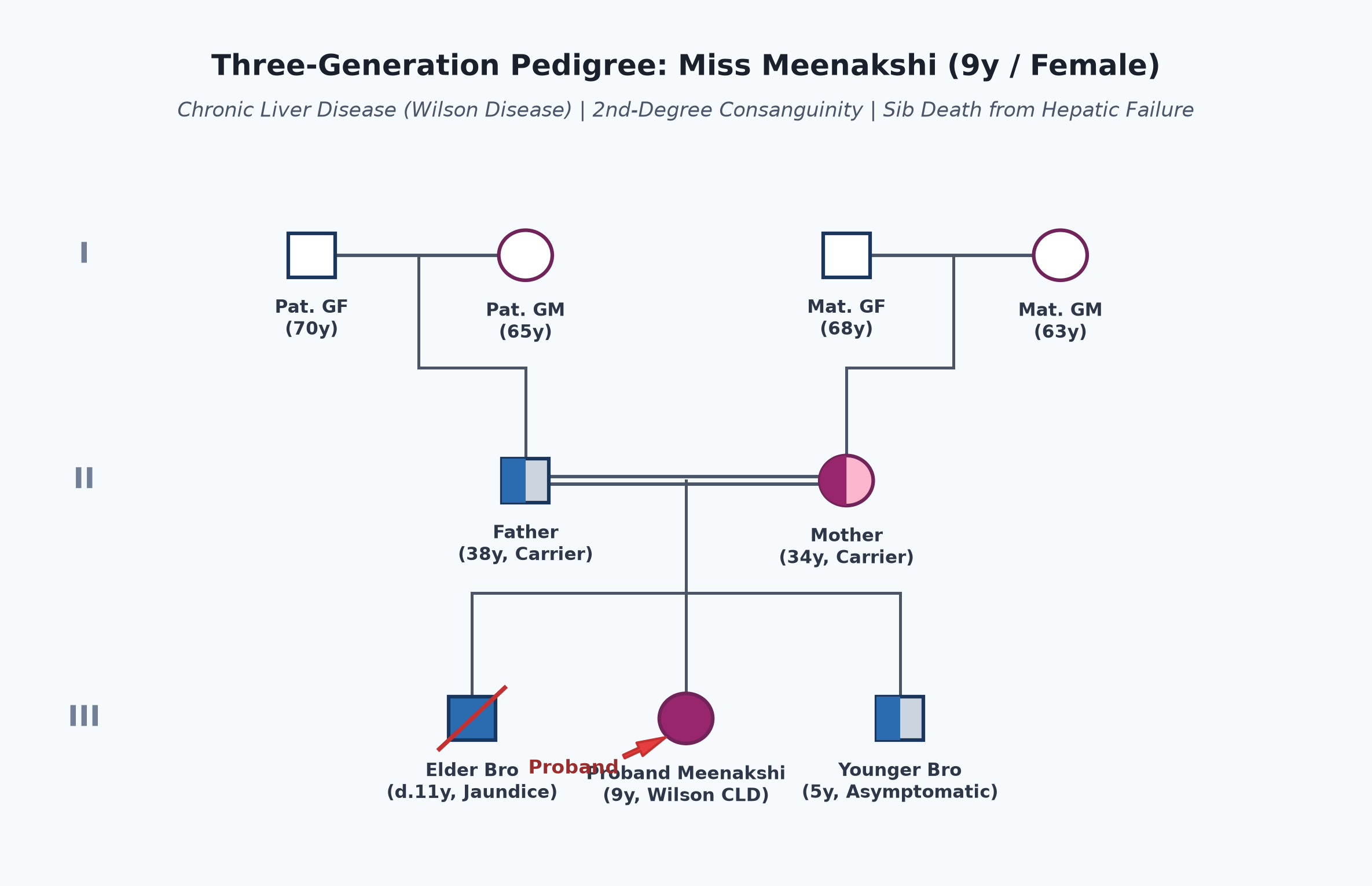
- Born of a second-degree consanguineous marriage (parents are maternal first cousins).
- Father 38 years, farmer; mother 34 years, homemaker; both asymptomatic.
- Sibling Death: An elder brother died at 11 years of age with acute fulminant jaundice, ascites, and severe hemolytic anemia (Coombs-negative hemolytic crisis in undiagnosed Wilson disease).
- Younger brother (5 years old) is currently asymptomatic but has never been screened.
Immunization history
- Received all primary childhood vaccines up to date under the UIP.
- Hepatitis B vaccine (3 doses) administered in infancy; Hepatitis A vaccine not given.
Dietary history
- Consumes a south Indian vegetarian diet based on rice, sambar, rasam, and curd.
- Frequently consumed copper-rich foods: chocolates, cashews, and peanuts.
| Food Item | Quantity | Calories (kcal) | Protein (g) |
|---|---|---|---|
| Cooked Rice (2 cups) | 250 g | 325 | 6.5 |
| Sambar / Rasam with Dal | 1.5 cups | 140 | 6.2 |
| Curd (Cow's milk) | 100 mL | 60 | 3.2 |
| Idli (2 pieces) | 80 g | 130 | 4.0 |
| Peanuts / Chikki snack | 25 g | 140 | 5.5 |
| Total Observed Daily Intake | — | 795 kcal | 25.4 g |
24-Hour Recall Deficit Analysis
$$ \text{Ideal Body Weight (IBW for 9 years, 50th centile WHO)} = 28.0\text{ kg} $$| Nutrient | Expected Intake (ICMR-NIN 2024 for IBW 28.0 kg) | Observed Intake | Deficit | Percentage Deficit |
|---|---|---|---|---|
| Energy (kcal) | $28.0\text{ kg} \times 65\text{ kcal/kg} = 1820\text{ kcal}$ | 795 kcal | 1025 kcal | 56.3% Deficit |
| Protein (g) | $28.0\text{ kg} \times 1.2\text{ g/kg} = 33.6\text{ g}$ | 25.4 g | 8.2 g | 24.4% Deficit |
The expected calories and proteins should be calculated from the ideal body weight, not from current weight.
Socioeconomic and KAP
- Belongs to Modified BG Prasad Socioeconomic Class III (Middle Class).
- Lives in a semi-pucca house in Madurai; uses tap water stored in traditional copper vessels (Kudam).
- Parents are deeply distressed having lost their firstborn child to similar symptoms; highly motivated for evaluation and definitive therapy.
Summary of History
Miss Meenakshi, a 9-year-old girl, 2nd order child born of consanguineous marriage from Madurai with a family history of sibling death from fulminant jaundice, presented with a 6-month history of fluctuating icterus and dark urine, progressive abdominal distension with ascites for 4 months, easy bruising and epistaxis for 2 months, and deteriorating handwriting with tremors and academic decline for 1 month, without hematemesis, melena, or overt encephalopathy.
I would like to think of a Decompensated Chronic Liver Disease with Portal Hypertension and Cirrhosis, most likely secondary to Wilson Disease (Hepatolenticular Degeneration) with both hepatic and early extrapyramidal neurological involvement, complicated by hypersplenism and coagulopathy.
General head to toe examination
- Child Behavioral State: Conscious, oriented, cooperative; speech is mildly slurred (scanning dysarthria); responds accurately to questions.
- Vitals:
- Pulse Rate: 92 beats/minute, regular, normal volume, no bounding character.
- Respiratory Rate: 22 breaths/minute, regular, abdominothoracic.
- Blood Pressure: $96/60\text{ mmHg}$ ($50^{\text{th}}$ centile for age and height).
- Temperature: $36.8^\circ\text{C}$ (afebrile).
- Anthropometry:
| Parameter | Observed | Expected (50th WHO) | Z-score / Centile | Inference |
|---|---|---|---|---|
| Weight | 22.0 kg | 28.0 kg | $< -2\text{ SD}$ | Moderate Underweight (masked by ascites) |
| Height | 125 cm | 133 cm | $-2\text{ SD}$ | Moderate Stunting (Chronic Illness) |
| Mid-Upper Arm Circumference | 13.0 cm | 16.5 cm | $< -2\text{ SD}$ | Severe muscle wasting |
- Stigmata of Chronic Liver Disease (General Exam):
- Icterus: Moderate lemon-yellow icterus in the superior bulbar conjunctiva and underside of the tongue.
- Pallor: Moderate pallor in palpebral conjunctiva and nail beds.
- Cutaneous Stigmata:
- Spider Angiomas / Nevi: 3 classical spider nevi observed over the upper anterior chest wall and neck (central arteriole with radiating blanching capillaries).
- Palmar Erythema: Symmetrical mottled redness over the thenar and hypothenar eminences.
- Leuconychia: White transverse bands across nail beds (Muehrcke's lines / Terry's nails) Marker of severe chronic hypoalbuminemia.
- Bruising: Multiple resolving ecchymotic patches over bilateral pretibial areas.
- Parotid Enlargement: Mild, non-tender bilateral parotid fullness.
- Clubbing: Grade II clubbing (loss of Lovibond angle) in all digits.
- Pedal Edema: Bilateral soft pitting edema extending up to the ankles.
- Ocular Slit-Lamp Finding: Kayser-Fleischer (KF) Ring — a distinct, golden-brown/greenish pigmented granular band visible at the periphery of both corneas in Descemet's membrane (pathognomonic of copper deposition).
Systemic Examination
Abdomen
- Inspection:
- Distended abdomen, flanks full, everted umbilicus.
- Abdominal Wall Collaterals: Prominent, dilated, tortuous superficial veins visible over the anterior abdominal wall; blood flow directed away from the umbilicus (centrifugal / upwards above umbilicus and downwards below) confirming portal-systemic collateral pathway.
- No visible peristalsis; no scars.
- Palpation:
- Soft, mildly tense, non-tender throughout; no guarding or rebound tenderness (excludes SBP).
- Liver:
- Palpable 1.5 cm below right costal margin; firm to hard in consistency, surface irregular/nodular, margin sharp and uneven.
- Total Liver Span is 6.5 cm (shrunken, contracted cirrhotic liver).
- Spleen:
- Massive Splenomegaly: Spleen is enlarged 5.5 cm below the left costal margin along its long axis towards the right iliac fossa.
- Firm in consistency, smooth surface, prominent splenic notch felt on the anterior border, non-tender, no friction rub.
- Kidneys: Not palpable.
- Percussion:
- Tympanitic note over central abdomen with bilateral flank dullness.
- Shifting Dullness: Distinctly positive (moderate free intraperitoneal fluid).
- Fluid Thrill: Absent (requires massive tense ascites).
- Auscultation: Normal bowel sounds; no venous hum at the umbilicus (Cruveilhier-Baumgarten murmur absent); no arterial bruits over liver or renal areas.
Central Nervous System (CNS)
- Higher Mental Functions: Mini-Mental State Examination adapted for age shows mild cognitive slowing; speech dysarthric, slow, scanning.
- Involuntary Movements:
- Wing-Beating Tremor: On sustained abduction of the arms with elbows flexed and hands pronated, child exhibits a coarse, irregular, flapping tremor at the wrists and shoulders.
- Resting postural tremor of hands.
- Asterixis (Negative Myoclonus): Absent on dorsiflexion of hands with wrists extended (no overt Stage 2 hepatic encephalopathy).
- Motor Examination: Mild cogwheel rigidity in bilateral wrist joints; power 5/5; deep tendon reflexes $2+$ throughout; plantar responses bilateral flexor.
- Cerebellar & Sensory: Mild dysdiadochokinesia; sensation intact.
Cardiovascular & Respiratory Systems
- Normal heart sounds ($S_1, S_2$), no murmurs. JVP not elevated.
- Bilateral vesicular breath sounds; no basal crackles, no pleural effusion.
other systems
- Musculoskeletal: Generalized muscle wasting; no joint effusions.
- Genitalia: Normal female genitalia, Tanner stage 1.
Summary
Miss Meenakshi, a 9-year-old girl, born of second-degree consanguineous parents from Madurai with a positive family history of sibling death from jaundice, presented with a 6-month history of fluctuating icterus, dark urine, progressive abdominal distension, splenomegaly, recurrent epistaxis, and bilateral hand tremors with academic decline for 1 month. Physical examination reveals bilateral golden-brown Kayser-Fleischer (KF) rings, stigmata of chronic liver disease (spider nevi, palmar erythema, leuconychia), a shrunken nodular liver (span 6.5 cm), massive splenomegaly (5.5 cm), moderate ascites with caput medusae collaterals, and extrapyramidal signs (wing-beating tremor, cogwheel rigidity, dysarthria), without active variceal bleeding or overt hepatic encephalopathy.
The clinical presentation is definitive for Decompensated Chronic Liver Disease (Cirrhosis) with Portal Hypertension, Splenomegaly, and Extrapyramidal Neurological Involvement secondary to Wilson Disease (Hepatolenticular Degeneration), Child-Turcotte-Pugh Class B/C.
Differential Diagnosis
| Disease | Points IN FAVOR | Points AGAINST |
|---|---|---|
| Wilson Disease (Hepatolenticular Degeneration) | Age >5 years, consanguinity, sibling death, combined hepatic cirrhosis + portal hypertension + bilateral KF rings + wing-beating tremor + shrunken liver | Primary Diagnosis |
| Autoimmune Hepatitis (AIH Type 1 or 2) | Young female, insidious jaundice, cirrhosis, portal hypertension, hypergammaglobulinemia | Absence of KF rings, lacks extrapyramidal tremors, does not explain sibling death from acute hemolysis |
| Extrahepatic Portal Venous Obstruction (EHPVO) | Massive splenomegaly, portal hypertension, abdominal collaterals, normal cognitive function | Liver is normal (not shrunken/nodular) in EHPVO, jaundice is rare, stigmata of CLD absent, KF rings absent |
| Chronic Viral Hepatitis (Hepatitis B / C) | Cirrhosis, portal hypertension, ascites | Immunized against Hep B, no transfusion history, does not account for KF rings or neurologic manifestations |
| Alpha-1 Antitrypsin Deficiency | Cirrhosis, hepatosplenomegaly, portal hypertension | Lacks extrapyramidal features, no pulmonary emphysema, KF rings absent |
| Glycogen Storage Disease Type IV (Amylopectinosis) | Early onset cirrhosis, splenomegaly | Presents in infancy/early childhood with severe failure to thrive and death by 3-5 years; lacks ocular and basal ganglia signs |
Investigation Protocol & Diagnostic Workup
flowchart TD
    A["Child > 5y with Cirrhosis & Portal Hypertension"] --> B["Slit-Lamp Examination for KF Rings"]
    B --> C["Serum Ceruloplasmin & 24-hr Urinary Copper Excretion"]
    C --> D{"Ceruloplasmin < 20 mg/dL & 24-hr Urine Copper > 40 mcg?"}
    D -->|Yes| E["Leipzig Score ≥ 4: Definite Wilson Disease Confirmed"]
    D -->|Equivocal| F["Penicillamine Challenge Test & Hepatic Copper on Biopsy"]
    E --> G["Assess Severity: LFT, Coagulation Profile (PT/INR), CBC (Hypersplenism)"]
    G --> H["Doppler USG Abdomen & Upper GI Endoscopy for Varices"]
    H --> I["Family Screening: Screen All Siblings (ATP7B Gene Sequencing)"]
1. Wilson Disease Confirmatory Testing (Leipzig Score)
- Slit-Lamp Biomicroscopy: Positive bilateral Kayser-Fleischer (KF) rings (2 points on Leipzig score).
- Serum Ceruloplasmin: Markedly reduced ($<10\text{ mg/dL}$, normal $20-40\text{ mg/dL}$; 2 points on Leipzig score).
- 24-Hour Urinary Copper Excretion: Markedly elevated ($>100\text{ mcg/24 hours}$, normal $<40\text{ mcg/24 hours}$; 2 points).
- Total Leipzig Score: $>4\text{ points}$ (establishes a Definite Diagnosis of Wilson Disease without requiring invasive liver biopsy).
- Molecular Genetic Testing: ATP7B gene mutation analysis (identifies homozygous or compound heterozygous mutations).
- Neuroimaging (Brain MRI): T2-weighted MRI brain shows hyperintensity in the lenticular nuclei, putamen, and the classical "Face of the Giant Panda" sign in the midbrain tegmentum.
2. Hepatic Synthetic Function & Hypersplenism Workup
- Liver Function Tests (LFT):
- Total Bilirubin: $4.6\text{ mg/dL}$; Direct Bilirubin: $3.2\text{ mg/dL}$.
- AST ($146\text{ U/L}$) and ALT ($88\text{ U/L}$) — characteristic AST > ALT ratio $>2.0$ typical of Wilson cirrhosis.
- Alkaline Phosphatase (ALP): Disproportionately low or normal ($98\text{ U/L}$) — highly characteristic of Wilson disease (copper displaces zinc cofactor in ALP).
- Serum Albumin: $2.4\text{ g/dL}$ (severe hypoalbuminemia).
- Coagulation Profile: Prothrombin Time (PT) $22.5\text{ seconds}$ (Control 12s), INR 1.9 (unresponsive to parenteral Vitamin K).
- Complete Blood Count (Hypersplenism):
- Hb $8.2\text{ g/dL}$ (normocytic normochromic, Coombs-negative hemolytic component).
- Total Leukocyte Count: $3,100/\mu\text{L}$ (leukopenia).
- Platelet Count: $58,000/\mu\text{L}$ (thrombocytopenia secondary to splenic sequestration).
3. Imaging & Endoscopy
- Abdominal Doppler Ultrasonography:
- Shrunken, nodular liver parenchyma with caudate lobe hypertrophy.
- Splenomegaly (bipolar length 14.2 cm).
- Portal vein dilated ($11.5\text{ mm}$) with reduced, hepatofugal flow velocity; recanalized umbilical vein; moderate free ascites.
- Upper Gastrointestinal Endoscopy:
- Reveals Grade 3 Esophageal Varices with red wale markings and mild portal hypertensive gastropathy.
Management Plan
1. Specific Copper Chelation & Decoppering Therapy
- Initial Chelating Phase (Decoppering):
- D-Penicillamine: First-line chelator. Start low at $5-10\text{ mg/kg/day}$ to prevent paradoxical neurological worsening, then titrate weekly up to $20\text{ mg/kg/day}$ divided into two doses (administered strictly 1 hour before or 2 hours after meals).
- Co-prescription: Oral Pyridoxine (Vitamin B6) at $25-50\text{ mg/day}$ (penicillamine is a pyridoxine antagonist).
- Alternative: Trientine hydrochloride ($20\text{ mg/kg/day}$) if penicillamine adverse effects occur (rash, fever, proteinuria, bone marrow suppression).
- Maintenance Therapy / Induction of Intestinal Blockade:
- Oral Zinc (Zinc Acetate / Gluconate): $50\text{ mg}$ elemental zinc three times daily (for children $>5$ years).
- Zinc induces intestinal enterocyte metallothionein, which binds copper and prevents systemic absorption; must be spaced at least 1-2 hours apart from chelators.
- Strict Dietary Copper Restriction: Prohibit copper-rich foods: organ meats, shellfish, mushrooms, nuts, cocoa, chocolates, and unpurified water from copper vessels.
2. Management of Portal Hypertension & Variceal Bleed Prophylaxis
- Primary Prophylaxis of Variceal Hemorrhage:
- Endoscopic Variceal Ligation (EVL / Banding): Perform elective banding of high-risk Grade 3 esophageal varices every 2-4 weeks until variceal eradication is achieved.
- Non-Selective Beta-Blocker: Oral Propranolol starting at $0.5-1.0\text{ mg/kg/day}$ divided bid, titrating up to achieve a $20-25\%$ reduction in baseline resting heart rate (reduces portal venous inflow and HVPG).
3. Ascites & Fluid Management
- Dietary Sodium Restriction: Limit sodium intake to $<2\text{ g/day}$ ($<1-2\text{ mEq/kg/day}$).
- Dual Diuretic Therapy:
- Oral Spironolactone at $2-4\text{ mg/kg/day}$ (aldosterone antagonist) combined with oral Furosemide at $1-2\text{ mg/kg/day}$ (maintaining standard 100:40 mg ratio to preserve serum potassium balance).
- Monitor daily body weight (target weight loss $0.5\text{ kg/day}$).
4. Hepatic Encephalopathy Prophylaxis
- Oral Lactulose: Administer $0.5-1.0\text{ mL/kg/dose}$ two to three times daily, titrated to achieve 2 to 3 soft, acidic stools per day (promotes trapping of toxic ammonia as non-absorbable ammonium $NH_4^+$).
- Oral Rifaximin: $200\text{ mg}$ bid to reduce urease-producing gut bacterial flora.
5. Definitive Therapy & Family Screening
- Liver Transplantation Evaluation: Calculate Pediatric End-Stage Liver Disease (PELD) / Child-Pugh Score / Revised King's Wilson Index ($>11$ points predicts 100% mortality without transplantation). Living-Donor Liver Transplantation (LDLT) is curative for decompensated cirrhotic end-stage disease.
- Mandatory Screening of Relatives: Immediate screening of the 5-year-old younger brother with slit-lamp exam, LFT, serum ceruloplasmin, 24-hr urine copper, and ATP7B genetic testing (presymptomatic detection allows prevention of organ damage with oral zinc).